Priya had been commuting into central London for three years on a Kawasaki Ninja 400. She loved the brand, the ergonomics, the handling — but after a congestion charge hike and a third oil change in eighteen months, she started looking for an alternative. When Kawasaki announced the Kawasaki Ninja E-1 electric motorcycle, she was first in line at her local Kawasaki dealer. She rode it for a weekend. She ordered one on the Monday. “It’s still a Ninja,” she told us. “It just doesn’t cost me anything to ride.”
The Kawasaki Ninja E-1 electric motorcycle is Kawasaki’s first fully electric road-legal production motorcycle — and its arrival signals a genuine shift in the Kawasaki electric motorcycle lineup. Built on the Ninja platform, aimed squarely at A1-licence and learner riders, and priced to compete with the best entry-level electric motorcycles on the market, the Ninja E-1 is not a concept or a prototype. It is here, it is rideable, and this is the definitive expert guide to everything you need to know about it.
Ready to compare the Kawasaki Ninja E-1 against every rival electric motorcycle? See our full electric motorcycle comparison guide — specs, range, price, and real-world owner scores side by side.
Kawasaki Ninja E-1 Electric Motorcycle: What Is It?
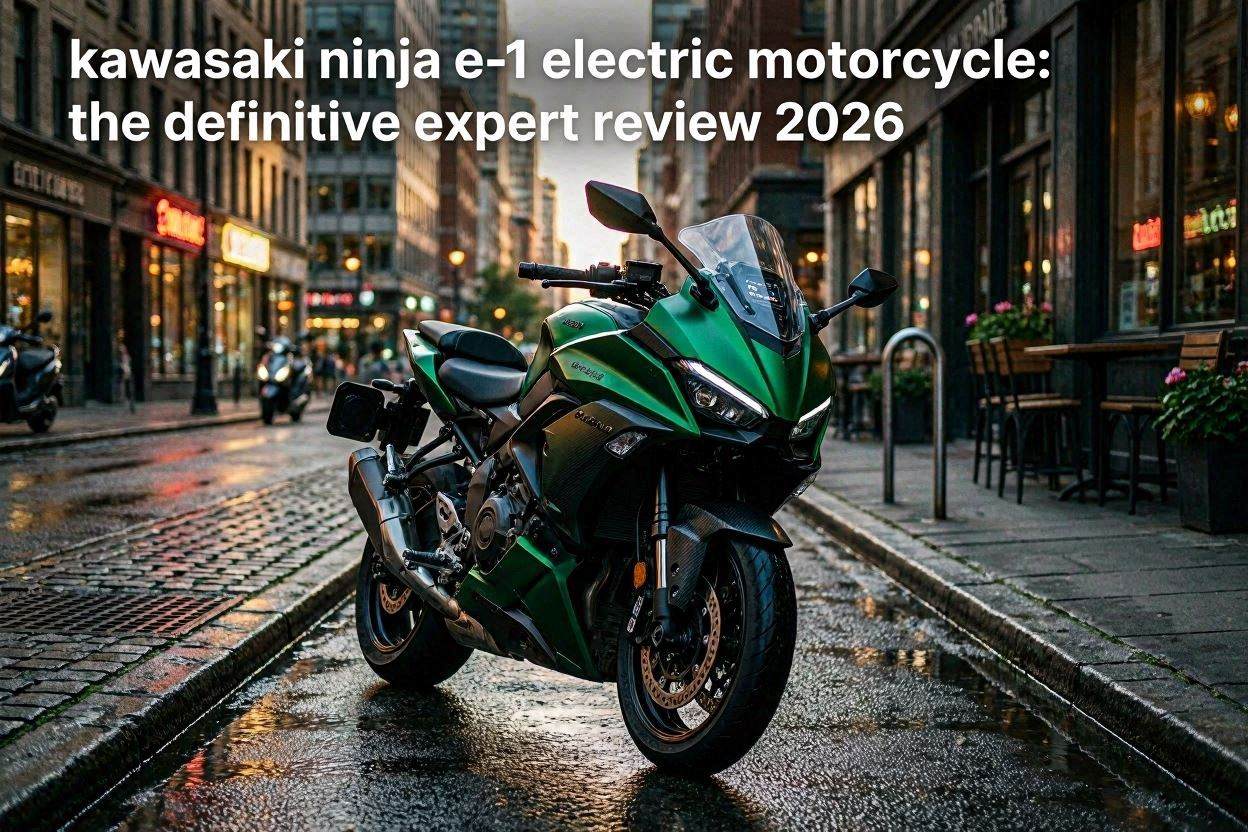
The Kawasaki Ninja E-1 electric motorcycle is a full-fairing electric sport motorcycle designed for urban commuting and A1-licence riders. It shares its visual DNA with the iconic Kawasaki Ninja family — the angular fairing, the twin headlights, the aggressive sport-bike stance — but replaces the combustion engine entirely with a Kawasaki electric drivetrain. The result is a machine that looks and feels like a Kawasaki sport motorcycle but operates with the silent, instant-torque character of a pure EV.
Kawasaki positions the Ninja E-1 as the electric ninja motorcycle for everyday riders — not a track weapon, not a long-distance tourer, but a practical, characterful, genuinely fun electric sport bike for city streets and weekend back roads. It sits at the entry point of Kawasaki’s broader EV strategy, which also includes the Kawasaki Ninja HEV (hybrid) and future Kawasaki EV models across multiple segments.
| Specification | Kawasaki Ninja E-1 |
|---|---|
| Motor type | Permanent magnet synchronous (PMSM) |
| Peak power | 9 kW (12 bhp) continuous / higher peak |
| Peak torque | ~40 Nm (instant from 0 rpm) |
| Battery capacity | 3.0 kWh (×2 removable packs) |
| Total battery energy | 3.0 kWh usable |
| Range (ECE city cycle) | ~72 km / ~45 miles |
| Top speed | ~100 km/h / ~62 mph |
| Charging (standard AC) | ~3.7 hours (0–100%) |
| Removable battery packs | Yes — dual swappable units |
| Licence category | A1 (Europe) / equivalent learner approved |
| Kerb weight | 140 kg |
| MSRP (Europe, approx.) | ~€8,000–€9,000 |

Kawasaki Ninja E-1 Electric Motorcycle: Design and Build Quality
If you’ve ridden a Kawasaki Ninja 300 or Kawasaki Ninja 400, the E-1 will feel immediately familiar from the saddle. The full fairing, the clip-on-style bars, the compact proportions — Kawasaki’s designers have done something genuinely impressive here: they’ve built an electric ninja bike that doesn’t announce its powertrain through awkward styling compromises. The absence of an exhaust system is the most obvious visual tell, along with the slightly different frame geometry necessitated by the dual battery placement.
The twin removable battery packs — one of the most practically significant features of the Kawasaki Ninja E-1 — are housed in the area where the combustion engine and fuel tank would typically sit. Each pack weighs approximately 10 kg and can be removed without tools in minutes, allowing riders to carry a charged spare or charge indoors without access to a dedicated charging point. This is a feature that distinguishes the Ninja E-1 from many rivals, including the Zero Motorcycles lineup, where the battery is fixed and requires onboard or fast charging infrastructure.
Build quality is Kawasaki-standard throughout — which is to say, excellent. Panel fit, switch quality, and instrument cluster finish all reflect the same standard you’d find on a Kawasaki Ninja 500 or Kawasaki Ninja 650. The TFT display is clear, informative, and well-integrated, showing remaining range, power mode, battery percentage, and regenerative braking level.
Kawasaki Ninja E-1 Electric Motorcycle: Performance and Real-World Riding
The Kawasaki Ninja E-1 electric motorcycle‘s performance numbers tell only part of the story. On paper, 9 kW continuous and ~40 Nm of torque position it firmly in the 125cc equivalent performance bracket — which is exactly where A1-licence regulations require it to sit in Europe. In practice, the riding experience feels considerably more engaging than a 125cc combustion bike, for one fundamental reason: all of that torque is available from zero rpm.
Twist the throttle from a standstill on the electric ninja motorcycle and the acceleration is immediate, linear, and confidence-inspiring. There is no waiting for a power band. No clutch to feather. No gear to select. The bike simply goes — cleanly, smoothly, and with a sense of total control that makes urban riding significantly less stressful than an equivalent combustion machine. Experienced riders accustomed to Kawasaki sport bikes may find the outright performance modest, but for its target audience — new riders, urban commuters, and those moving from scooters — it is entirely appropriate.
Riding modes on the Kawasaki Ninja E-1
- ECO mode — reduces peak power output for maximum range. Ideal for motorway stretches or when battery is low. Noticeably softer throttle response.
- ROAD mode — the default riding mode, delivering full continuous power with balanced throttle response. The mode you’ll use 90% of the time.
- RAIN mode (where available) — reduces power and traction sensitivity for wet conditions. Particularly useful for new riders building confidence.
Regenerative braking on the Kawasaki Ninja E-1
The Ninja E-1 offers adjustable regenerative braking — a feature that both extends range and changes the fundamental character of the riding experience. At its strongest setting, lifting off the throttle produces a noticeable deceleration force that experienced riders can use as a primary braking tool in traffic. At its weakest, the bike coasts more naturally. Most riders settle on a mid-level setting that recovers meaningful energy without requiring significant technique adjustment. According to the U.S. Department of Energy, regenerative braking in urban cycles can recover 10–18% of the energy used during acceleration — a significant range contribution in stop-start city riding.
Kawasaki Ninja E-1 Electric Motorcycle: Range, Battery and Charging
Range is the question every prospective Kawasaki electric motorcycle buyer asks first — and for the Ninja E-1, the honest answer requires context. The official ECE city-cycle figure of ~72 km (45 miles) reflects genuine urban riding: low speeds, frequent stops, significant regenerative braking contribution. Real-world range in pure city use consistently comes close to this figure. At sustained motorway speeds (90–100 km/h), expect 40–55 km. For most urban commuters covering 20–35 km daily, the Ninja E-1 comfortably handles a full working week on a single weekend charge.
| Riding condition | Estimated range | Notes |
|---|---|---|
| ECE city cycle (official) | ~72 km / 45 miles | Official test figure |
| Urban commuting (real world) | 60–70 km / 37–43 miles | Stop-start, regen active |
| Mixed urban/A-road | 50–60 km / 31–37 miles | Most common real-world scenario |
| Motorway / sustained 100 km/h | 40–50 km / 25–31 miles | No regen contribution, high drag |
| ECO mode, city | Up to 80 km / 50 miles | Reduced power, max efficiency |
The dual removable battery system is the Ninja E-1’s most practical innovation. Each pack charges via a standard household socket in approximately 1.8–2 hours per unit (using the supplied charger). Both packs can be charged simultaneously with two chargers, bringing total charge time to under 2 hours from flat. For riders without garage or driveway access — a significant proportion of urban motorcycle commuters — the ability to carry the packs upstairs and charge from a domestic socket is transformative. This directly addresses the primary practical barrier to electric motorcycle adoption in dense urban environments.

Kawasaki Ninja E-1 Electric Motorcycle vs the Competition
The Kawasaki Ninja E-1 electric motorcycle enters a market segment that is rapidly developing. Here is how it compares to the most relevant alternatives a prospective buyer should consider:
| Model | Power | Range (city) | Battery | Price (approx.) | Removable battery |
|---|---|---|---|---|---|
| Kawasaki Ninja E-1 | 9 kW cont. | ~72 km | 3.0 kWh (dual) | ~€8,500 | ✅ Yes |
| Zero S | 34 kW peak | ~230 km | 14.4 kWh | ~€12,000 | ❌ No |
| LiveWire Del Mar | 52 kW peak | ~200 km | 10.5 kWh | ~€17,000 | ❌ No |
| Energica Eva Ribelle RS | 80 kW peak | ~200 km | 19 kWh | ~€24,000 | ❌ No |
| Honda EM1 e: | 1.7 kW cont. | ~40 km | 1.3 kWh (×1) | ~€3,800 | ✅ Yes |
| Vmoto Stash | 7 kW peak | ~100 km | 3.6 kWh | ~€6,500 | ✅ Yes |
The Ninja E-1 occupies a clearly defined niche: more capable and more characterful than scooter-based electric commuter motorcycles, but more accessible and more practical (removable battery) than the best electric motorcycles in the mid-range segment. Zero and LiveWire offer substantially more range and performance — but at a significant price premium and without removable battery convenience. The Honda EM1 e: costs less but delivers less. The Kawasaki sits in the sweet spot for a rider who wants genuine electric sport motorcycle character within A1 licence limits.
Who Is the Kawasaki Ninja E-1 Electric Motorcycle For?
Understanding who the Kawasaki Ninja E-1 electric motorcycle is built for is essential before making a purchase decision. Kawasaki has been precise in its targeting — and that precision means the Ninja E-1 is an outstanding choice for some riders, and the wrong choice for others.
The Kawasaki Ninja E-1 is ideal for:
- A1-licence riders and new motorcyclists — the Ninja E-1 is fully A1-compliant, making it one of the most sophisticated machines available in the learner category. The absence of a clutch, gearbox, and stall risk makes it a genuinely forgiving first motorcycle.
- Urban commuters covering under 50 miles daily — for a rider doing 15–30 miles of city riding per day, the Ninja E-1’s range is entirely sufficient. The removable battery makes apartment charging practical.
- Existing Kawasaki Ninja owners moving to electric — if you’ve ridden a Kawasaki Ninja 300, Ninja 400, or Ninja 500 and you’re ready to go electric without leaving the brand, the E-1 delivers a genuinely familiar ergonomic and visual experience.
- Commuters in congestion-charge zones — zero emissions, exempt from most urban access restrictions, and dramatically lower running costs than any equivalent kawasaki sport motorcycle.
The Kawasaki Ninja E-1 may not be right for:
- Riders who regularly cover 60+ miles daily — the range ceiling is real. If your daily commute is 35 miles each way, the Ninja E-1 will require midday charging or a second battery set.
- Touring or long-distance riders — the Ninja E-1 is not a touring machine. Without DC fast charging and with modest range, longer journeys require planning that most riders will find impractical.
- Full licence riders wanting maximum performance — the 9 kW continuous limit is a regulatory constraint, not a technical one. Riders with A-category licences seeking real electric sport bike performance should look at the Zero SR/F or LiveWire One.
The Kawasaki Ninja E-1 and Kawasaki’s Broader Electric Motorcycle Strategy
Kawasaki electric motorcycle development has accelerated significantly since 2022, when the brand committed to electrifying its entire lineup with ten EV models and ten HEV (hybrid electric vehicle) models by 2035. The Ninja E-1 is the first road-legal production result of that commitment — but it sits alongside a broader Kawasaki EV strategy that includes:
- Kawasaki Ninja 7 HEV — the world’s first mass-production parallel twin hybrid motorcycle, pairing a 451cc combustion engine with an electric motor for enhanced performance and fuel efficiency. A full-licence machine aimed at experienced riders.
- Kawasaki Ninja HEV (variant) — hybrid technology applied to the Ninja platform, bridging the gap between combustion and full EV for riders not yet ready to commit to pure electric.
- Future Kawasaki EV models — Kawasaki has confirmed further kawasaki electric bikes across multiple segments, including adventure and naked categories, targeting the mid-2020s through 2030 timeframe.
- Kawasaki EV Project partnerships — joint development with Yamaha, Honda, and Suzuki on hydrogen fuel cell motorcycle technology for longer-range zero-emission applications.
The Ninja E-1 should therefore be understood not as a standalone product but as the foundation layer of a Kawasaki electric ecosystem — the entry point through which a generation of new riders will first experience kawasaki electric motorcycle technology, before potentially progressing to higher-output models as the lineup expands.
Kawasaki Ninja E-1 Electric Motorcycle: Running Costs and Ownership
One of the most compelling arguments for the Kawasaki Ninja E-1 electric motorcycle — particularly for daily commuters — is the dramatic reduction in running costs compared to any combustion alternative. Here is a realistic 5-year cost-of-ownership comparison between the Ninja E-1 and an equivalent gas-powered Kawasaki Ninja 400:
| Cost factor | Kawasaki Ninja E-1 | Kawasaki Ninja 400 |
|---|---|---|
| Purchase price (approx.) | ~€8,500 | ~€5,800 |
| Annual fuel/energy cost (8,000 km/yr) | ~€90–€120 | ~€650–€800 |
| Annual servicing | ~€80–€150 | ~€250–€400 |
| No oil changes, filters, spark plugs | ✅ Saving ~€120/yr | ❌ |
| Insurance (new rider, indicative) | Similar to Ninja 400 | Baseline |
| Congestion/emissions charges | €0 (exempt most zones) | Up to €1,200/yr (central London) |
| 5-year total cost of ownership | ~€10,500–€11,500 | ~€13,000–€16,000 |
The calculation clearly favours the Kawasaki electric motorcycle for urban riders — particularly in cities with congestion charges or clean air zones. According to Consumer Reports, EV owners spend significantly less on fuel and maintenance over a vehicle’s lifetime — a pattern that holds for electric motorcycles as strongly as for cars.
FAQ — Kawasaki Ninja E-1 Electric Motorcycle
What licence do I need for the Kawasaki Ninja E-1?
In Europe, the Kawasaki Ninja E-1 electric motorcycle is classified as an A1-category machine, meaning it is accessible with an A1 motorcycle licence (available from age 16 in most EU countries) or a full B (car) licence held for a minimum of 3 years. In the UK, it falls within the learner-legal category for riders with a CBT and provisional licence. In the US, licensing requirements vary by state — check your local DMV for electric motorcycle power and speed thresholds in your jurisdiction.
Can I charge the Kawasaki Ninja E-1 at a public charging point?
The Ninja E-1’s removable battery system is designed primarily for domestic socket charging rather than public EV infrastructure. The battery packs use a proprietary connector and charging unit rather than a CCS or CHAdeMO standard. This means public fast-charging stations are not compatible with the Ninja E-1’s removable packs. However, for most urban riders, this is irrelevant — the ability to charge from any standard domestic socket is a more practical solution than depending on public charging infrastructure.
How does the Kawasaki Ninja E-1 compare to the Kawasaki Ninja 400?
Visually and ergonomically, the Ninja E-1 and Kawasaki Ninja 400 share significant DNA — both feature full fairings, similar seating positions, and the Kawasaki brand aesthetic. Performance-wise, the Ninja 400 is significantly faster and offers substantially more range (its 14L tank gives ~300 km touring range). The Ninja E-1 wins on running costs, urban practicality, zero emissions, and the unique character of instant electric torque. They target different rider profiles: the Ninja 400 suits confident riders wanting weekend performance alongside commuting; the Ninja E-1 suits daily urban commuters who rarely venture beyond 50 km from home.
What is the Kawasaki Ninja E-1 top speed?
The Kawasaki Ninja E-1 electric motorcycle has a governed top speed of approximately 100 km/h (62 mph) — consistent with A1-licence power limits in Europe. This is sufficient for urban and suburban riding, including national speed limit roads in the UK (60 mph) and most European secondary roads. It is not designed for sustained motorway cruising, where it would be limited to 62 mph and would experience accelerated battery depletion.
Is the Kawasaki Ninja E-1 available in the USA?
As of 2026, Kawasaki electric motorcycle availability varies by region. The Ninja E-1 launched first in Europe and selected Asian markets. US availability is subject to Kawasaki’s regional rollout schedule and homologation requirements. Check the Kawasaki Motors official website or your nearest Kawasaki dealership for current availability in your territory.
How long does the Kawasaki Ninja E-1 battery last?
Kawasaki has designed the Ninja E-1’s lithium-ion battery packs for a service life exceeding 1,000 charge cycles before reaching 80% of original capacity — equivalent to approximately 3–5 years of daily use for most riders. Battery longevity is maximised by avoiding deep discharges, storing packs at 20–80% charge when not in regular use, and keeping packs out of extreme cold. Kawasaki provides a battery warranty — check current terms with your authorised Kawasaki dealer.
Verdict: Is the Kawasaki Ninja E-1 the Right Electric Motorcycle for You?
Priya put 3,400 km on her Kawasaki Ninja E-1 electric motorcycle in its first four months. She’s saved enough on fuel and congestion charges to have paid for two year’s worth of insurance. She still misses the sound, she admits — but only occasionally, and less each week. “I didn’t think I’d adapt,” she said. “But I have. And now the gas bikes feel like they’re doing too much just to go forward.”
The Kawasaki Ninja E-1 is not the most powerful electric motorcycle on the market. It is not the longest-range. It is not the cheapest. But it is the most credible, most practically engineered, and most brand-authentic electric sport motorcycle in its category — and for the rider it is built for, it is close to perfect. If you are an urban commuter, a new rider, or an existing Kawasaki ninja owner ready to make the electric transition, the Ninja E-1 deserves a serious place on your shortlist.
Ready to explore your options? Browse our full electric motorcycle comparison — every A1-legal, learner-legal, and full-licence electric motorcycle on the market, with real-world range data and owner scores. And when you’re ready to buy, our electric motorcycle dealer directory lists authorised Kawasaki electric motorcycle dealers and rival stockists across the US, UK, and EU.
Leave a Reply