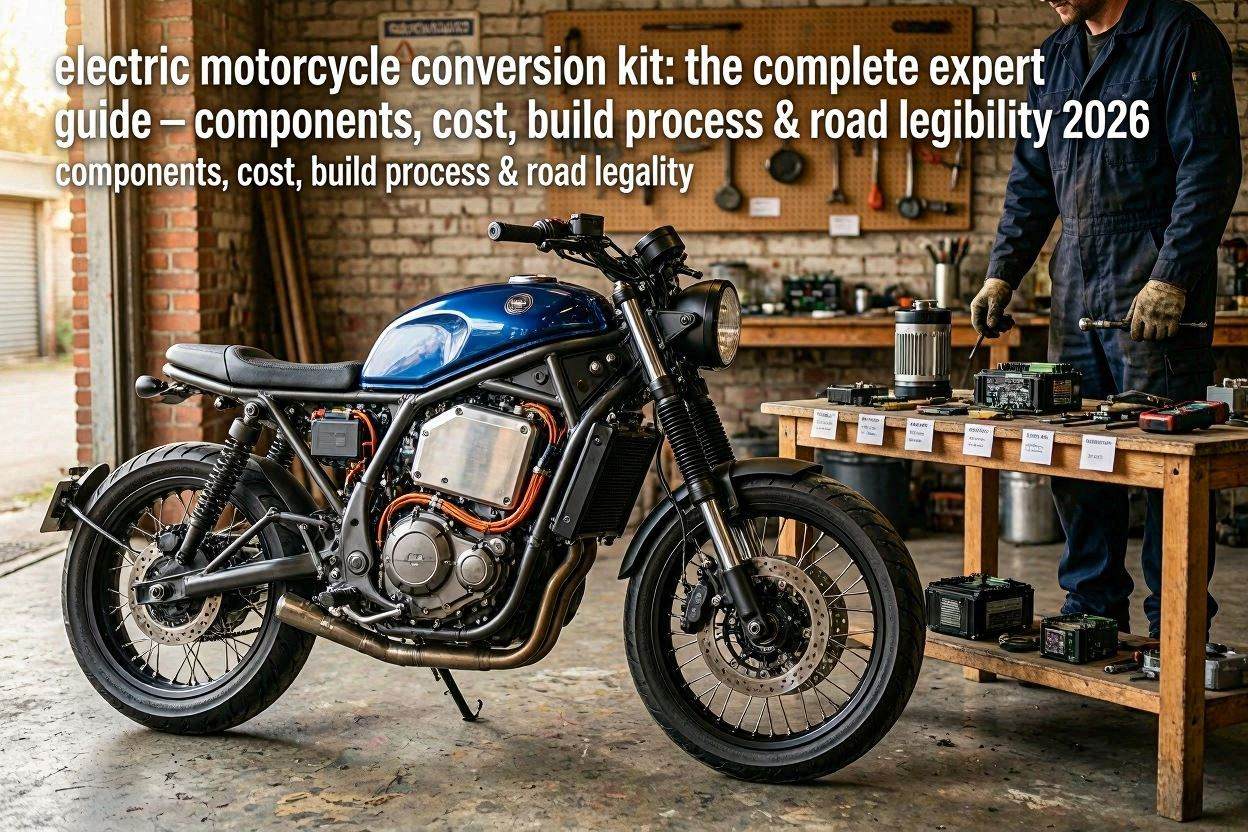
Marco had owned a 1979 Honda CB750 for eleven years. The frame was straight, the engine was tired, and the carburettors needed rebuilding for the third time. When a friend showed him an electric motorcycle conversion kit being sold online, he spent a week reading build threads before ordering the components. Eight months later, his CB750 was silent. It pulled harder off the line than it ever had with the combustion engine, charged from his garage socket overnight, and cost him less than £1.50 per hundred miles to run. “I didn’t want to restore it to stock,” he told us. “I wanted it to be better than stock. The electric motorcycle conversion kit did that.”
The electric motorcycle conversion kit market has matured significantly since the early DIY days of salvaged Nissan Leaf cells and improvised motor mounts. In 2026, purpose-built motorcycle conversion kits are available from established suppliers with technical support, pre-matched motor-controller combinations, purpose-designed battery enclosures, and detailed build documentation. Whether the goal is converting a vintage cafe racer, a motocross bike, a chopper frame, or a modern naked motorcycle, there is an electric motorcycle conversion kit solution available — and this guide covers every aspect of choosing and executing one.
Already converted or buying factory electric? Compare every electric motorcycle in one place at our electric motorcycle comparison guide — specs, range, price, and real-world owner scores.
Electric Motorcycle Conversion Kit: Why Convert Rather Than Buy?
The first question any prospective converter should answer honestly: is an electric motorcycle conversion kit the right approach for their situation, or would purchasing a factory electric motorcycle serve better? The answer depends on several factors — and the honest truth is that conversion is not always the better choice.
Reasons to choose an electric motorcycle conversion kit
- Sentimental or collector value — if the donor motorcycle has personal meaning, aesthetic appeal, or collector value that no factory electric can match, conversion is the only path. Electrifying a vintage Honda, a custom chopper frame, or a specific model with cultural significance preserves what makes the bike worth keeping while replacing what is costing money to maintain.
- Custom build goals — builders who want a specific aesthetic result that no production machine delivers have no alternative to an electric motorcycle conversion kit. The freedom to position the motor, design the battery enclosure, choose the controller, and fabricate mounting points from scratch is available only through the conversion route.
- Cost — a quality electric motorcycle conversion kit for a mid-power build costs $5,000–$15,000 in components, plus fabrication time. This is below the entry price of most factory electric motorcycles with comparable performance. For builders with fabrication skills and access to tools, conversion can achieve higher performance per dollar than any production machine at equivalent price points.
- Learning and craftsmanship — many converters cite the build process itself as primary motivation. Understanding every component, designing the packaging, and solving the engineering problems specific to a chosen donor bike is deeply satisfying for mechanically inclined builders.
- Donor bike availability — cheap, structurally sound donor motorcycles are abundantly available. A stripped Suzuki GS400, a Honda XL250, or a Kawasaki Z650 with a seized engine can be acquired for $300–$800, providing a complete frame, suspension, braking system, and wiring infrastructure at minimal cost.
Reasons NOT to choose an electric motorcycle conversion kit
- No mechanical experience — an electric motorcycle conversion kit requires comfort with electrical systems, metalwork or fabrication, and systematic problem-solving. Builders without prior mechanical experience should expect a steep learning curve and potential safety issues if guidance is not followed carefully.
- Road legality requirements — factory electric motorcycles come pre-certified for road use. A converted motorcycle must pass individual vehicle approval (IVA in the UK, FMVSS compliance in the US, or equivalent national standards) to be road registered. This process is achievable but adds cost, time, and compliance complexity. Off-road-only conversions bypass this requirement.
- Warranty and support — a factory machine carries manufacturer warranty. A conversion carries only the warranty of individual components. System-level problems that span multiple components have no single point of resolution.
- Time investment — a first-time electric motorcycle conversion realistically takes 200–600 hours of build time from stripped donor to running machine. This is the most commonly underestimated factor in conversion projects.

Electric Motorcycle Conversion Kit: The 6 Core Components You Need
Every electric motorcycle conversion kit — regardless of power level, donor bike, or supplier — consists of the same six core components. Understanding each component, its specification, and how it interacts with the others is the foundation of a successful conversion.
1. Electric Motor
The motor is the heart of the electric motorcycle conversion kit. Two motor architectures dominate conversion builds: BLDC (Brushless DC) and PMSM (Permanent Magnet Synchronous Motor). Both deliver high efficiency and long service life, but PMSM motors offer higher power density and smoother low-speed torque — making them the preferred choice for road motorcycle conversions where refined power delivery matters. Key specifications to evaluate: continuous power rating (kW), peak power rating (kW), torque (Nm), RPM range, and physical dimensions (diameter, length, shaft size). Popular motor choices for motorcycle electric conversion kits include the Motenergy ME1616 (42 kW peak, widely used in mid-power builds), the QS Motor 138 series (30–80 kW depending on voltage), and the Thunderstruck Motors TMM series (purpose-designed for motorcycle conversions, with extensive build documentation).
2. Motor Controller / Inverter
The controller converts the DC electricity from your battery into the form the motor requires, managing throttle response, riding modes, regenerative braking, and protection functions. Matching the controller to the motor is critical — mismatched voltage or current ratings cause either underperformance or component failure. Established controller suppliers for electric motorcycle conversion kits include Kelly Controls (KLS and KEB series — widely used, good budget-to-performance ratio), Sevcon (now Danfoss) (premium, widely used in OEM applications), and Alltrax (US-made, strong technical support). For builders using QS motors or similar high-power units, purpose-matched SVMC or Sabvoton controllers are the established pairing.
3. Battery Pack
The battery is typically the largest single cost in an electric motorcycle conversion kit, and the component that most determines range, weight, and long-term ownership experience. Lithium iron phosphate (LiFePO4) cells offer the best safety profile and longest cycle life for conversion builds — they are less energy-dense than NMC (nickel manganese cobalt) cells but significantly more thermally stable, which matters when packaging a battery in a custom enclosure without the sophisticated thermal management of a factory EV. Popular cell formats for motorcycle conversions include 18650 cylindrical cells (high energy density, requires spot-welding into packs), 21700 cylindrical cells (higher capacity per cell than 18650), and prismatic LiFePO4 cells (easier to package, safer, preferred by most conversion builders). Budget $1,500–$5,000 for a usable battery pack of 3–10 kWh, depending on cell chemistry and capacity.
4. Battery Management System (BMS)
A BMS is non-negotiable in any lithium battery system — it protects cells from overcharge, over-discharge, thermal runaway, and imbalance. For a motorcycle conversion, the BMS must be rated for the full discharge current your motor draw requires (a 30 kW motor at 72V draws approximately 416A peak — your BMS must handle this or include bypass provisions). Common BMS choices for electric motorcycle conversion kits include the Electrodacus SBMS (sophisticated, highly configurable), Orion BMS 2 (industry-standard for serious EV conversions), and the ANT BMS series (cost-effective, adequate for lower-power builds).
5. Charging System
Your conversion needs an onboard charger (OBC) or an external charger, plus a compatible charging inlet. For road-legal conversions, a J1772 (Type 1) or Type 2 inlet is standard, enabling charging at any public Level 1 or Level 2 charging point. The Elcon / TC Charger series and Brusa NLG5 are widely used onboard chargers for motorcycle conversions, offering 1.5–6.6 kW AC charging capability. For off-road-only builds, a simple external charger through a waterproof connector is sufficient.
6. Transmission and Drivetrain Adapter
The motor must be coupled to the existing or modified drivetrain. Most motorcycle conversions use one of three approaches: direct chain drive (motor sprocket to existing rear sprocket — simplest, most common), belt drive (quieter, lower maintenance), or direct hub motor (motor integrated into the rear wheel — eliminates chain entirely but limits motor options). A custom motor mount and sprocket adapter are required for chain/belt drive builds — these are typically fabricated by the builder or purchased from specialist suppliers like Thunderstruck Motors or EVWest for common donor bike platforms.
| Component | Budget option | Mid-range option | Premium option | Typical cost range |
|---|---|---|---|---|
| Motor | QS Motor 138 70H | Motenergy ME1616 | PMSM custom wind | $400–$2,500 |
| Controller | Kelly Controls KLS | Sevcon Gen4 | Danfoss FC series | $300–$1,800 |
| Battery (5 kWh) | LiFePO4 prismatic cells | 21700 NMC pack | Custom NMC module | $1,500–$4,000 |
| BMS | ANT BMS 16S | Electrodacus SBMS | Orion BMS 2 | $80–$900 |
| Charger | External charger (off-road) | Elcon 3.3 kW OBC | Brusa NLG5 6.6 kW | $150–$1,200 |
| Motor mount / adapter | DIY fabricated | Supplier kit (donor-specific) | CNC machined custom | $100–$800 |
Electric Motorcycle Conversion Kit: Best Suppliers in 2026
Several suppliers have established themselves as the reference points for electric motorcycle conversion kit purchases — offering pre-matched component combinations, technical support, and build documentation that significantly reduces the research burden for first-time converters.
Thunderstruck Motors
Thunderstruck Motors (California, USA) is widely regarded as the most comprehensive electric motorcycle conversion kit supplier in North America. They offer complete drivetrain kits — motor, controller, cables, connectors, and documentation — with pre-verified component matching and a technical support team that actively assists builders through the conversion process. Their TMM series motors are purpose-designed for motorcycle applications, with integrated mounting provisions and sprocket options for common donor configurations. Full kits from Thunderstruck start at approximately $3,500 for lower-power builds and reach $8,000–$12,000 for high-performance configurations.
EVWest
EVWest (California, USA) offers a broader range of EV conversion components covering motorcycles, cars, and industrial applications. Their motorcycle-relevant inventory includes HPEVS motors (AC series, well-suited to motorcycle conversions), Kelly and Curtis controllers, lithium battery packs, and charging systems. EVWest’s technical team provides pre-purchase consultation to match components to specific donor bikes and power targets. A complete electric motorcycle conversion kit through EVWest typically costs $4,000–$10,000 depending on specification.
ElectricMotorsport / EM-1 Kits
Electric Motorsport offers conversion-specific kits with a focus on accessibility for builders with limited prior EV experience. Their documentation is particularly strong, with step-by-step build guides for specific donor platforms. Budget-oriented builders will find their entry-level offerings (starting around $2,500 for basic drivetrain packages) the most accessible starting point for a first electric motorcycle conversion kit build.
QS Motor / Sabvoton (direct from manufacturer)
For builders comfortable with Chinese-language technical documentation and willing to do their own component matching, QS Motor and their paired Sabvoton or SVMC controllers offer extraordinary performance per dollar. A QS 138 70H motor (peak ~50 kW) with matched SVMC controller costs approximately $600–$900 shipped — a fraction of equivalent Western-sourced components. The tradeoff is limited English-language support and the need for builder expertise in component matching and configuration. Widely used by experienced conversion builders globally.
Luna Cycle and Grin Technologies (bicycle-to-motorcycle crossover)
For lower-power conversions in the 1–5 kW range — suitable for light motorcycles, scooters, or off-road builds where performance requirements are modest — Luna Cycle and Grin Technologies offer hub motor kits, mid-drive kits, battery packs, and controllers originally designed for e-bicycle conversions but applicable to light motorcycle builds. Their electric bike conversion kits with battery are available from $500–$1,500 and represent the lowest-cost entry point into electric motorcycle conversion.
Electric Motorcycle Conversion Kit: Hub Motor vs Mid-Drive vs Direct Drive
One of the most consequential decisions in planning an electric motorcycle conversion kit is the motor placement and drivetrain integration approach. Three architectures are in common use, each with distinct advantages and trade-offs.
| Architecture | How it works | Advantages | Disadvantages | Best for |
|---|---|---|---|---|
| Hub motor | Motor integrated into rear wheel hub; no chain or belt required | Simplest installation; no drivetrain modifications; quiet; regenerative braking easy to implement | Limits motor choice; unsprung mass increases; difficult to change tyres; limited to lower power levels | Scooters, light motorcycles, low-power builds |
| Mid-drive (chain/belt) | Motor mounted centrally; drives rear wheel via chain or belt through existing sprocket | Flexible motor choice; better mass centralisation; sprocket ratio adjustable; higher power capacity | Requires custom motor mount; chain/belt maintenance; sprocket adapter fabrication needed | Most motorcycle conversions; best all-round approach |
| Direct drive (motor to wheel shaft) | Motor output shaft connected directly to wheel axle via coupling | No chain loss; simple; very quiet | Complex engineering; limited to specific frame geometries; rare in practice | Specialist builds; engineering-led projects |
The mid-drive with chain architecture is the recommended approach for the majority of motorcycle conversions — it allows the widest choice of motors, permits gear ratio optimisation through sprocket selection, and integrates naturally with existing motorcycle frame geometry. The hub motor approach is appropriate for lower-power builds on scooters and light motorcycles where simplicity and reduced installation complexity outweigh performance considerations.
Electric Motorcycle Conversion Kit: The Build Process Step by Step
Understanding the complete build sequence before beginning an electric motorcycle conversion kit project prevents the most common mistakes — components ordered in the wrong sequence, packaging conflicts discovered mid-build, and wiring designed before motor placement is confirmed.
- Step 1: Define your performance targets — before ordering a single component, decide on target range (km/miles), top speed, and continuous power. These three numbers determine battery capacity (kWh), motor power (kW), and voltage (V). Range = (battery kWh × 1000) / Wh/km. A target range of 80 km at 60 km/h average requires approximately 4–5 kWh of usable battery capacity.
- Step 2: Choose and acquire your donor motorcycle — the donor frame and its geometry determine motor placement options, battery volume available, and drivetrain routing. Assess the donor for: frame condition (look for cracks at welds and stress points), suspension serviceability, brake condition, and the availability of the original title/registration documents if road use is planned.
- Step 3: Strip the donor completely — remove the engine, fuel tank, exhaust system, airbox, fuel lines, and all combustion-related components. Document everything with photos before removal. Clean and inspect the frame, swing arm, and steering head bearings.
- Step 4: Mock-up motor placement — before ordering your motor mount, place the motor (or a cardboard template of its dimensions) in the frame to confirm fitment, chain line, and clearance. Most mid-drive motorcycle conversions position the motor low in the frame where the engine sat, using the existing engine mounting points or custom fabricated brackets.
- Step 5: Design and fabricate motor mount — the motor mount transfers all drivetrain forces from the motor to the frame. This is a structural component — it must be engineered appropriately. For common donor bikes, Thunderstruck Motors and EVWest sell pre-designed mounts. For unusual donors, custom fabrication in 6061 aluminium or mild steel is required.
- Step 6: Design battery enclosure — the battery must be physically protected, thermally manageable, and aesthetically integrated. Design the enclosure to fill as much of the available frame volume as possible (maximises range), maintain access for maintenance and BMS connections, and distribute weight as low and centrally as possible.
- Step 7: Order components and assemble battery pack — with mounting positions confirmed, order motor, controller, cells, BMS, charger, and wiring. Assemble the battery pack with appropriate cell interconnects, BMS wiring, and enclosure. This step requires the most care — lithium battery assembly involves high stored energy and short-circuit risk.
- Step 8: Wiring and integration — wire the system following the controller manufacturer’s wiring diagram. Use appropriate gauge cable for all high-current runs (motor phase wires, battery positive and negative). Install fusing at the battery output. Wire the BMS sense wires to all cell groups. Test continuity and isolation before applying power.
- Step 9: Initial power-up and configuration — with the rear wheel off the ground, apply power and configure the controller using the manufacturer’s PC software or app. Set current limits, throttle input range, regenerative braking level, and speed limits. Verify motor rotation direction and throttle response before first ride.
- Step 10: Road test and refinement — initial riding reveals real-world performance, thermal behaviour, and any vibration or interference issues. Log data from the BMS and controller during test rides. Adjust gearing (sprocket ratio), riding mode settings, and regenerative braking intensity based on real-world experience.
Electric Motorcycle Conversion Kit: Full Cost Breakdown for 2026
| Build tier | Motor | Battery | Total component cost | Expected range | Expected top speed |
|---|---|---|---|---|---|
| Budget build (off-road / light use) | QS Motor 138 30H / hub motor | 2–3 kWh LiFePO4 | $2,500–$4,000 | 40–60 km | 60–80 km/h |
| Mid-range build (road-capable) | Motenergy ME1616 / QS138 70H | 5–7 kWh LiFePO4 or NMC | $5,000–$9,000 | 80–120 km | 100–130 km/h |
| Performance build (full road spec) | High-wind PMSM 50–80 kW | 10–15 kWh NMC | $10,000–$18,000 | 150–200 km | 150+ km/h |
| Donor motorcycle | $300–$2,000 depending on model and condition | ||||
| Fabrication / miscellaneous | $500–$3,000 (tools, consumables, motor mount, enclosure materials) | ||||
Total build cost for a competent mid-range electric motorcycle conversion kit — capable of road use, 100+ km range, and 120 km/h cruising — typically falls in the $7,000–$12,000 range inclusive of donor bike and fabrication. This is below the purchase price of most factory electric motorcycles with equivalent performance, but represents a significant investment of time (200–400+ hours) that must be factored into the true cost calculation. According to the U.S. Department of Energy, electric vehicle energy costs run 3–5× lower per mile than gasoline equivalents — meaning the converted machine pays back its higher build cost through operating savings over its service life.

Electric Motorcycle Conversion Kit: Road Legality and Registration
Road registering a converted motorcycle is achievable but requires navigating a compliance process that varies significantly by country and, in the US, by state. Understanding the requirements before beginning an electric motorcycle conversion kit project prevents expensive surprises at the end of a build.
Road legality in the United States
In the US, converted motorcycles must comply with Federal Motor Vehicle Safety Standards (FMVSS) applicable to motorcycles. For motorcycles retaining the original frame, VIN, and structural components, most states treat a converted motorcycle as a modification of the existing registered vehicle rather than a new vehicle — simplifying the compliance path. Key requirements typically include: operational lights (headlight, tail/brake light, indicators), mirrors, horn, and tyres rated for the vehicle’s maximum speed. Emissions testing requirements are eliminated for electric vehicles in most states. Consult your state’s DMV for the specific process for registering a converted motorcycle.
Road legality in the United Kingdom
In the UK, converted motorcycles require Individual Vehicle Approval (IVA) from the Driver and Vehicle Licensing Agency (DVLA) if the conversion substantially changes the vehicle’s original specification. The DVLA IVA process assesses the converted vehicle against relevant safety standards including lighting, braking, steering, and structural integrity. A Type Approval certificate from a recognised test centre is also an alternative path. Most converted motorcycles retain their original V5C (logbook) if the frame and VIN are unchanged; the DVLA is notified of the powertrain change.
Road legality in Europe (EU)
EU member states apply WVTA (Whole Vehicle Type Approval) standards, and individual country rules for conversions vary. Germany, France, and the Netherlands each have specific conversion registration processes. Most EU countries allow registration of a converted vehicle through a national technical inspection authority (TÜV in Germany, DEKRA, etc.) — the conversion must be inspected and certified before road registration is issued. Budget additional time and cost ($500–$2,000) for the compliance process in EU markets.
FAQ — Electric Motorcycle Conversion Kit
How much does an electric motorcycle conversion kit cost?
A complete electric motorcycle conversion kit — covering motor, controller, battery pack, BMS, charger, and wiring — costs approximately $2,500–$5,000 for a budget/off-road build, $5,000–$9,000 for a mid-range road-capable build, and $10,000–$18,000 for a high-performance conversion. These figures cover components only. Donor motorcycle acquisition ($300–$2,000) and fabrication materials ($500–$3,000) add to the total. Labour (if outsourced) or time investment (if DIY) must also be factored in.
Can any motorcycle be converted to electric?
Technically, any motorcycle with a sound frame and compatible geometry can be converted using an electric motorcycle conversion kit. In practice, some donors are significantly more conversion-friendly than others. The most suitable donor bikes have: a large engine bay (more space for motor and battery), simple frame geometry (easier motor mounting), good parts availability (brakes, suspension serviceable), and a clear title (essential for road registration). Vintage British singles, Honda CB series, Kawasaki Z series, and Yamaha XS series are among the most commonly used donors, with established conversion communities and documented build information available online.
How long does an electric motorcycle conversion take?
A first-time builder completing a competent mid-range conversion should budget 300–600 hours of work — spread over 6–18 months depending on access to tools, availability of components, and the complexity of the donor bike. Experienced builders with existing EV knowledge and machine shop access complete comparable builds in 150–250 hours. The most time-consuming phases are typically battery pack assembly, motor mount fabrication, and wiring — each requiring careful, methodical work that cannot be rushed without risk.
What is the best electric motorcycle conversion kit for beginners?
For builders new to EV conversions, the most recommended starting point is a pre-matched kit from Thunderstruck Motors or Electric Motorsport — where motor, controller, and wiring are pre-matched and build documentation is provided. Avoid assembling components from multiple unrelated suppliers for a first build; the integration work and troubleshooting complexity is significantly higher. A lower-power build (15–25 kW) on a simple donor frame is also strongly recommended for a first project — it is safer, cheaper to correct if mistakes occur, and still delivers a genuinely enjoyable riding experience.
Is it legal to sell a converted electric motorcycle?
This varies by jurisdiction. In most countries, a converted motorcycle can be sold as a private vehicle transaction, provided it is properly registered and roadworthy in its converted form. Selling converted motorcycles as a business activity may trigger additional compliance requirements (commercial vehicle approval, consumer protection obligations). Consult your local legal and regulatory framework before entering commercial conversion activity.
What range can I expect from an electric motorcycle conversion kit?
Expected range from a converted motorcycle depends primarily on battery capacity (kWh) and riding speed. A 5 kWh pack at 60 km/h average gives approximately 80–100 km; at 90 km/h average, expect 50–65 km. A 10 kWh pack doubles these figures proportionally. High-performance builds pushing 150+ km/h consume energy rapidly — expect 6–10 kWh per 100 km at sustained highway speeds. Real-world range is also affected by rider weight, terrain, temperature, and the efficiency of the motor-controller combination.
Verdict: Is the Electric Motorcycle Conversion Kit Right for You?
Marco’s CB750 has now covered 8,000 km in electric form. He’s replaced the rear tyre, bled the brakes once, and checked the battery balance four times. Total maintenance cost in 18 months: less than £120. “I was going to sell it,” he said. “Now I can’t imagine selling it. It’s more the bike I wanted it to be than it ever was with the combustion engine.” He’s already sourcing a 1981 Moto Guzzi Le Mans as the next donor.
The electric motorcycle conversion kit is not the right answer for every rider or every motorcycle. But for builders with the skills, the patience, and a donor bike worth saving, it is one of the most technically satisfying projects in motorcycling — and the result is a machine that is uniquely yours in a way that no factory motorcycle can be.
Ready to start? Compare the components and suppliers at our full electric motorcycle comparison guide, and find authorised EV component suppliers through our electric motorcycle shop directory — covering the US, UK, and EU.
Leave a Reply