
Dr. Elena Vasquez spent six years at a major automotive OEM developing electric drivetrains before she joined a boutique electric motorcycle motor startup in California. “The first thing most people get wrong about the electric motorcycle motor,” she told us, “is thinking of it like an engine. It is not an engine. An engine is a controlled explosion happening over and over again. A motor is a conversation between electrons and magnetic fields. It is elegant in a way that combustion never quite manages to be.” The distinction matters because understanding how an electric motorcycle motor actually works — what makes one specification better than another, why two motors with identical power ratings feel completely different on the road — is the foundation of choosing, building, or evaluating any electric motorcycle intelligently.
This guide covers everything a rider, builder, or buyer needs to know about the electric motorcycle motor: the physics, the motor types, the key specifications and what they really mean, how production motorcycle motors compare, and how to choose the right electric motor for motorcycle applications — whether you are buying a production bike or building your own.
Already know which electric motorcycle motor you want? Browse our full electric motorcycle comparison guide — every production model ranked by motor power, torque, and real-world performance.
Electric Motorcycle Motor: How It Works
The electric motorcycle motor converts electrical energy into mechanical rotation through the interaction of magnetic fields. In all motor types used in electric motorcycles, this conversion happens through a fundamental electromagnetic principle: a conductor carrying current in a magnetic field experiences a force — and that force produces rotation.
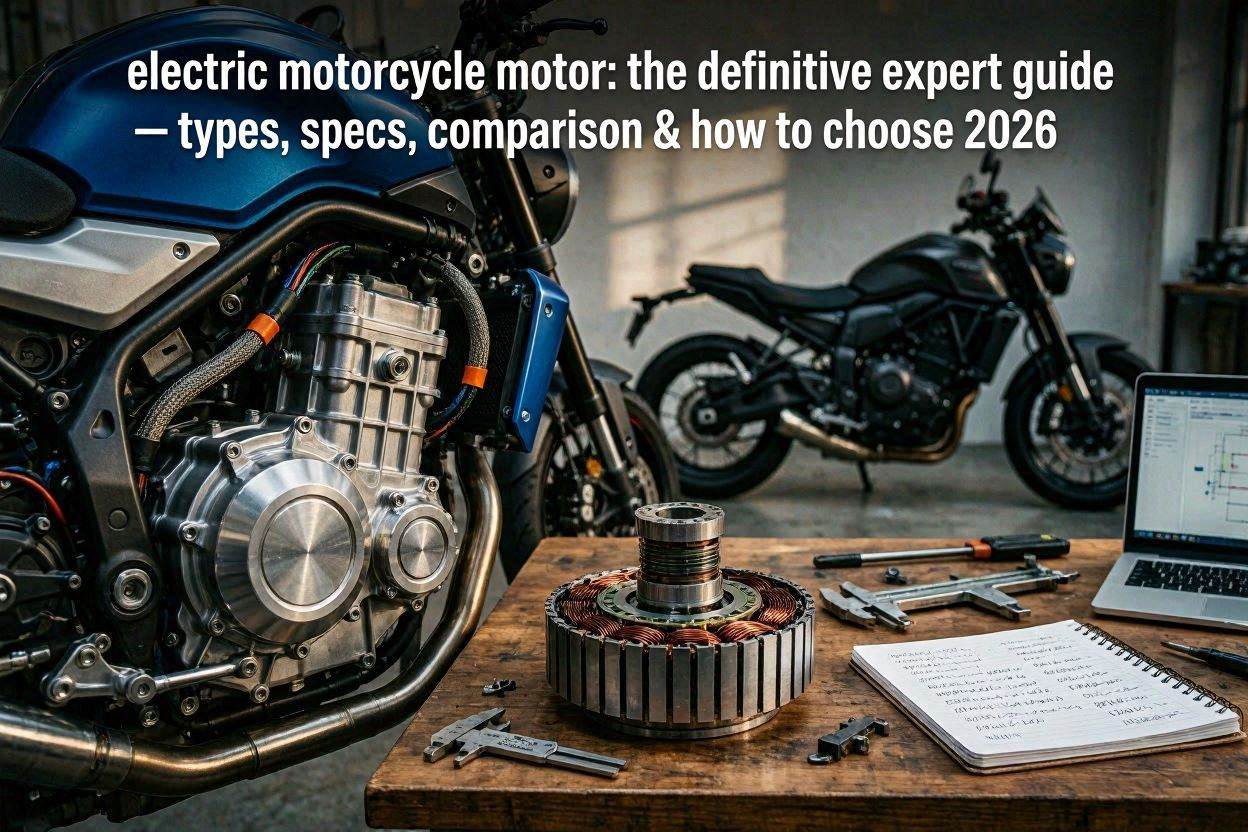
Every electric motorcycle motor consists of two primary structures: the stator (the stationary component, containing electromagnetic coils wound around iron cores) and the rotor (the rotating component, containing permanent magnets or, in older induction designs, induced magnetic fields). When alternating current is passed through the stator coils in a controlled sequence — managed by the motor controller — it creates a rotating magnetic field. The rotor’s permanent magnets are attracted to and repelled by this rotating field, causing the rotor to spin. The rotor is mechanically connected to the output shaft, which drives the motorcycle’s rear wheel through a sprocket, chain, or belt.
The key insight that separates the electric motorcycle motor from a combustion engine is the torque curve. A combustion engine builds torque as RPM increases — it has a power band, and getting the most from it requires keeping the engine in that band through gear changes. An electric motorcycle motor produces its maximum torque at zero RPM. The moment the rotor begins to turn, full torque is available. This is the physical reason why electric motorcycles accelerate so dramatically from a standstill — and why experienced riders consistently describe the sensation as unlike anything a combustion machine produces.

Electric Motorcycle Motor Types: BLDC vs PMSM vs AC Induction
Three primary motor architectures are used in production and conversion electric motorcycles in 2026. Understanding the differences between them is essential for anyone evaluating an electric motorcycle motor specification.
BLDC — Brushless DC Motor
The BLDC (Brushless DC) motor is the most widely used electric motorcycle motor architecture globally, found in everything from entry-level electric motorbikes to mid-range production machines and the majority of electric motorcycle conversion builds. Despite its name, a BLDC motor is actually driven by AC current generated by its controller — the “DC” refers to the DC power source (the battery) from which it draws.
In a BLDC motor, permanent magnets are mounted on the rotor. The stator contains wound coils that are energised in sequence by the controller, creating a rotating magnetic field that drives the rotor. Hall effect sensors (or, in sensorless designs, back-EMF measurement) allow the controller to track rotor position and time the energisation sequence precisely. BLDC motors offer high efficiency (typically 85–93%), good power density, low maintenance (no brushes to replace), and wide controller compatibility. They are the default choice for most electric motorcycle motor conversions and mid-range production machines.
PMSM — Permanent Magnet Synchronous Motor
The PMSM (Permanent Magnet Synchronous Motor) is the highest-performance electric motorcycle motor architecture used in production machines. Structurally similar to a BLDC motor — permanent magnets on the rotor, wound stator — the key distinction is in how the motor is controlled and the resulting performance characteristics. A PMSM is driven by sinusoidal AC current (true sine wave, rather than the trapezoidal waveform of a BLDC), which produces smoother torque delivery, lower torque ripple, and superior efficiency across a wider operating range.
The Zero Motorcycles Z-Force motor (used in the SR/F, SR/S, and FX), the Energica SAM motor, the LiveWire PMAD motor, and the Stark Varg’s custom motor are all PMSM designs. They deliver the best combination of peak power, efficiency across the full operating range, regenerative braking capability, and thermal management. The trade-off is cost and controller complexity — PMSM drives require more sophisticated vector control algorithms (Field Oriented Control, or FOC) than BLDC drives, adding controller cost and programming complexity.
AC Induction Motor
AC induction motors — the dominant architecture in industrial electric motors and early production EVs — are now rare in motorcycle applications. Tesla’s early vehicle lineup used induction motors; most current production EVs (including electric motorcycles) have migrated to PMSM for superior power density and efficiency at motorcycle-relevant power levels. Some conversion builders still encounter induction motors salvaged from industrial or automotive sources, but they are not recommended for new electric motorcycle motor builds due to lower efficiency and complexity versus modern BLDC or PMSM options.
| Motor type | Efficiency | Torque at 0 rpm | Controller complexity | Cost | Used in |
|---|---|---|---|---|---|
| BLDC | 85–93% | ✅ Full torque | Medium | Low–medium | Most conversion builds, entry/mid-range EV motorcycles |
| PMSM | 90–97% | ✅ Full torque | High (FOC required) | Medium–high | Zero SR/F, LiveWire, Energica, Stark Varg |
| AC Induction | 80–90% | ⚠️ Reduced | High | Medium | Industrial sources, early EV salvage |
Electric Motorcycle Motor: Hub Motor vs Mid-Drive
Beyond motor architecture, placement is the second most important design decision in any electric motorcycle motor system. Two configurations dominate: hub motors and mid-drive (centrally mounted) motors.
Hub Motor Motorcycle
A hub motor integrates the electric motorcycle motor directly into the wheel hub — typically the rear wheel. The motor’s stator is fixed to the axle; the rotor is the hub itself, rotating around the stator and driving the wheel directly. Hub motors are mechanically simple — no chain, belt, or secondary drive required between the motor and the wheel. They also allow fully independent motor and suspension operation.
Hub motors are popular in lighter applications: electric scooters, Sur-Ron style lightweight trail bikes, and some entry-level electric motorbikes. Their limitations in full-size motorcycle applications include: unsprung weight increase (the motor mass is part of the unsprung wheel assembly, affecting suspension dynamics), limited torque multiplication (no gear reduction between motor and wheel), and the physical constraints of packaging sufficient motor power within a wheel hub. For full-performance road motorcycles, most manufacturers prefer mid-drive configurations for these reasons.
Mid-Drive Electric Motorcycle Motor
A mid-drive electric motorcycle motor is mounted centrally in the frame — typically where the combustion engine would sit — and drives the rear wheel through a chain, belt, or shaft drive with a fixed reduction ratio. This configuration offers several advantages over hub motors: the motor’s mass is positioned low and central in the frame, optimising weight distribution; a gear reduction ratio can be selected to multiply torque at the wheel; and the motor can be optimised for its preferred operating speed range rather than being constrained by wheel diameter and direct drive ratios.
All major performance electric motorcycle motors in production — Zero’s Z-Force, Energica’s SAM, the LiveWire PMAD, the Stark Varg motor — use mid-drive configurations with sprocket and chain or belt final drive. This is the correct architecture for any performance-oriented electric motorcycle motor application.
Electric Motorcycle Motor: Key Specifications Explained
Reading an electric motorcycle motor specification sheet requires understanding what the numbers actually mean — and where manufacturers sometimes present figures in ways that flatter the specification without fully representing real-world performance.
Peak Power vs Continuous Power
The single most important distinction in any electric motorcycle motor specification is the difference between peak power and continuous power. Peak power is the maximum output the motor can produce for a short burst — typically 10–60 seconds before thermal limiting reduces output. Continuous power is what the motor sustains indefinitely without thermal derating. A motor rated at “80 kW peak / 35 kW continuous” can sprint at 80 kW but will reduce to 35 kW for sustained high-power riding. For comparison: the Zero SR/F’s Z-Force motor is rated at 82 kW peak / 62 kW continuous — an unusually strong continuous rating that reflects the Z-Force’s liquid-cooled architecture.
Torque
Motor torque in an electric motorcycle motor is typically stated as motor shaft torque (Nm at the motor output shaft) or wheel torque (Nm at the rear wheel, after the final drive ratio). These figures are very different — a motor producing 150 Nm at the shaft through a 5:1 final drive ratio delivers 750 Nm at the wheel. Always confirm which figure is being stated. Zero’s SR/F produces 190 Nm at the rear wheel — this is the wheel torque figure. The Stark Varg produces approximately 938 Nm at the rear wheel through its drive ratio from a motor producing significantly less shaft torque.
Voltage and Current
The operating voltage of an electric motorcycle motor is matched to the battery system voltage. Most quality production electric motorcycles operate at 72V–400V depending on segment and power targets. Higher voltage systems — like Energica’s 400V platform — can deliver the same power at lower current, reducing cable and connector sizing requirements and improving efficiency. For conversion builders, matching motor voltage rating to battery voltage is non-negotiable — overvoltage damages motor insulation and can cause catastrophic failure.
Efficiency
Motor efficiency is expressed as the percentage of electrical input power that is converted to mechanical output power — the rest is lost as heat. A PMSM motor operating at its efficiency sweet spot (typically mid-RPM, mid-torque) achieves 92–97% efficiency. At very low or very high torque/speed combinations, efficiency drops. This is why manufacturers publish efficiency maps (or “efficiency islands”) rather than single efficiency figures — real-world electric motorcycle motor efficiency varies across the operating range, and understanding this variation helps riders maximise range.
RPM / Speed
The no-load maximum RPM of an electric motorcycle motor determines, in combination with the final drive ratio, the motorcycle’s maximum road speed. Zero’s Z-Force motor spins to approximately 5,000 RPM; through Zero’s final drive ratio, this produces approximately 102 mph top speed for the SR/F. Conversion builders select their final drive sprocket ratio to achieve their target top speed from their chosen motor’s RPM range — a critical calculation in any motorcycle motor conversion project.
| Specification | What to look for | Red flag |
|---|---|---|
| Peak power | Stated with duration (e.g. “82 kW for 30s”) | Peak only stated, no continuous figure |
| Continuous power | ≥50% of peak for quality motors | Continuous much lower than peak (thermal limitation) |
| Torque | Wheel torque stated clearly | Only motor shaft torque stated (appears larger) |
| Voltage | Matches battery system exactly | Vague “nominal voltage” without min/max range |
| Efficiency | Peak efficiency map or % at rated power | Single peak efficiency only, no range data |
| Cooling | Liquid-cooled for sustained high power | Air-cooled at >20 kW continuous (thermal risk) |
| IP rating | IP65 minimum for motorcycle use | No IP rating stated (water ingress risk) |
Electric Motorcycle Motor: Production Models Compared
Here is how the electric motorcycle motors in the most significant production machines of 2026 compare across the key specifications that matter to riders:
| Model | Motor | Type | Peak power | Cont. power | Peak torque (wheel) | Cooling |
|---|---|---|---|---|---|---|
| Zero SR/F | Z-Force 75-10 | PMSM | 82 kW | 62 kW | 190 Nm | Liquid |
| LiveWire One | PMAD | PMSM | 78 kW | ~52 kW | ~145 Nm | Liquid |
| Energica Ego+ | SAM (custom) | PMSM | 107 kW | ~65 kW | ~215 Nm | Liquid |
| Stark Varg MX | Custom PMSM | PMSM | 80 kW | ~55 kW | ~938 Nm | Liquid |
| Zero FX | Z-Force 75-5 | PMSM | 46 kW | 34 kW | ~106 Nm | Air |
| KTM Freeride E-XC | KTM custom PMSM | PMSM | 30 kW | 18 kW | ~N/A wheel | Air |
| Kawasaki Ninja E-1 | Custom PMSM | PMSM | ~12 kW | 9 kW | ~40 Nm | Air |
The most important observation from this comparison: all high-performance production electric motorcycle motors use PMSM architecture with liquid cooling. Liquid cooling is not a luxury feature — at sustained power outputs above 30–40 kW, air-cooled motors thermally derate (reduce power output) to protect themselves. The Zero SR/F’s 62 kW continuous rating versus the FX’s 34 kW continuous rating reflects precisely this difference: both use Z-Force PMSM motors, but the SR/F’s liquid cooling enables dramatically higher sustained output.

Electric Motorcycle Motor for Conversion Builds: How to Choose
For builders selecting an electric motor for motorcycle conversion projects, the choice involves balancing power targets, frame packaging constraints, budget, and controller compatibility. Here is the systematic approach experienced conversion builders use.
Step 1 — Define your power target
Most classic motorcycle conversion builds target 15–50 kW of peak power — sufficient for genuine road performance without extreme packaging challenges. A 15–20 kW motor delivers performance comparable to a 300–400cc gas bike. A 30–50 kW motor delivers performance in the Zero FX / FXE range. Targeting above 50 kW peak in a custom conversion requires liquid cooling, large-format battery packs, and advanced controller selection — appropriate for experienced builders only.
Step 2 — Select motor architecture
For most conversion builds, a BLDC motor from Motenergy (ME1616, ME1302, ME0913) paired with a Kelly Controls or Alltrax controller provides the most accessible and well-documented path to a working electric motorcycle motor system. For higher-performance builds where efficiency and sustained power matter, a PMSM motor with a compatible FOC controller (Sevcon Gen4, Tritium WaveSculptor, or similar) delivers superior results at higher cost and complexity.
Step 3 — Match voltage to battery
- 48V–72V systems: accessible battery voltage, wide controller compatibility, appropriate for 5–20 kW builds. Common in lightweight conversions and budget builds.
- 72V–96V systems: the sweet spot for mid-range conversions (15–35 kW). Motenergy ME1616 at 72–96V is the most popular choice at this level.
- 96V–144V systems: higher performance territory (30–60 kW). Requires more care in component selection and wiring; rewards with significantly improved continuous power capability.
- 144V+ systems: high-performance conversion territory. Exceptional power possible but demands professional-grade components, careful BMS selection, and thorough HV safety practices.
Recommended motors for conversion by power level
| Power target | Recommended motor | Voltage range | Approx. motor cost | Controller match |
|---|---|---|---|---|
| 5–15 kW | Motenergy ME0913 | 48–72V | ~$600–$900 | Kelly KLS / Alltrax AXE |
| 15–30 kW | Motenergy ME1616 | 72–96V | ~$900–$1,400 | Kelly KLS / Sevcon Gen4 |
| 20–40 kW | Motenergy ME1302 | 72–144V | ~$1,200–$1,800 | Kelly KEB / Sevcon Gen4 |
| 30–60 kW | HPEVS AC-51 / AC-75 | 96–144V | ~$2,000–$3,500 | Curtis 1238 / Sevcon Gen4 |
| 50+ kW | EV salvage (Leaf, Tesla SDU) | 300–400V | ~$500–$3,000 (used) | OEM inverter or OpenInverter |
Electric Motorcycle Motor Cooling: Why It Matters More Than Peak Power
Thermal management is the least glamorous but most practically important aspect of any electric motorcycle motor specification. Every motor produces heat as a byproduct of electrical resistance in the windings and magnetic losses in the iron — and heat is the primary enemy of motor longevity and sustained performance.
An air-cooled electric motorcycle motor relies on the motor casing surface area and ambient airflow to dissipate heat. At power outputs below 20–25 kW, this is generally adequate for typical road riding. Above this level — particularly in sustained high-load scenarios like motorway overtaking, hill climbing, or track use — air cooling becomes insufficient and the motor’s thermal protection system reduces power output to protect the windings. This is motor “derating” — and it explains why the Zero FX (air-cooled, 46 kW peak / 34 kW continuous) cannot sustain its peak power output the way the liquid-cooled SR/F can.
Liquid cooling circulates coolant through channels in the motor stator, removing heat far more efficiently than air alone. According to the U.S. Department of Energy’s electric motor thermal management research, liquid cooling enables 3–5× higher continuous power density compared to equivalent air-cooled designs. For high-performance production electric motorcycles and ambitious conversion builds, liquid cooling is the correct choice above ~25 kW continuous.
FAQ — Electric Motorcycle Motor
What type of motor do electric motorcycles use?
Most production electric motorcycles use PMSM (Permanent Magnet Synchronous Motor) architecture — the most efficient and highest-performance option currently available. Entry-level and mid-range machines may use BLDC (Brushless DC) motors, which offer good performance at lower cost. The specific electric motorcycle motor types used by leading brands: Zero Motorcycles uses PMSM (Z-Force series), LiveWire uses PMSM (PMAD), Energica uses PMSM (SAM), Stark Future uses a custom PMSM. Older or lower-cost electric motorcycles may use BLDC motors or, rarely, AC induction motors.
How powerful is an electric motorcycle motor?
Production electric motorcycle motor power outputs range from approximately 1.7 kW (Honda EM1 e: — learner/urban segment) to 107 kW (Energica Ego+ — high-performance segment). Most full-size adult electric motorcycles in the mainstream market produce 35–82 kW peak. The Zero SR/F produces 82 kW peak / 62 kW continuous — comparable to a 600–750cc gas sportsbike in terms of real-world performance. The Stark Varg produces 80 kW in a 110 kg package — the highest power-to-weight ratio of any production electric motorcycle motor in 2026.
What is the difference between a BLDC and PMSM electric motorcycle motor?
Both BLDC and PMSM electric motorcycle motors use permanent magnets on the rotor and wound coils in the stator. The key difference is in how current is delivered to the stator: BLDC motors use trapezoidal current waveforms (simpler to control, lower cost), while PMSM motors use sinusoidal waveforms via Field Oriented Control (higher efficiency, smoother torque, better performance across a wider operating range, but requiring more sophisticated and expensive controllers). For maximum performance and efficiency, PMSM is superior. For accessible conversion builds on a budget, BLDC provides excellent results at lower cost.
How does an electric motorcycle motor produce instant torque?
The instant torque of an electric motorcycle motor is a direct consequence of its operating principle. In a PMSM or BLDC motor, the stator’s rotating magnetic field and the rotor’s permanent magnets interact immediately — the moment current flows, force is produced on the rotor. There is no need to build up combustion pressure, no delay for a flywheel to store rotational energy, and no RPM threshold below which torque is unavailable. The motor’s maximum torque is available from the first instant of operation, at zero RPM, and remains available throughout the usable RPM range — typically decreasing only as the back-EMF of the spinning motor limits current at high speeds.
How do I choose an electric motor for a motorcycle conversion?
The key selection criteria for an electric motor for motorcycle conversion are: target power output (kW), system voltage (must match your planned battery), motor physical dimensions (must fit in your donor frame), final drive compatibility (sprocket or pulley must mate to your chosen drivetrain), and controller availability (a matched, well-supported controller must exist for your chosen motor). Start with Thunderstruck Motors or EVWest — both offer matched motor and controller packages with technical support, significantly reducing the selection complexity for first-time builders.
What is the lifespan of an electric motorcycle motor?
A quality PMSM or BLDC electric motorcycle motor has no brushes or other wearing contact surfaces — its primary wear mechanisms are bearing degradation and winding insulation breakdown over time. Quality motorcycle motors from established manufacturers are designed for 100,000+ km service life under normal operating conditions. Motor lifespan is primarily limited by: sustained operation above rated temperature (damages winding insulation), contamination by water or debris (causes insulation breakdown or bearing damage), and mechanical shock from crashes or extreme off-road use. Zero Motorcycles provides a 5-year / unlimited mileage warranty on their Z-Force motor — reflecting genuine confidence in motor longevity.
Verdict: Understanding the Electric Motorcycle Motor Changes How You Ride and Buy
Dr. Vasquez’s insight — that an electric motorcycle motor is a conversation between electrons and magnetic fields rather than a series of controlled explosions — is more than poetic. It is practically useful. Riders who understand that their motor produces maximum torque at zero RPM ride differently: they use that torque deliberately, building speed from corners with an authority that gas bikes require specific RPM bands to match. Builders who understand BLDC versus PMSM make better component choices. Buyers who understand continuous versus peak power are not misled by headline figures.
The electric motorcycle motor is the defining component of the electric motorcycle experience. Every choice that follows — battery size, controller selection, final drive ratio, cooling architecture — is made in service of what the motor can do. Understanding it deeply makes every other decision clearer.
Ready to put this knowledge to work? Our full electric motorcycle comparison guide breaks down the motor specifications of every production model in 2026 — with real-world performance data alongside the spec sheet numbers. And our dealer directory connects you with authorised stockists across the US, UK, and EU.
Leave a Reply