Category: Electric Motorcycle Guides

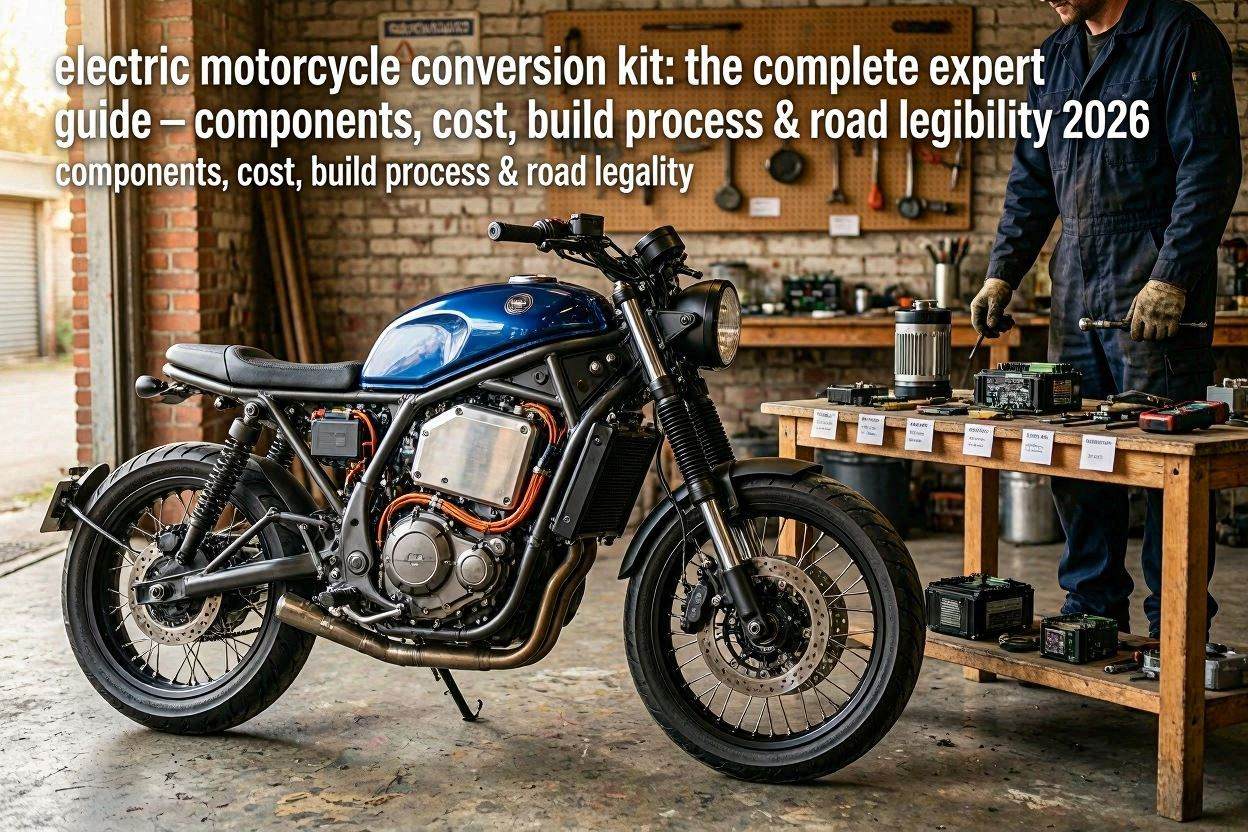
  • Electric Motorcycle Conversion Kit: The Complete Expert Guide — Components, Cost, Build Process & Road Legality 2026

    Electric Motorcycle Conversion Kit: The Complete Expert Guide — Components, Cost, Build Process & Road Legality 2026

    Marco had owned a 1979 Honda CB750 for eleven years. The frame was straight, the engine was tired, and the carburettors needed rebuilding for the third time. When a friend showed him an electric motorcycle conversion kit being sold online, he spent a week reading build threads before ordering the components. Eight months later, his CB750 was silent. It pulled harder off the line than it ever had with the combustion engine, charged from his garage socket overnight, and cost him less than £1.50 per hundred miles to run. “I didn’t want to restore it to stock,” he told us. “I wanted it to be better than stock. The electric motorcycle conversion kit did that.”

    The electric motorcycle conversion kit market has matured significantly since the early DIY days of salvaged Nissan Leaf cells and improvised motor mounts. In 2026, purpose-built motorcycle conversion kits are available from established suppliers with technical support, pre-matched motor-controller combinations, purpose-designed battery enclosures, and detailed build documentation. Whether the goal is converting a vintage cafe racer, a motocross bike, a chopper frame, or a modern naked motorcycle, there is an electric motorcycle conversion kit solution available — and this guide covers every aspect of choosing and executing one.

    Already converted or buying factory electric? Compare every electric motorcycle in one place at our electric motorcycle comparison guide — specs, range, price, and real-world owner scores.

    Electric Motorcycle Conversion Kit: Why Convert Rather Than Buy?

    The first question any prospective converter should answer honestly: is an electric motorcycle conversion kit the right approach for their situation, or would purchasing a factory electric motorcycle serve better? The answer depends on several factors — and the honest truth is that conversion is not always the better choice.

    Reasons to choose an electric motorcycle conversion kit

    • Sentimental or collector value — if the donor motorcycle has personal meaning, aesthetic appeal, or collector value that no factory electric can match, conversion is the only path. Electrifying a vintage Honda, a custom chopper frame, or a specific model with cultural significance preserves what makes the bike worth keeping while replacing what is costing money to maintain.
    • Custom build goals — builders who want a specific aesthetic result that no production machine delivers have no alternative to an electric motorcycle conversion kit. The freedom to position the motor, design the battery enclosure, choose the controller, and fabricate mounting points from scratch is available only through the conversion route.
    • Cost — a quality electric motorcycle conversion kit for a mid-power build costs $5,000–$15,000 in components, plus fabrication time. This is below the entry price of most factory electric motorcycles with comparable performance. For builders with fabrication skills and access to tools, conversion can achieve higher performance per dollar than any production machine at equivalent price points.
    • Learning and craftsmanship — many converters cite the build process itself as primary motivation. Understanding every component, designing the packaging, and solving the engineering problems specific to a chosen donor bike is deeply satisfying for mechanically inclined builders.
    • Donor bike availability — cheap, structurally sound donor motorcycles are abundantly available. A stripped Suzuki GS400, a Honda XL250, or a Kawasaki Z650 with a seized engine can be acquired for $300–$800, providing a complete frame, suspension, braking system, and wiring infrastructure at minimal cost.

    Reasons NOT to choose an electric motorcycle conversion kit

    • No mechanical experience — an electric motorcycle conversion kit requires comfort with electrical systems, metalwork or fabrication, and systematic problem-solving. Builders without prior mechanical experience should expect a steep learning curve and potential safety issues if guidance is not followed carefully.
    • Road legality requirements — factory electric motorcycles come pre-certified for road use. A converted motorcycle must pass individual vehicle approval (IVA in the UK, FMVSS compliance in the US, or equivalent national standards) to be road registered. This process is achievable but adds cost, time, and compliance complexity. Off-road-only conversions bypass this requirement.
    • Warranty and support — a factory machine carries manufacturer warranty. A conversion carries only the warranty of individual components. System-level problems that span multiple components have no single point of resolution.
    • Time investment — a first-time electric motorcycle conversion realistically takes 200–600 hours of build time from stripped donor to running machine. This is the most commonly underestimated factor in conversion projects.
    electric motorcycle conversion kit components motor battery controller BMS 2026 complete build
    A complete electric motorcycle conversion kit layout — motor, controller, lithium battery pack, BMS, and wiring harness before installation into the donor chassis.

    Electric Motorcycle Conversion Kit: The 6 Core Components You Need

    Every electric motorcycle conversion kit — regardless of power level, donor bike, or supplier — consists of the same six core components. Understanding each component, its specification, and how it interacts with the others is the foundation of a successful conversion.

    1. Electric Motor

    The motor is the heart of the electric motorcycle conversion kit. Two motor architectures dominate conversion builds: BLDC (Brushless DC) and PMSM (Permanent Magnet Synchronous Motor). Both deliver high efficiency and long service life, but PMSM motors offer higher power density and smoother low-speed torque — making them the preferred choice for road motorcycle conversions where refined power delivery matters. Key specifications to evaluate: continuous power rating (kW), peak power rating (kW), torque (Nm), RPM range, and physical dimensions (diameter, length, shaft size). Popular motor choices for motorcycle electric conversion kits include the Motenergy ME1616 (42 kW peak, widely used in mid-power builds), the QS Motor 138 series (30–80 kW depending on voltage), and the Thunderstruck Motors TMM series (purpose-designed for motorcycle conversions, with extensive build documentation).

    2. Motor Controller / Inverter

    The controller converts the DC electricity from your battery into the form the motor requires, managing throttle response, riding modes, regenerative braking, and protection functions. Matching the controller to the motor is critical — mismatched voltage or current ratings cause either underperformance or component failure. Established controller suppliers for electric motorcycle conversion kits include Kelly Controls (KLS and KEB series — widely used, good budget-to-performance ratio), Sevcon (now Danfoss) (premium, widely used in OEM applications), and Alltrax (US-made, strong technical support). For builders using QS motors or similar high-power units, purpose-matched SVMC or Sabvoton controllers are the established pairing.

    3. Battery Pack

    The battery is typically the largest single cost in an electric motorcycle conversion kit, and the component that most determines range, weight, and long-term ownership experience. Lithium iron phosphate (LiFePO4) cells offer the best safety profile and longest cycle life for conversion builds — they are less energy-dense than NMC (nickel manganese cobalt) cells but significantly more thermally stable, which matters when packaging a battery in a custom enclosure without the sophisticated thermal management of a factory EV. Popular cell formats for motorcycle conversions include 18650 cylindrical cells (high energy density, requires spot-welding into packs), 21700 cylindrical cells (higher capacity per cell than 18650), and prismatic LiFePO4 cells (easier to package, safer, preferred by most conversion builders). Budget $1,500–$5,000 for a usable battery pack of 3–10 kWh, depending on cell chemistry and capacity.

    4. Battery Management System (BMS)

    A BMS is non-negotiable in any lithium battery system — it protects cells from overcharge, over-discharge, thermal runaway, and imbalance. For a motorcycle conversion, the BMS must be rated for the full discharge current your motor draw requires (a 30 kW motor at 72V draws approximately 416A peak — your BMS must handle this or include bypass provisions). Common BMS choices for electric motorcycle conversion kits include the Electrodacus SBMS (sophisticated, highly configurable), Orion BMS 2 (industry-standard for serious EV conversions), and the ANT BMS series (cost-effective, adequate for lower-power builds).

    5. Charging System

    Your conversion needs an onboard charger (OBC) or an external charger, plus a compatible charging inlet. For road-legal conversions, a J1772 (Type 1) or Type 2 inlet is standard, enabling charging at any public Level 1 or Level 2 charging point. The Elcon / TC Charger series and Brusa NLG5 are widely used onboard chargers for motorcycle conversions, offering 1.5–6.6 kW AC charging capability. For off-road-only builds, a simple external charger through a waterproof connector is sufficient.

    6. Transmission and Drivetrain Adapter

    The motor must be coupled to the existing or modified drivetrain. Most motorcycle conversions use one of three approaches: direct chain drive (motor sprocket to existing rear sprocket — simplest, most common), belt drive (quieter, lower maintenance), or direct hub motor (motor integrated into the rear wheel — eliminates chain entirely but limits motor options). A custom motor mount and sprocket adapter are required for chain/belt drive builds — these are typically fabricated by the builder or purchased from specialist suppliers like Thunderstruck Motors or EVWest for common donor bike platforms.

    ComponentBudget optionMid-range optionPremium optionTypical cost range
    MotorQS Motor 138 70HMotenergy ME1616PMSM custom wind$400–$2,500
    ControllerKelly Controls KLSSevcon Gen4Danfoss FC series$300–$1,800
    Battery (5 kWh)LiFePO4 prismatic cells21700 NMC packCustom NMC module$1,500–$4,000
    BMSANT BMS 16SElectrodacus SBMSOrion BMS 2$80–$900
    ChargerExternal charger (off-road)Elcon 3.3 kW OBCBrusa NLG5 6.6 kW$150–$1,200
    Motor mount / adapterDIY fabricatedSupplier kit (donor-specific)CNC machined custom$100–$800

    Electric Motorcycle Conversion Kit: Best Suppliers in 2026

    Several suppliers have established themselves as the reference points for electric motorcycle conversion kit purchases — offering pre-matched component combinations, technical support, and build documentation that significantly reduces the research burden for first-time converters.

    Thunderstruck Motors

    Thunderstruck Motors (California, USA) is widely regarded as the most comprehensive electric motorcycle conversion kit supplier in North America. They offer complete drivetrain kits — motor, controller, cables, connectors, and documentation — with pre-verified component matching and a technical support team that actively assists builders through the conversion process. Their TMM series motors are purpose-designed for motorcycle applications, with integrated mounting provisions and sprocket options for common donor configurations. Full kits from Thunderstruck start at approximately $3,500 for lower-power builds and reach $8,000–$12,000 for high-performance configurations.

    EVWest

    EVWest (California, USA) offers a broader range of EV conversion components covering motorcycles, cars, and industrial applications. Their motorcycle-relevant inventory includes HPEVS motors (AC series, well-suited to motorcycle conversions), Kelly and Curtis controllers, lithium battery packs, and charging systems. EVWest’s technical team provides pre-purchase consultation to match components to specific donor bikes and power targets. A complete electric motorcycle conversion kit through EVWest typically costs $4,000–$10,000 depending on specification.

    ElectricMotorsport / EM-1 Kits

    Electric Motorsport offers conversion-specific kits with a focus on accessibility for builders with limited prior EV experience. Their documentation is particularly strong, with step-by-step build guides for specific donor platforms. Budget-oriented builders will find their entry-level offerings (starting around $2,500 for basic drivetrain packages) the most accessible starting point for a first electric motorcycle conversion kit build.

    QS Motor / Sabvoton (direct from manufacturer)

    For builders comfortable with Chinese-language technical documentation and willing to do their own component matching, QS Motor and their paired Sabvoton or SVMC controllers offer extraordinary performance per dollar. A QS 138 70H motor (peak ~50 kW) with matched SVMC controller costs approximately $600–$900 shipped — a fraction of equivalent Western-sourced components. The tradeoff is limited English-language support and the need for builder expertise in component matching and configuration. Widely used by experienced conversion builders globally.

    Luna Cycle and Grin Technologies (bicycle-to-motorcycle crossover)

    For lower-power conversions in the 1–5 kW range — suitable for light motorcycles, scooters, or off-road builds where performance requirements are modest — Luna Cycle and Grin Technologies offer hub motor kits, mid-drive kits, battery packs, and controllers originally designed for e-bicycle conversions but applicable to light motorcycle builds. Their electric bike conversion kits with battery are available from $500–$1,500 and represent the lowest-cost entry point into electric motorcycle conversion.

    Electric Motorcycle Conversion Kit: Hub Motor vs Mid-Drive vs Direct Drive

    One of the most consequential decisions in planning an electric motorcycle conversion kit is the motor placement and drivetrain integration approach. Three architectures are in common use, each with distinct advantages and trade-offs.

    ArchitectureHow it worksAdvantagesDisadvantagesBest for
    Hub motorMotor integrated into rear wheel hub; no chain or belt requiredSimplest installation; no drivetrain modifications; quiet; regenerative braking easy to implementLimits motor choice; unsprung mass increases; difficult to change tyres; limited to lower power levelsScooters, light motorcycles, low-power builds
    Mid-drive (chain/belt)Motor mounted centrally; drives rear wheel via chain or belt through existing sprocketFlexible motor choice; better mass centralisation; sprocket ratio adjustable; higher power capacityRequires custom motor mount; chain/belt maintenance; sprocket adapter fabrication neededMost motorcycle conversions; best all-round approach
    Direct drive (motor to wheel shaft)Motor output shaft connected directly to wheel axle via couplingNo chain loss; simple; very quietComplex engineering; limited to specific frame geometries; rare in practiceSpecialist builds; engineering-led projects

    The mid-drive with chain architecture is the recommended approach for the majority of motorcycle conversions — it allows the widest choice of motors, permits gear ratio optimisation through sprocket selection, and integrates naturally with existing motorcycle frame geometry. The hub motor approach is appropriate for lower-power builds on scooters and light motorcycles where simplicity and reduced installation complexity outweigh performance considerations.

    Electric Motorcycle Conversion Kit: The Build Process Step by Step

    Understanding the complete build sequence before beginning an electric motorcycle conversion kit project prevents the most common mistakes — components ordered in the wrong sequence, packaging conflicts discovered mid-build, and wiring designed before motor placement is confirmed.

    • Step 1: Define your performance targets — before ordering a single component, decide on target range (km/miles), top speed, and continuous power. These three numbers determine battery capacity (kWh), motor power (kW), and voltage (V). Range = (battery kWh × 1000) / Wh/km. A target range of 80 km at 60 km/h average requires approximately 4–5 kWh of usable battery capacity.
    • Step 2: Choose and acquire your donor motorcycle — the donor frame and its geometry determine motor placement options, battery volume available, and drivetrain routing. Assess the donor for: frame condition (look for cracks at welds and stress points), suspension serviceability, brake condition, and the availability of the original title/registration documents if road use is planned.
    • Step 3: Strip the donor completely — remove the engine, fuel tank, exhaust system, airbox, fuel lines, and all combustion-related components. Document everything with photos before removal. Clean and inspect the frame, swing arm, and steering head bearings.
    • Step 4: Mock-up motor placement — before ordering your motor mount, place the motor (or a cardboard template of its dimensions) in the frame to confirm fitment, chain line, and clearance. Most mid-drive motorcycle conversions position the motor low in the frame where the engine sat, using the existing engine mounting points or custom fabricated brackets.
    • Step 5: Design and fabricate motor mount — the motor mount transfers all drivetrain forces from the motor to the frame. This is a structural component — it must be engineered appropriately. For common donor bikes, Thunderstruck Motors and EVWest sell pre-designed mounts. For unusual donors, custom fabrication in 6061 aluminium or mild steel is required.
    • Step 6: Design battery enclosure — the battery must be physically protected, thermally manageable, and aesthetically integrated. Design the enclosure to fill as much of the available frame volume as possible (maximises range), maintain access for maintenance and BMS connections, and distribute weight as low and centrally as possible.
    • Step 7: Order components and assemble battery pack — with mounting positions confirmed, order motor, controller, cells, BMS, charger, and wiring. Assemble the battery pack with appropriate cell interconnects, BMS wiring, and enclosure. This step requires the most care — lithium battery assembly involves high stored energy and short-circuit risk.
    • Step 8: Wiring and integration — wire the system following the controller manufacturer’s wiring diagram. Use appropriate gauge cable for all high-current runs (motor phase wires, battery positive and negative). Install fusing at the battery output. Wire the BMS sense wires to all cell groups. Test continuity and isolation before applying power.
    • Step 9: Initial power-up and configuration — with the rear wheel off the ground, apply power and configure the controller using the manufacturer’s PC software or app. Set current limits, throttle input range, regenerative braking level, and speed limits. Verify motor rotation direction and throttle response before first ride.
    • Step 10: Road test and refinement — initial riding reveals real-world performance, thermal behaviour, and any vibration or interference issues. Log data from the BMS and controller during test rides. Adjust gearing (sprocket ratio), riding mode settings, and regenerative braking intensity based on real-world experience.

    Electric Motorcycle Conversion Kit: Full Cost Breakdown for 2026

    Build tierMotorBatteryTotal component costExpected rangeExpected top speed
    Budget build (off-road / light use)QS Motor 138 30H / hub motor2–3 kWh LiFePO4$2,500–$4,00040–60 km60–80 km/h
    Mid-range build (road-capable)Motenergy ME1616 / QS138 70H5–7 kWh LiFePO4 or NMC$5,000–$9,00080–120 km100–130 km/h
    Performance build (full road spec)High-wind PMSM 50–80 kW10–15 kWh NMC$10,000–$18,000150–200 km150+ km/h
    Donor motorcycle$300–$2,000 depending on model and condition
    Fabrication / miscellaneous$500–$3,000 (tools, consumables, motor mount, enclosure materials)

    Total build cost for a competent mid-range electric motorcycle conversion kit — capable of road use, 100+ km range, and 120 km/h cruising — typically falls in the $7,000–$12,000 range inclusive of donor bike and fabrication. This is below the purchase price of most factory electric motorcycles with equivalent performance, but represents a significant investment of time (200–400+ hours) that must be factored into the true cost calculation. According to the U.S. Department of Energy, electric vehicle energy costs run 3–5× lower per mile than gasoline equivalents — meaning the converted machine pays back its higher build cost through operating savings over its service life.

    electric motorcycle conversion kit build process 2026 motor mount battery pack wiring mid-drive
    The electric motorcycle conversion kit build process — motor mounted in the donor frame, battery pack assembled in custom enclosure, and controller wiring in progress. Mid-drive chain configuration.

    Electric Motorcycle Conversion Kit: Road Legality and Registration

    Road registering a converted motorcycle is achievable but requires navigating a compliance process that varies significantly by country and, in the US, by state. Understanding the requirements before beginning an electric motorcycle conversion kit project prevents expensive surprises at the end of a build.

    Road legality in the United States

    In the US, converted motorcycles must comply with Federal Motor Vehicle Safety Standards (FMVSS) applicable to motorcycles. For motorcycles retaining the original frame, VIN, and structural components, most states treat a converted motorcycle as a modification of the existing registered vehicle rather than a new vehicle — simplifying the compliance path. Key requirements typically include: operational lights (headlight, tail/brake light, indicators), mirrors, horn, and tyres rated for the vehicle’s maximum speed. Emissions testing requirements are eliminated for electric vehicles in most states. Consult your state’s DMV for the specific process for registering a converted motorcycle.

    Road legality in the United Kingdom

    In the UK, converted motorcycles require Individual Vehicle Approval (IVA) from the Driver and Vehicle Licensing Agency (DVLA) if the conversion substantially changes the vehicle’s original specification. The DVLA IVA process assesses the converted vehicle against relevant safety standards including lighting, braking, steering, and structural integrity. A Type Approval certificate from a recognised test centre is also an alternative path. Most converted motorcycles retain their original V5C (logbook) if the frame and VIN are unchanged; the DVLA is notified of the powertrain change.

    Road legality in Europe (EU)

    EU member states apply WVTA (Whole Vehicle Type Approval) standards, and individual country rules for conversions vary. Germany, France, and the Netherlands each have specific conversion registration processes. Most EU countries allow registration of a converted vehicle through a national technical inspection authority (TÜV in Germany, DEKRA, etc.) — the conversion must be inspected and certified before road registration is issued. Budget additional time and cost ($500–$2,000) for the compliance process in EU markets.

    FAQ — Electric Motorcycle Conversion Kit

    How much does an electric motorcycle conversion kit cost?

    A complete electric motorcycle conversion kit — covering motor, controller, battery pack, BMS, charger, and wiring — costs approximately $2,500–$5,000 for a budget/off-road build, $5,000–$9,000 for a mid-range road-capable build, and $10,000–$18,000 for a high-performance conversion. These figures cover components only. Donor motorcycle acquisition ($300–$2,000) and fabrication materials ($500–$3,000) add to the total. Labour (if outsourced) or time investment (if DIY) must also be factored in.

    Can any motorcycle be converted to electric?

    Technically, any motorcycle with a sound frame and compatible geometry can be converted using an electric motorcycle conversion kit. In practice, some donors are significantly more conversion-friendly than others. The most suitable donor bikes have: a large engine bay (more space for motor and battery), simple frame geometry (easier motor mounting), good parts availability (brakes, suspension serviceable), and a clear title (essential for road registration). Vintage British singles, Honda CB series, Kawasaki Z series, and Yamaha XS series are among the most commonly used donors, with established conversion communities and documented build information available online.

    How long does an electric motorcycle conversion take?

    A first-time builder completing a competent mid-range conversion should budget 300–600 hours of work — spread over 6–18 months depending on access to tools, availability of components, and the complexity of the donor bike. Experienced builders with existing EV knowledge and machine shop access complete comparable builds in 150–250 hours. The most time-consuming phases are typically battery pack assembly, motor mount fabrication, and wiring — each requiring careful, methodical work that cannot be rushed without risk.

    What is the best electric motorcycle conversion kit for beginners?

    For builders new to EV conversions, the most recommended starting point is a pre-matched kit from Thunderstruck Motors or Electric Motorsport — where motor, controller, and wiring are pre-matched and build documentation is provided. Avoid assembling components from multiple unrelated suppliers for a first build; the integration work and troubleshooting complexity is significantly higher. A lower-power build (15–25 kW) on a simple donor frame is also strongly recommended for a first project — it is safer, cheaper to correct if mistakes occur, and still delivers a genuinely enjoyable riding experience.

    Is it legal to sell a converted electric motorcycle?

    This varies by jurisdiction. In most countries, a converted motorcycle can be sold as a private vehicle transaction, provided it is properly registered and roadworthy in its converted form. Selling converted motorcycles as a business activity may trigger additional compliance requirements (commercial vehicle approval, consumer protection obligations). Consult your local legal and regulatory framework before entering commercial conversion activity.

    What range can I expect from an electric motorcycle conversion kit?

    Expected range from a converted motorcycle depends primarily on battery capacity (kWh) and riding speed. A 5 kWh pack at 60 km/h average gives approximately 80–100 km; at 90 km/h average, expect 50–65 km. A 10 kWh pack doubles these figures proportionally. High-performance builds pushing 150+ km/h consume energy rapidly — expect 6–10 kWh per 100 km at sustained highway speeds. Real-world range is also affected by rider weight, terrain, temperature, and the efficiency of the motor-controller combination.

    Verdict: Is the Electric Motorcycle Conversion Kit Right for You?

    Marco’s CB750 has now covered 8,000 km in electric form. He’s replaced the rear tyre, bled the brakes once, and checked the battery balance four times. Total maintenance cost in 18 months: less than £120. “I was going to sell it,” he said. “Now I can’t imagine selling it. It’s more the bike I wanted it to be than it ever was with the combustion engine.” He’s already sourcing a 1981 Moto Guzzi Le Mans as the next donor.

    The electric motorcycle conversion kit is not the right answer for every rider or every motorcycle. But for builders with the skills, the patience, and a donor bike worth saving, it is one of the most technically satisfying projects in motorcycling — and the result is a machine that is uniquely yours in a way that no factory motorcycle can be.

    Ready to start? Compare the components and suppliers at our full electric motorcycle comparison guide, and find authorised EV component suppliers through our electric motorcycle shop directory — covering the US, UK, and EU.
  • Electric Motorcycle: The Complete Expert Guide for 2026 — How They Work, Best Models, Range, Cost & Buying Advice

    Electric Motorcycle: The Complete Expert Guide for 2026 — How They Work, Best Models, Range, Cost & Buying Advice

    Elena had been commuting on a Kawasaki Z400 for three years. The bike was good — reliable, nimble, well-priced. But the toll lanes, the oil changes, the petrol stops on cold mornings, and the noise complaints from her building’s parking garage were starting to add up into a quiet irritation she couldn’t quite shake. She spent six weeks researching electric motorcycles before she bought a Zero SR/F. Eighteen months later, she describes the purchase as “the best decision I’ve made about a vehicle in my adult life.” Not because the technology dazzled her. Because it solved every single one of the problems the Z400 couldn’t.

    The electric motorcycle is no longer a niche technology for early adopters and engineering enthusiasts. In 2026, it is a mature, commercially available, and rapidly diversifying product category that spans entry-level commuters under $3,000, high-performance sport bikes capable of 150+ mph, competition-grade off-road machines racing in FIM-sanctioned events, and custom-built one-offs that represent the leading edge of what motorcycle design can become. This guide covers everything — how electric motorcycles work, the best models in every segment, real-world range and charging, costs, legality, maintenance, and the honest comparison with gas bikes that every prospective buyer deserves.

    Already know what you want? Jump straight to our full electric motorcycle comparison guide — every model ranked by performance, range, and real-world owner scores — or browse authorised dealers in our electric motorcycle shop directory.

    What Is an Electric Motorcycle?

    An electric motorcycle is a two-wheeled motor vehicle powered entirely by an electric motor drawing energy from an onboard rechargeable battery pack — with no internal combustion engine, no fuel tank, no exhaust system, and no gearbox. The powertrain consists of four core components: a battery (measured in kWh), an electric motor (measured in kW and Nm torque), a motor controller (which manages power delivery), and a Battery Management System or BMS (which protects and monitors the battery). That is the complete drivetrain. Everything else on the machine — frame, suspension, brakes, tyres, lights, instruments — is conventional motorcycle engineering.

    The category is broad. An electric motorcycle includes everything from a 6V toddler ride-on to a 150 kW superbike. The defining characteristic is the electric powertrain — and within that definition, the riding experience, performance envelope, price range, and practical use cases vary as widely as in the gas motorcycle world. Understanding which part of the electric motorcycle spectrum is relevant to a specific rider’s needs is the first step in making a good purchase decision.

    electric motorcycle complete guide 2026 — zero srf livewire stark varg kawasaki ninja e-1 lineup
    The electric motorcycle landscape in 2026 — from the Zero SR/F and LiveWire One to the Stark Varg MX and Kawasaki Ninja E-1, the category now spans every segment of motorcycling.

    How Do Electric Motorcycles Work?

    Understanding how electric motorcycles work does not require an engineering background. The fundamental operation is simpler than a combustion motorcycle — fewer components, no fuel-air mixture, no ignition timing, no gearbox. Here is the complete picture:

    The battery pack

    The battery stores electrical energy in lithium-ion cells, measured in kilowatt-hours (kWh). A larger kWh figure means more stored energy and more range. Modern electric motorcycle batteries range from 2 kWh (entry-level and youth machines) to 21.5 kWh (Energica Ego+). Battery voltage varies from 48V in low-power machines to 400V in high-performance models — higher voltage allows faster charging and more efficient high-power delivery. The battery is the most expensive single component in an electric motorcycle, and its capacity is the primary determinant of range.

    The electric motor

    The motor converts stored electrical energy into mechanical rotation. Most electric motorcycles use either a BLDC (Brushless DC) or PMSM (Permanent Magnet Synchronous Motor) — both are highly efficient (85–95% energy conversion vs 20–35% for a combustion engine) and produce maximum torque at zero RPM. This is the physical fact that every new electric motorcycle rider notices first: the power is instantaneous, requiring no clutch, no rev, no gear selection. The Zero SR/F produces 190 Nm of torque from a standstill. A Ducati Panigale V4 produces its peak 124 Nm at 11,500 RPM.

    The motor controller

    The controller converts battery DC power into the form the motor requires, managing throttle response, riding modes, regenerative braking intensity, and protection functions. On modern electric motorcycles, the controller is programmable — either through manufacturer smartphone apps or proprietary software — allowing riders to set power curves, engine braking, and maximum output for different conditions. This programmability replaces the mechanical adjustability (jetting, sprocket ratios, camshaft profiles) of gas engines.

    The Battery Management System (BMS)

    The BMS monitors every cell in the battery thousands of times per second, preventing overcharge, over-discharge, thermal runaway, and cell imbalance. The BMS is why modern electric motorcycle batteries last for hundreds of charge cycles with minimal capacity loss — and why low-quality BMS implementations in budget machines degrade significantly faster.

    Regenerative braking

    When the rider lifts off the throttle or applies light braking, the motor reverses function — resisting wheel rotation to generate electricity that flows back into the battery. In urban stop-start riding, regenerative braking recovers 10–18% of the energy used in acceleration, which is why city range figures for electric motorcycles consistently exceed highway range figures. According to the U.S. Department of Energy, EV energy costs run 3–5× lower per mile than gasoline — regenerative braking is a significant contributor to this efficiency advantage.

    Best Electric Motorcycles in 2026: By Category

    The best electric motorcycle is not a single machine — it is the right machine for a specific rider, use case, and budget. Here is the definitive breakdown of the leading models by category in 2026.

    Best electric motorcycle overall: Zero SR/F

    The Zero SR/F remains the benchmark electric motorcycle for road riders who want the most complete package. Its 14.4 kWh battery delivers 179 miles of city range; 82 kW peak power gives 0–60 mph in approximately 3.5 seconds; the Z-Force PMSM motor is refined, durable, and thoroughly proven over multiple model years. The optional Charge Tank accessory enables DC fast charging (0–100% in ~1 hour). Zero’s US dealer network and 5-year battery warranty make it the most buyer-confident choice in the category. MSRP: approximately $18,995.

    Best electric motorcycle for beginners: Kawasaki Ninja E-1

    The Kawasaki Ninja E-1 is the most credible A1-licence and learner-legal electric motorcycle in production. Its full fairing, familiar Ninja ergonomics, dual removable battery packs (chargeable indoors without a dedicated charging point), and ~72 km city range make it ideal for urban commuters and new riders. The absence of a clutch and the instant, predictable torque delivery make it significantly more forgiving than an equivalent gas bike for less experienced riders. MSRP: approximately €8,500.

    Best electric motorcycle for performance: LiveWire One

    The LiveWire One is the most refined high-performance electric motorcycle from a mainstream brand. With 78 kW peak, 146 miles city range, DC fast charging (0–80% in ~60 minutes), and Harley-Davidson’s engineering heritage, it is the machine that most convincingly bridges the gap between electric technology and traditional premium motorcycle character. MSRP: approximately $22,799.

    Best electric motorcycle for off-road: Stark Varg MX

    The Stark Varg MX is the fastest, most capable electric motorcycle in the off-road segment — 80 kW, 110 kg, 200+ programmable settings via app, and lap times that challenge the fastest 450cc gas bikes in the same class. For riders whose electric motorcycle use is exclusively off-road, it is the unambiguous choice. MSRP: approximately $12,000.

    Best electric motorcycle for the money: Sur-Ron Ultra Bee

    The Sur-Ron Ultra Bee delivers genuine electric motorcycle performance at a price point ($8,500–$9,500) that undercuts every comparable machine. At 55 kg with 22.5 kW continuous power, it is capable of serious trail riding and recreational use without the competition-grade price of a Stark or KTM. Not road-legal as standard, but the performance-per-dollar ratio is unmatched in the category.

    ModelPowerCity rangeTop speedPrice (approx.)Best for
    Zero SR/F82 kW179 mi124 mph~$18,995Best overall
    LiveWire One78 kW146 mi110 mph~$22,799Performance / premium
    Energica Ego+ RS80 kW (peak 147 kW)~250 mi150 mph~$28,000Longest range
    Kawasaki Ninja E-19 kW45 mi62 mph~€8,500Beginners / A1
    Stark Varg MX80 kWN/A (off-road)~80 mph~$12,000Electric dirt motorcycle
    Zero FX46 kW~95 mi85 mph~$12,195Dual sport
    Sur-Ron Ultra Bee22.5 kW~60 mi~60 mph~$8,500Best value trail
    Sondors Metacycle~8 kW~80 mi~80 mph~$6,500Budget commuter

    Electric Motorcycle Range: What You Can Realistically Expect

    Range is the most frequently misunderstood aspect of the electric motorcycle — and the most important to evaluate honestly before purchase. Manufacturer figures are real, but they require context.

    The fundamental truth: speed kills range. An electric motorcycle consuming 8 Wh/mile at 45 mph will consume 18–22 Wh/mile at 75 mph — a 125–175% increase in energy consumption for a 67% increase in speed. This is why city range figures consistently exceed highway range figures for every electric motorcycle on the market. Temperature matters too: lithium-ion batteries deliver approximately 75–85% of rated capacity at 0°C (32°F).

    ModelBatteryCity range (official)Highway range (est.)Real-world urban range
    Zero SR/F14.4 kWh179 miles~82 miles140–165 miles
    LiveWire One15.5 kWh146 miles~70 miles120–140 miles
    Energica Ego+21.5 kWh~250 miles~130 miles200–230 miles
    Kawasaki Ninja E-13.0 kWh45 miles~25 miles37–43 miles
    Zero FX7.2 kWh~95 miles~55 miles75–90 miles
    Sondors Metacycle4.0 kWh~80 miles~45 miles60–75 miles

    For most urban commuters covering under 40 miles daily, even the most affordable electric motorcycle provides ample range. For longer distances and multi-day touring, the Energica platform — with its DC fast charging capability — is the only production machine that makes longer journeys consistently practical. The longest range electric motorcycle in production is the Energica Ego+, with a city-cycle range exceeding 250 miles on a single charge.

    Electric Motorcycle Charging: Everything You Need to Know

    Charging an electric motorcycle is simpler than most riders expect — and significantly more convenient than a petrol stop for daily commuters who charge at home overnight.

    The three charging levels

    • Level 1 (120V AC / standard socket) — adds 5–8 miles of range per hour. Suitable for overnight charging for riders covering under 50 miles daily. Requires no special equipment — any standard domestic socket works. All electric motorcycles can charge at Level 1.
    • Level 2 (240V AC / Type 2 or J1772) — adds 20–55 miles per hour depending on the bike’s onboard charger capacity (3.3–7.2 kW). The standard home charging setup for electric motorcycle owners. A wallbox charger installation costs approximately $300–$800. Most electric motorcycles can charge at Level 2.
    • DC Fast Charging (CCS / CHAdeMO) — 25–50 kW charge rates. The LiveWire One and Energica models charge from 0–80% in approximately 40–60 minutes. Zero SR/F with Charge Tank accessory also supports DC fast charging. Currently available on a minority of electric motorcycle models but expanding rapidly as the category matures.

    For daily commuters, the most practical approach is overnight Level 1 or Level 2 home charging — the electric motorcycle is always “full” in the morning, eliminating petrol station stops entirely. For riders without home charging access (apartment dwellers, urban parking without outlets), removable battery systems — like the Kawasaki Ninja E-1’s dual packs — offer an alternative by allowing packs to be carried indoors and charged from any domestic socket.

    Electric Motorcycle Cost: Purchase Price, Running Costs and 5-Year Ownership

    The electric motorcycle‘s higher purchase price relative to gas equivalents is the most common objection from prospective buyers — and the most commonly misunderstood aspect of the full cost picture.

    Purchase price

    The electric motorcycle price range in 2026 spans from approximately $200 (toddler ride-ons) to $28,000+ (Energica Ego+ RS). Road-legal adult electric motorcycles start at approximately $3,000–$4,000 for basic commuter/scooter models. Mid-range performance models (Zero S, Livewire Del Mar) cost $12,000–$16,000. Premium full-performance models (Zero SR/F, LiveWire One, Energica) cost $18,000–$28,000. At comparable performance levels, electric models carry a 20–40% purchase price premium over gas equivalents.

    Running costs: where electric wins decisively

    Cost factorElectric motorcycle (Zero SR/F)Gas motorcycle (comparable performance)
    Annual fuel/energy (8,000 miles)~$120–$180~$800–$1,200
    Annual servicing~$150–$250~$400–$800
    Oil changes$0 (none required)~$80–$120/year
    Tyres (same wear rate)~$200–$400/year~$200–$400/year
    Brake pads (regen extends life)~$30–$80/year~$60–$150/year
    InsuranceSimilar to gas equivalentBaseline
    5-year total running cost~$3,000–$5,000~$8,000–$14,000

    The 5-year total cost of ownership — purchase price plus running costs — typically favours electric motorcycles for riders covering 5,000+ miles annually, with the break-even point falling at 2–4 years depending on model, local electricity prices, and petrol costs. According to Consumer Reports, EV owners consistently report significantly lower lifetime fuel and maintenance costs than combustion vehicle owners.

    Electric motorcycle tax credit and incentives

    In the US, electric motorcycles may qualify for a federal tax credit of up to $1,500 under the Inflation Reduction Act (IRC Section 30D), subject to vehicle price and buyer income thresholds. Several states offer additional incentives including rebates, HOV lane access, and reduced registration fees. In the UK, the Plug-in Motorcycle Grant has been discontinued but zero-emission vehicles benefit from reduced road tax and exemption from most ULEZ and clean air zone charges. Check fueleconomy.gov for current US federal tax credit eligibility by model.

    Electric Motorcycle vs Gas Motorcycle: The Honest Comparison

    No pillar guide to the electric motorcycle is complete without an honest, point-by-point comparison with gas motorcycles — acknowledging both the genuine advantages and the real limitations that still exist in 2026.

    FactorElectric motorcycleGas motorcycleWinner
    Powertrain efficiency85–95%20–35%Electric
    Torque deliveryInstant, from 0 RPMRPM-dependentElectric
    Fuel/energy cost per 100 miles$1.50–$2.50$6–$12Electric
    Annual maintenance cost$150–$300$400–$900Electric
    Maximum highway range70–130 miles150–250 milesGas
    Refuelling time40 min (DC fast) — 8+ hrs (L1)5 minutesGas
    NoiseNear-silent85–110 dBDepends on preference
    Purchase price (equivalent performance)20–40% higherBaselineGas (initial)
    5-year total cost of ownershipLower for high-mileage ridersHigher running costsElectric (TCO)
    Gearbox requiredNoYesElectric (simplicity)
    Sound characterElectric whine / silenceEngine character / exhaust noteSubjective
    Cold weather performance~15–25% range reductionMinimal effectGas
    Long-distance touringRequires charging planningMinimal planningGas
    Environmental impactZero at point of useCO₂, NOx, particulatesElectric

    Are Electric Motorcycles Street Legal?

    Yes — road-legal electric motorcycles are regulated and registered as standard motorcycles in the US, UK, and EU. The key distinction is between road-legal production machines and off-road-only models.

    Street legal electric motorcycles in the USA

    In the United States, a street legal electric motorcycle must comply with Federal Motor Vehicle Safety Standards (FMVSS) applicable to motorcycles — specifically lighting (headlight, tail/brake light, indicators), mirrors, horn, and tyres rated for the vehicle’s top speed. Factory electric motorcycles like the Zero SR/F, LiveWire One, Energica, Zero FX, and Honda EM1 e: are pre-certified and fully road-legal in all 50 states. Licensing follows standard state motorcycle licence requirements — in most states, a motorcycle endorsement (M class) is required regardless of whether the machine is electric or gas-powered. Some states define low-speed electric motorcycles differently — check your state’s DMV for speed-based vehicle classifications.

    Do you need a licence for an electric motorcycle?

    Yes — in the US, UK, and EU, a road-legal electric motorcycle requires an appropriate motorcycle licence regardless of the powertrain. In the US, a standard M-class motorcycle endorsement is required. In the UK, A1 licence covers machines up to 11 kW (e.g. Kawasaki Ninja E-1); full A licence is required for higher-powered machines. In the EU, the same licence category structure applies: AM (moped), A1 (125cc equivalent), A2, or A (full). An electric motorcycle does not receive any licensing exemption simply for being electric in any major market.

    Electric motorcycle titles and registration

    Factory electric motorcycles come with a standard Manufacturer’s Certificate of Origin (MCO) and are titled and registered identically to gas motorcycles in all US states. A common search query — “why do electric motorcycles have no titles” — reflects confusion about lower-power models (under 49cc equivalent) which may be classified as mopeds or motorised bicycles and titled differently, or about imported Chinese machines that sometimes lack compliant documentation. Any factory production electric motorcycle from a recognised manufacturer (Zero, LiveWire, Energica, Kawasaki, etc.) has a standard title and is registered as a motorcycle.

    Electric Motorcycle Maintenance: What You Actually Need to Do

    The maintenance schedule of an electric motorcycle is one of the most genuinely compelling practical advantages of ownership — and one of the most misunderstood. Here is the complete, honest picture.

    What you never need to do on an electric motorcycle

    • Oil changes — there is no engine oil in an electric motorcycle.
    • Air filter cleaning or replacement — there is no air intake system.
    • Spark plug replacement — there are no spark plugs.
    • Valve clearance checks — there are no valves.
    • Coolant changes — most electric motorcycles are air or liquid cooled at the battery/motor, but there is no combustion cooling circuit.
    • Carburettor or fuel injection servicing — there is no fuel system.
    • Exhaust system maintenance — there is no exhaust.
    • Clutch cable adjustment or replacement — there is no clutch.
    • Fuel filter replacement — there is no fuel filter.

    What you do need to maintain

    • Tyres — same inspection and replacement intervals as any motorcycle. Check pressure before each ride; inspect for wear and damage.
    • Brake fluid — annual inspection and replacement every 2 years as per standard motorcycle practice.
    • Chain or belt — chain-driven electric motorcycles (Zero SR/F, Energica) require chain cleaning and lubrication every 300–500 miles, and replacement at approximately 10,000–15,000 miles. Belt-driven models (LiveWire) require periodic tension checks only.
    • Fork seals and suspension — standard motorcycle service intervals, typically every 2–3 years depending on mileage.
    • Battery — no active maintenance required. Best practice: avoid consistently charging to 100% for daily use (charge to 80% reduces cell stress); avoid deep discharge below 10%; store at 20–80% charge if not in regular use. The BMS handles all protection functions automatically.
    • Software updates — most modern electric motorcycles receive over-the-air or dealer-applied software updates that improve performance, fix bugs, and occasionally add features. Zero and LiveWire both have established OTA update programmes.

    Electric Motorcycle Brands: The Complete 2026 Landscape

    The electric motorcycle brand landscape has expanded dramatically since 2020. Here is the current state of every significant manufacturer:

    • Zero Motorcycles — California’s dedicated electric motorcycle manufacturer, founded 2006. The most established pure-EV brand, with the broadest road-legal lineup (S, SR, SR/F, SR/S, DSR, FX, FXE) and the strongest dealer network in North America. The benchmark for reliability and long-term ownership confidence.
    • LiveWire — Harley-Davidson’s dedicated EV brand. The LiveWire One and Del Mar combine American motorcycle heritage with genuine electric performance and DC fast charging. Strong brand identity; growing dealer network.
    • Energica — Italian premium performance electric motorcycle manufacturer. The Ego+ RS and Eva Ribelle RS offer the longest real-world range and the highest performance in the production EV motorcycle segment. Former MotoE supplier.
    • Kawasaki — the Ninja E-1 and Ninja 7 HEV mark Kawasaki’s EV entry. The E-1 targets learner/urban riders; multiple further EV models confirmed before 2030.
    • Yamaha — the E01 is in limited launch markets; Yamaha’s dominant position in the electric bike motor market (PW series) signals serious EV engineering capability.
    • Honda — the EM1 e: is Honda’s first road-legal electric motorcycle for Western markets. Low power, removable battery, and Honda reliability credentials. Further models confirmed.
    • BMW Motorrad — the CE 04 electric scooter and CE 02 electric moped are BMW’s current EV offering. Strong build quality and brand support; limited range and performance relative to price.
    • Stark Future — Swedish startup producing the Varg MX, the benchmark electric motocross motorcycle for competition. 80 kW, 110 kg, racing-proven.
    • Sur-Ron — Chinese manufacturer of the Light Bee X and Ultra Bee, the dominant force in mid-range trail and recreational electric motorcycles globally. Exceptional performance per dollar.
    • Can-Am (BRP) — the Can-Am Origin and Pulse are BRP’s adventure and sport electric motorcycles, bringing snowmobile and ATV engineering expertise to the road EV space.

    Electric Motorcycle Buying Guide: How to Choose the Right One

    The correct electric motorcycle for any given rider is determined by five questions. Answer these honestly before evaluating any specific model.

    • 1. What is your primary use case? Daily urban commuting, weekend sport riding, trail/off-road, touring, or a mix? Each use case prioritises different specifications — range, power, charging capability, road legality, and weight all matter differently for different riding patterns.
    • 2. What is your realistic daily range requirement? If you cover 30 miles daily, even a $4,000 machine with 60-mile range is sufficient. If you regularly need 100+ miles, you need a 10+ kWh battery and DC charging capability.
    • 3. Do you have access to home charging? Riders with a garage or driveway can charge overnight on Level 1 or Level 2 — the most convenient charging scenario. Apartment dwellers without dedicated charging need either a removable battery system (Kawasaki E-1, Honda EM1 e:) or reliable access to public charging infrastructure.
    • 4. What is your budget — total cost of ownership, not just purchase price? An $18,000 Zero SR/F costs approximately the same to own over 5 years as a $10,000 gas equivalent when fuel and maintenance savings are factored in. Use TCO, not sticker price, as the primary financial metric.
    • 5. What licence do you hold? A1-licence holders in Europe are restricted to machines up to 11 kW. Full-licence holders have the full range of electric motorcycle performance available. In the US, any M-class licence covers all power levels.
    electric motorcycle buying guide 2026 — range charging cost licence use case decision framework
    The five questions that determine the right electric motorcycle purchase in 2026 — use case, range, charging access, total cost of ownership, and licence category.

    FAQ — Electric Motorcycle: Every Question Answered

    Are electric motorcycles automatic?

    Yes — virtually all production electric motorcycles are automatic. There is no clutch and no gearbox. The motor operates across its full RPM range on a single fixed-ratio drivetrain, and all power management is handled electronically by the controller. This makes electric motorcycles significantly more accessible for new riders and simpler to operate in stop-start urban traffic. Some specialist high-performance models use a two-speed transmission to extend highway RPM range, but these are rare exceptions.

    Do electric motorcycles have gears?

    No — standard production electric motorcycles do not have a gearbox or manual gears. Power delivery is managed electronically through the motor controller, which adjusts current flow (and therefore torque and speed) in response to throttle input. The riding experience is analogous to an automatic scooter in terms of throttle-only operation, but with dramatically more power and performance potential than any scooter.

    How much is an electric motorcycle?

    The price range for road-legal adult electric motorcycles in 2026 starts at approximately $3,000–$4,000 for basic commuter models and scooters, rises through $8,000–$15,000 for mid-range performance machines, and reaches $18,000–$28,000+ for premium full-performance models. The cheapest electric motorcycle viable for regular adult road use is approximately $3,500–$4,500 (entry scooter or Sondors Metacycle range). The best electric motorcycle for most adult road riders — balancing performance, range, reliability, and running costs — falls in the $12,000–$19,000 range.

    Are electric motorcycles faster than gas?

    In straight-line acceleration from a standstill, electric motorcycles are faster than gas equivalents at comparable power levels because of instant torque delivery from 0 RPM. The Zero SR/F reaches 60 mph in approximately 3.5 seconds — faster than many 600cc sport bikes. At sustained high speeds and in top-speed contests, the advantage narrows; the fastest electric motorcycle in production (Energica Ego+ RS, 150 mph) is comparable to a high-performance 1000cc superbike in absolute maximum speed. The Curtiss Zeus exceeds 170 mph in specialist builds.

    Are electric motorcycles good for beginners?

    Yes — electric motorcycles have several characteristics that make them well-suited to new riders: no clutch or gearbox eliminates one of the most common sources of beginner mistakes (stalling, missed gears, improper clutch control); power delivery is linear and predictable with no power band surprises; riding modes allow power to be restricted for learning; regenerative braking provides additional deceleration control. The main caution for beginners is that instant torque means sudden throttle inputs have immediate, powerful consequences — smooth throttle control is essential. Overall, most riding instructors who have evaluated both report electric motorcycles as easier to learn on than gas equivalents.

    Are electric motorcycles worth it?

    For urban commuters covering 20–60 miles daily with home charging access, an electric motorcycle is unambiguously worth it in 2026 — lower running costs, zero urban emissions, no gear changes in traffic, and minimal maintenance. For occasional weekend riders who cover 100+ miles per ride in areas without charging infrastructure, a gas motorcycle remains more practical. The answer depends entirely on use case — which is why the buying guide questions above are the correct starting point for every prospective buyer.

    What is the best electric motorcycle for adults?

    The best electric motorcycle for adults in general use is the Zero SR/F — its combination of 179-mile city range, 82 kW performance, optional DC fast charging, 5-year battery warranty, and Zero’s established dealer network makes it the most complete package for a road-riding adult in 2026. For adults primarily interested in trail/dual sport, the Zero FX. For adults on a tighter budget, the Sondors Metacycle or equivalent commuter machines. For adults wanting the brand experience of a major OEM, the LiveWire One.

    Who makes electric motorcycles?

    In 2026, the major electric motorcycle manufacturers include: Zero Motorcycles (US), LiveWire / Harley-Davidson (US), Energica (Italy), Kawasaki (Japan), Yamaha (Japan), Honda (Japan), BMW Motorrad (Germany), Stark Future (Sweden), Sur-Ron (China), Can-Am / BRP (Canada), KTM (Austria), Gas Gas (Spain/Austria), and a growing number of smaller specialist manufacturers including Curtiss Motorcycles, Ryvid, Cake, and others. The category is expanding rapidly — established OEMs are accelerating EV programmes, and new entrants continue to bring innovative designs to market.

    The Future of Electric Motorcycles: What’s Coming Beyond 2026

    The electric motorcycle industry in 2026 is evolving faster than any comparable vehicle segment. Several developments will define the next phase:

    • Solid-state batteries — currently in development at Toyota, Samsung SDI, and specialist suppliers, solid-state cells promise 2× energy density, faster charging, and superior thermal stability compared to current lithium-ion. When available in motorcycle-scale formats (expected late 2020s), they will roughly double the range of any given battery pack size — transforming the long-distance touring case for electric motorcycles.
    • Hydrogen fuel cell motorcycles — a consortium of Honda, Yamaha, Kawasaki, and Suzuki is developing hydrogen fuel cell motorcycle technology for applications where battery range is insufficient. Hydrogen offers refuelling times comparable to petrol and potentially greater range than battery-electric — targeting touring and long-distance use cases. Demonstrator vehicles are targeted for the late 2020s.
    • Major OEM full EV lineups — Honda, Yamaha, Kawasaki, and Suzuki have all committed to multiple EV motorcycle models by 2030. The arrival of these brands’ full EV lineups — with their global dealer networks and established engineering credibility — will dramatically expand the accessible market for the electric motorcycle.
    • Expanding charging infrastructure — the growth of CCS and CHAdeMO fast charging networks, combined with the increasing prevalence of destination charging at hotels, campsites, and parking facilities, is progressively extending the practical range of touring on an electric motorcycle.
    • Price parity — analysts at BloombergNEF project purchase price parity between electric and combustion motorcycles in the commuter segment before 2030, as battery costs continue their long-run decline. When parity arrives, the running cost advantages of the electric motorcycle will make the total cost of ownership argument decisive.

    Final Verdict: Is an Electric Motorcycle Right for You in 2026?

    Elena covered 11,000 miles on her Zero SR/F in the first twelve months. Her total energy cost was £180. She has had one service — a brake fluid check and chain lubrication. The parking garage that previously objected to her gas bike has no objection to the Zero. She has converted two colleagues to electric motorcycling through the simple act of letting them ride it. “The technology argument is over,” she says. “Now it’s just a question of which one.”

    The electric motorcycle in 2026 is not a compromise technology or a proof of concept. It is a mature, commercially available, continuously improving product category that outperforms gas motorcycles on the metrics that matter most to daily riders: running cost, maintenance burden, urban practicality, and instant torque delivery. Its limitations — range at sustained speeds, charging time relative to a petrol stop, and purchase price premium — are real but manageable for the majority of riders whose use case the technology suits.

    If your daily riding is urban and regular, home charging is accessible, and you value simplicity and low running costs, an electric motorcycle is the superior choice in 2026. If you regularly tour 200+ miles in a single day through areas without charging infrastructure, a gas motorcycle remains more practical — for now. For everyone else, the question is not whether an electric motorcycle makes sense. It is which one.

    Start your search with our full electric motorcycle comparison guide — every model in production, ranked by segment, with real-world range data, owner scores, and current pricing. When you’re ready to buy, our electric motorcycle dealer directory lists authorised dealers and verified retailers across the US, UK, and EU.

  • How to Electric Motorcycles Work: The Definitive Expert Guide for 2026

    How to Electric Motorcycles Work: The Definitive Expert Guide for 2026

    Marcus Reed had ridden gas bikes for eleven years — a Honda CB1000R, then a Ducati Scrambler, then a Kawasaki Z900. When a friend handed him the key to a Zero SR/F on a damp Tuesday morning in Portland, he climbed on without much expectation. He twisted the throttle. The bike moved. And then he sat in a parking lot for twenty minutes, genuinely struggling to articulate what had just happened to him. How to electric motorcycles work became the question he could not stop asking — because whatever he had just experienced felt less like riding a motorcycle and more like operating a different category of machine entirely.

    Understanding how to electric motorcycles work does not require an engineering degree. Riders who know how to electric motorcycles work choose better bikes, ride them more confidently, and maintain them for less money over time. This guide covers all of it: the battery, the motor, the controller, the BMS, regenerative braking, real-world range, and how electric motorcycles compare to gas bikes on every dimension that matters to riders.

    Ready to find your first electric motorcycle? Browse our full model comparison, current pricing, and range data at electricbikes-news.com/shop — from budget commuters to high-performance sport models.

    How to Electric Motorcycles Work: The 4 Core Components

    Every electric motorcycle — from a $3,500 entry-level commuter to a $28,000 Energica Ego+ — operates on the same four-component architecture. These four parts replace the entire combustion system of a gas bike: engine, fuel tank, gearbox, clutch, exhaust, and oil circuit.

    ComponentRoleGas EquivalentKey Spec
    Battery packStores electrical energyFuel tank + fuelCapacity in kWh
    Electric motorConverts electricity to rotationEnginePeak torque (Nm) & power (kW)
    Motor controller (inverter)Manages power flow, speed, modesCarburettor / fuel injection + gearboxMax current (A) & switching frequency
    Battery Management System (BMS)Protects and monitors the batteryNo direct equivalentCell balancing precision (mV)

    That is the complete powertrain of an electric motorcycle. No gearbox. No clutch. No exhaust. No oil. No spark plugs. No air filter. This component reduction is one reason why electric motorcycle maintenance costs run approximately 40% lower than equivalent gas bikes over five years — and it begins to explain how to electric motorcycles work so differently from what most riders have experienced.

    How to Electric Motorcycles Work: The Battery Pack

    To truly understand how to electric motorcycles work, start with the battery. It is the foundation of every electric motorcycle and stores the electrical energy that powers everything else. Modern electric motorcycles use lithium-ion battery packs — the same fundamental chemistry as a laptop battery, scaled up dramatically and engineered for the thermal and vibration demands of road use. Battery capacity is measured in kilowatt-hours (kWh): the higher the kWh, the more energy stored, and the further the bike can travel before recharging.

    ModelBattery CapacityVoltageCity RangeHighway Range
    Zero SR/F14.4 kWh102V179 miles82 miles
    Harley-Davidson LiveWire One15.5 kWh116V146 miles70 miles
    Energica Ego+21.5 kWh400V~250 miles~130 miles
    Sur-Ron Light Bee X2.0 kWh60V~60 milesN/A (off-road)
    BMW CE 048.9 kWh48V~80 miles~55 miles

    The voltage figure matters as much as capacity. Higher voltage systems — like the Energica’s 400V architecture — deliver more power from the same physical battery size and accept faster DC charging. A Zero SR/F battery replacement costs approximately $3,500–$5,000. Zero Motorcycles mitigates this with a 5-year unlimited mileage battery warranty — one of the strongest in the industry.

    how to electric motorcycles work — lithium-ion battery pack cell structure in a Zero SR/F electric motorcycle 2026
    How to electric motorcycles work — the lithium-ion battery pack that replaces the fuel tank: cell modules, BMS integration, and thermal management in a Zero SR/F

    How to Electric Motorcycles Work: The Electric Motor

    The motor is where electricity becomes motion — and where the most counter-intuitive part of how to electric motorcycles work becomes viscerally clear. Every rider who has wondered how to electric motorcycles work ends up captivated by this single component. Electric motorcycle motors produce their maximum torque from zero RPM. Not at 4,000 RPM. Not at 8,000 RPM. From the instant the throttle moves.

    A high performance electric motorcycle like the Zero SR/F produces 190 Nm of torque at 0 RPM. A Ducati Panigale V4 produces its peak 124 Nm at approximately 11,500 RPM. Getting to 11,500 RPM takes time, skill, and gear changes. Getting to 0 RPM takes nothing — you are already there.

    BLDC vs PMSM: the two motor types in electric motorcycles

    There are two primary motor architectures used in production electric motorcycles, and understanding the difference is part of understanding how to electric motorcycles work at a deeper level.

    • BLDC (Brushless DC) motors — the most widely used type. Found in the Sur-Ron Light Bee X, entry-level ev motorcycles, and many electric motorbikes. Permanent magnets in the rotor, electromagnetic coils in the stator. The controller switches current between stator coils to create a rotating magnetic field. High efficiency, low maintenance, long service life, lower manufacturing cost.
    • PMSM (Permanent Magnet Synchronous Motors) — used in high-performance applications. The Zero SR/F Z-Force motor, the Energica SAM motor, and the LiveWire One all use PMSM variants. Higher power density, better efficiency across a wider RPM range, superior regenerative braking capability.

    Both architectures share the same fundamental efficiency advantage: a gas engine converts 20–35% of fuel energy into motion; a BLDC motor electric motorcycle converts 85–95% of electrical energy into mechanical rotation. According to the U.S. Department of Energy, this efficiency gap is a key driver of the lower per-mile energy cost of electric vehicles.

    Hub motor vs mid-drive in electric motorcycles

    Hub motor motorcycles integrate the motor directly into the rear wheel hub — simpler, lighter, fewer drivetrain components, but limited torque multiplication. Mid-drive electric motorcycles position the motor centrally and drive through a chain or belt — allowing gear reduction for higher torque and better weight distribution. Most road-legal electric motorcycles for adults use mid-drive configurations for better performance dynamics.

    How to Electric Motorcycles Work: The Motor Controller

    The controller is the component that makes how to electric motorcycles work feel so different from gas — and the reason electric motorcycle throttle response is described by riders as “telepathic.” It is technically an inverter: it converts the DC electricity stored in the battery into the AC current that PMSM and BLDC motors require, at precisely controlled frequency and amplitude.

    When you open the throttle on an electric motorcycle, the controller reads the throttle position sensor signal in milliseconds and adjusts the current delivered to the motor with corresponding precision. There is no mechanical throttle body. No combustion event. The response is electronic and effectively instantaneous.

    Modern controllers in sport electric motorcycles like the Zero SR/F, Harley-Davidson LiveWire, and Energica models are fully programmable via smartphone apps. This is why electric motorcycles can offer multiple riding modes — Eco, Street, Sport, Rain — without any mechanical change. The motor is identical in every mode. Only the controller’s instructions change.

    The Stark Varg MX — the most technically advanced electric enduro motorcycle currently in production — allows riders to program 200+ unique settings including torque maps, engine braking intensity, and regenerative braking curves via app.

    How to Electric Motorcycles Work: The Battery Management System (BMS)

    Knowing how to electric motorcycles work safely means understanding the BMS — the least visible but most safety-critical component in any battery-powered motorcycle. Lithium-ion cells are extraordinarily energy-dense, but chemically sensitive. Overcharge them and they can enter thermal runaway. Over-discharge them and they lose permanent capacity.

    The BMS monitors every cell thousands of times per second, performing five critical functions simultaneously:

    • Cell balancing — equalises charge and discharge rates across every cell to prevent weak-cell degradation
    • Overcharge protection — terminates charging automatically at the target voltage ceiling
    • Over-discharge protection — reduces power output before cells are damaged by deep discharge
    • Thermal management — monitors cell temperature and limits charging or power delivery when temperatures exceed safe thresholds
    • State of charge calculation — provides the battery percentage reading on the instrument cluster by integrating voltage, current, and temperature data

    The quality of the BMS is directly correlated with long-term battery health. This is one reason why road legal electric motorcycles from Zero, LiveWire, and Energica retain battery capacity better over time: their BMS systems are engineered to tighter tolerances with more sophisticated cell balancing algorithms.

    How to Electric Motorcycles Work: Regenerative Braking

    Regenerative braking is one of the most misunderstood features of electric motorcycles — and one of the key answers to how to electric motorcycles work so efficiently in urban environments. When you release the throttle or apply light braking, the motor reverses its function: instead of consuming electricity to produce rotation, it resists rotation to produce electricity, which flows back into the battery.

    In practical terms, regenerative braking on a fully electric motorcycle in city traffic can recover 10–18% of the energy used to accelerate. This is why city range figures consistently exceed highway range figures for electric motorcycles — the opposite of what gas riders expect. In stop-start urban riding, every deceleration event partially recharges the battery.

    The intensity of regenerative braking is adjustable on most performance electric motorcycles. The Zero SR/F offers three regenerative braking levels. The LiveWire offers two. Energica models allow continuous spectrum adjustment via app.

    How to Electric Motorcycles Work: Range, Charging and Real-World Performance

    Fully understanding how to electric motorcycles work in terms of energy consumption and how to electric motorcycles work with different charging infrastructure is the final piece of the puzzle. Speed is the dominant range variable: an electric motorcycle consuming 8 Wh/mile at 45 mph will consume 18–22 Wh/mile at 75 mph — a 125–175% increase in consumption for a 67% increase in speed.

    Charging levels for electric motorcycles

    • Level 1 (120V AC) — 1.0–1.5 kW. Adds 5–8 miles per hour of charging. Useful for overnight top-ups. Available everywhere.
    • Level 2 (240V AC) — 3.3–7.2 kW depending on the bike’s onboard charger. Adds 20–55 miles per hour. The standard home charging setup for electric motorcycle owners.
    • DC Fast Charging (CCS) — 25–50 kW. Charges an Energica from 0–80% in approximately 40 minutes. Currently available on high performance electric motorcycles with DC capability (Energica, LiveWire, and selected Zero models with the Charge Tank accessory).
    how to electric motorcycles work — electric motorcycle charging levels L1 L2 DC fast charge comparison 2026
    How to electric motorcycles work — the three charging levels for road legal electric motorcycles, with real charge time comparisons across Zero, LiveWire, and Energica

    How to Electric Motorcycles Work vs Gas: The Real Differences

    Understanding how to electric motorcycles work relative to gas bikes requires honest comparison across every dimension that affects real-world ownership.

    FactorElectric MotorcycleGas MotorcycleAdvantage
    Powertrain efficiency85–95%20–35%Electric
    Fuel/energy cost per 100 miles$0.80–$1.40$5.00–$9.00Electric
    Annual maintenance cost$150–$300$400–$800Electric
    Maximum range (highway)70–130 miles150–250 milesGas
    Refuel/recharge time40 min (DC fast) to 8 hrs5 minutesGas
    Purchase price (comparable performance)$8,000–$28,000$6,000–$25,000Gas (slight)
    Torque deliveryInstant, from 0 RPMRPM-dependentElectric
    Gearbox requiredNoYesElectric (simplicity)
    Federal tax credit (US 2026)Up to $1,500NoneElectric

    The 5-year total cost of ownership often favours electric motorcycles despite their higher purchase price. The combination of lower fuel costs, minimal maintenance (no oil changes, no spark plugs, no valve adjustments), and available tax incentives closes the purchase price gap within 2–3 years for most regular riders covering 5,000+ miles annually. According to Consumer Reports, EV owners spend significantly less on fuel and maintenance over a vehicle’s lifetime compared to combustion counterparts.

    FAQ — How to Electric Motorcycles Work

    How to electric motorcycles work without a gearbox?

    Most electric motorcycles use a single-speed fixed-ratio drivetrain — no gearbox, no clutch. The motor produces sufficient torque across its entire RPM range that multiple gear ratios are unnecessary. You simply open the throttle and the bike accelerates smoothly from 0 to maximum speed. Some high-performance models use a two-speed transmission to extend usable RPM range at highway speeds, but this is the exception.

    How do electric motorcycles work in cold weather?

    Cold temperatures reduce both peak power output and available range. At 0°C (32°F), most electric motorcycle batteries deliver approximately 75–85% of their rated capacity. Modern BMS systems manage this by pre-conditioning the battery in cold conditions and limiting maximum charge/discharge rates until the pack reaches operating temperature. Storing your electric motorcycle in a garage above freezing dramatically reduces cold-weather range loss.

    Do electric motorcycles need oil changes?

    Electric motorcycles have no internal combustion engine and therefore no engine oil, no oil filter, no coolant circuit, no spark plugs, and no air filter. The only fluids most electric motorcycles require are brake fluid and occasional fork oil. This is one of the most significant practical advantages of understanding how to electric motorcycles work — the maintenance schedule is genuinely minimal compared to any gas bike.

    How to electric motorcycles work differently from electric bicycles?

    Electric motorcycles for adults are full-power, road-legal motor vehicles with no pedal assistance and no speed limiter below 45 mph. They require a motorcycle licence, registration, and insurance. Electric bicycles are limited to 20–28 mph and typically produce 250W–750W. An electric motorcycle like the Zero SR/F produces 82 kW — more than 100× the power of a typical e-bike.

    What is the fastest electric motorcycle in 2026?

    The fastest electric motorcycle in production as of 2026 is the Energica Ego+ RS, with a claimed top speed of 150 mph and a 0–60 mph time of approximately 2.6 seconds. Among off-road models, the Stark Varg MX delivers the best power-to-weight ratio at 80 bhp in a 110 kg package.

    How long does it take to charge an electric motorcycle?

    On Level 2 (240V AC), a Zero SR/F charges from 0–100% in approximately 1 hour with the optional Charge Tank accessory, or 4.5 hours on the standard onboard charger. The LiveWire One charges from 0–80% in approximately 60 minutes on DC fast charging. The Energica Ego+ charges from 0–80% in under 40 minutes on a 50 kW DC fast charger.

    The Verdict: Why Understanding How to Electric Motorcycles Work Changes Everything

    The question of how to electric motorcycles work turned Marcus from a sceptic into a convert in four hours. He returned that Zero SR/F with a full battery — charged during lunch at a Level 2 station — and placed a deposit on his own that afternoon. What changed was not that he fell in love with the technology. What changed was that he understood it. He understood why the torque was instant. He understood why there was no clutch. He understood why the bike felt more responsive than any gas motorcycle he had ridden despite weighing 220 kg.

    Understanding how to electric motorcycles work — battery, motor, controller, BMS, regenerative braking — is the foundation of buying the right bike, riding it well, and owning it for the long term. The technology is not complicated. It is just different. And different, in this case, is measurably better on almost every metric that determines daily riding satisfaction.

    Ready to choose your model? Our full electric motorcycle comparison guide covers every road-legal model from $3,500 to $28,000 with real-world range data, owner reviews, and side-by-side specs. And when you are ready to buy, our electric motorcycle shop directory lists verified dealers with current inventory across the US, UK, and EU.

  • How to Electric Motorcycles Work: The Ultimate Brilliant Guide for 2026

    How to Electric Motorcycles Work: The Ultimate Brilliant Guide for 2026

    When Sofia test-rode a Zero SR/F for the first time, she was genuinely surprised. No clutch. No gear changes. No engine noise. The bike simply pulled — smoothly, instantly, and with a force that pushed her back in the seat from the very first centimetre of throttle travel. She loved it immediately. But she had one question she couldn’t stop thinking about on the drive home: how to electric motorcycles work? How does a bike with no engine, no fuel, and no gearbox produce that kind of performance? This guide answers that question — completely, simply, and without unnecessary jargon.

    Understanding how to electric motorcycles work doesn’t require an engineering degree. It requires understanding four components, how they connect, and why the result produces a riding experience that gas bikes simply cannot replicate.

    🛒 Ready to experience it yourself? Browse our electric motorcycle shop — current pricing and full specs on every model, from $2,495 to $38,000.

    How to Electric Motorcycles Work: The 4 Core Components

    Understanding how to electric motorcycles work starts with four components that replace an entire gas engine, fuel system, gearbox, and exhaust system:

    ComponentWhat It DoesGas Equivalent
    Battery packStores electrical energyFuel tank
    Controller (inverter)Manages power flow from battery to motorCarburettor / fuel injection + gearbox
    Electric motorConverts electrical energy to mechanical rotationEngine
    Battery Management System (BMS)Protects and monitors the batteryNo direct equivalent

    That’s it. Four components replace everything a gas motorcycle needs to move. Here’s how to electric motorcycles work — what each one does, why it matters, and how they work together to produce the riding experience Sofia experienced on that Zero SR/F.

    How to Electric Motorcycles Work: The Battery

    The battery is the starting point for understanding how to electric motorcycles work. It stores the electrical energy that powers everything else on the bike. Modern electric motorcycles use lithium-ion batteries — the same fundamental chemistry as a smartphone battery, scaled up dramatically.

    A Zero SR/F battery holds 14.4 kWh of energy. A Honda WN7 battery holds 15.5 kWh. To put that in perspective: 1 kWh of electrical energy is equivalent to approximately 0.093 litres of petrol in terms of the energy content. The Zero SR/F’s battery contains the energy equivalent of roughly 1.3 litres of fuel — yet it delivers 176 miles of city range. This is because electric motors are dramatically more efficient at converting stored energy into motion than combustion engines.

    Battery capacity is measured in kilowatt-hours (kWh) and voltage (V). Higher voltage means the same current produces more power — which is why performance electric motorcycles have progressively moved from 48V to 60V to 72V to 96V+ systems. The Altis Sigma’s 98V battery produces 22 kW of peak power; a 48V battery of the same physical size would produce roughly half that.

    The battery is also the most expensive single component in any electric motorcycle. A Zero SR/F’s 14.4 kWh battery pack costs approximately $3,000–$4,000 to replace — which is why Zero’s 5-year unlimited mileage battery warranty is one of the most significant ownership advantages the brand offers.

    how to electric motorcycles work — battery controller motor power flow diagram 2026
    How to electric motorcycles work — the power flow from battery through controller to motor: the three-step process that produces instant torque from zero RPM

    How to Electric Motorcycles Work: The Controller

    The controller is the component that makes how to electric motorcycles work so fundamentally different from gas — and why electric bikes feel the way they do when you open the throttle.

    A gas motorcycle controls power through mechanical means — opening a throttle valve allows more air-fuel mixture into the engine, which burns and produces more power. This mechanical process has an inherent delay and non-linearity. Electric motorcycles control power electronically — the controller reads the throttle position signal and adjusts the current flowing to the motor with millisecond precision.

    The controller is technically an inverter — it converts the DC (direct current) electricity stored in the battery into the AC (alternating current) that most modern electric motorcycle motors require. It does this at very high frequency, typically thousands of times per second, creating a precisely controlled rotating magnetic field in the motor that produces torque.

    Modern controllers — like those in the Zero SR/F and Stark Varg — are programmable. This is why performance electric motorcycles can offer multiple riding modes: the controller simply adjusts the current delivery profile based on the selected mode. Eco mode reduces maximum current. Sport mode unlocks full current. The motor doesn’t change — only the controller’s instructions to it change.

    How to Electric Motorcycles Work: The Motor

    The motor is where electrical energy becomes motion — and where the most surprising part of how to electric motorcycles work becomes clear. Electric motors do not rotate faster to produce more power. They produce their maximum torque from the very first revolution. From zero RPM. Instantly.

    This is the fundamental physical difference between electric and gas power delivery. A gas engine must reach a certain RPM range — its “powerband” — to produce maximum torque. Below that range, it feels weak. Inside it, it pulls strongly. Above it, power falls off again. Managing the powerband is a skill that gas riders spend years developing.

    An electric motor has no powerband. Maximum torque — all of it — is available from the moment you touch the throttle. This is why a Zero SR/F with 140 lb-ft of torque feels so explosive off the line: all 140 lb-ft arrive immediately, with no waiting for revs to build.

    Types of Electric Motorcycle Motors

    There are two main motor types used in electric motorcycles, and understanding them is part of how to electric motorcycles work at a deeper level:

    • BLDC (Brushless DC) motors: The most common type. Used in the Zero SR/F, LiveWire, Sur-Ron, and most production electric motorcycles. Permanent magnets in the rotor, electromagnetic coils in the stator. The controller switches current between the stator coils to create a rotating magnetic field that pulls the permanent magnet rotor around. Highly efficient, low maintenance, long life.
    • PMSM (Permanent Magnet Synchronous Motors): A more sophisticated version of the BLDC architecture used in the highest-performance applications. The Zero Z-Force motor is a PMSM. Higher power density, better efficiency across a wider speed range, and more sophisticated control requirements.

    Both motor types share the same fundamental advantage: they are dramatically more efficient than combustion engines. While a gas engine converts 20–40% of fuel energy into motion, an electric motor converts 85–95% of electrical energy into mechanical rotation. This efficiency gap is why electric motorcycles can be so effective with relatively small batteries.

    how to electric motorcycles work — BLDC motor and Zero Z-Force motor architecture explained 2026
    How to electric motorcycles work — the BLDC and PMSM motor architectures that power production electric motorcycles, from the Sur-Ron Light Bee X to the Zero SR/F

    How to Electric Motorcycles Work: The Battery Management System

    The Battery Management System (BMS) is the least visible but most critical safety component in understanding how to electric motorcycles work reliably and safely.

    Lithium-ion batteries are extraordinarily energy-dense — but they’re also chemically sensitive. Charge them too much and they can overheat. Discharge them too deeply and they lose permanent capacity. Allow individual cells within a pack to drift out of balance and the whole pack degrades unevenly. The BMS monitors and manages all of these conditions simultaneously, thousands of times per second.

    A quality BMS — like those in Zero, LiveWire, and Energica motorcycles — performs these functions:

    • Cell balancing: Ensures every cell in the pack charges and discharges equally — preventing weak cells from limiting the performance of the entire pack
    • Overcharge protection: Stops charging automatically when the target voltage is reached — preventing thermal damage from overcharging
    • Over-discharge protection: Reduces power delivery and eventually cuts power before cells are damaged by deep discharge
    • Thermal management: Monitors cell temperature and limits charging or power output when temperatures exceed safe operating ranges
    • State of charge calculation: Provides the battery percentage reading on the instrument cluster by measuring voltage, current, and temperature

    The BMS is also why daily charging to 80% rather than 100% extends battery life. The BMS can be configured to stop charging at any percentage — and the chemical stress on lithium cells at very high charge states is significantly greater than at 80%. Zero’s app allows this configuration directly. Honda’s WN7 system will support similar settings when US software is finalised.

    How to Electric Motorcycles Work: The Complete Power Flow

    Now that all four components are clear, here is the complete power flow that answers how to electric motorcycles work from the moment you twist the throttle:

    1. Throttle input: You open the throttle. The throttle position sensor — usually a Hall-effect sensor — sends a 0–5V signal to the controller indicating exactly how far the throttle is open.
    2. Controller processes the signal: The controller reads the throttle signal and calculates the appropriate current to deliver to the motor. In milliseconds, it begins switching current between the motor’s stator coils at the appropriate frequency and phase.
    3. Motor produces torque: The rotating magnetic field created by the controller’s switching pulls the permanent magnet rotor around. Torque is produced instantly. The rotor connects directly to the drivetrain — chain, belt, or shaft — which drives the rear wheel.
    4. Battery delivers current: The BMS monitors the current flowing from the battery to the controller, ensuring cell temperatures and voltages remain within safe limits. If you demand more current than the pack can safely provide, the BMS limits output to protect the cells.
    5. Regenerative braking (where equipped): When you close the throttle or apply light braking, the controller reverses the motor’s role — it becomes a generator, converting the bike’s kinetic energy back into electrical current that recharges the battery. This is regenerative braking — why electric motorcycles slow down more noticeably when you roll off than gas bikes do.

    The entire cycle — from throttle input to wheel rotation — takes less than 10 milliseconds. This is why electric motorcycle throttle response feels immediate in a way that gas throttle response, with its mechanical delays and combustion cycle timing, simply cannot match.

    How to Electric Motorcycles Work: Why They’re More Efficient Than Gas

    The efficiency comparison is the most important practical answer to how to electric motorcycles work differently from gas bikes — and why the running cost difference is so dramatic.

    FactorElectric MotorcycleGas Motorcycle
    Energy conversion efficiency85–95%20–40%
    Energy wasted as heat5–15%60–80%
    Moving parts count~20~200+
    Fluids requiredCoolant only (some models)Engine oil, coolant, brake fluid, fuel
    Annual maintenance itemsTyres, brakes, chain/beltAbove + oil, filter, plugs, valves, air filter
    Cost per mile (fuel/charging)~$0.01–$0.02/mile~$0.08–$0.15/mile

    According to the US Department of Energy’s Electric Vehicle Basics, electric motors convert over 85% of electrical energy into vehicle motion, compared to internal combustion engines which convert only 20–40% of fuel energy into motion. This fundamental efficiency advantage is the reason electric motorcycles cost so much less per mile to operate — not because electricity is cheap, but because so little of it is wasted.

    How to Electric Motorcycles Work: Regenerative Braking Explained

    Regenerative braking is one of the most misunderstood aspects of how to electric motorcycles work. Here’s the simple explanation:

    When a gas motorcycle slows down, kinetic energy is converted to heat in the brake pads and discs — and that energy is permanently lost. When an electric motorcycle slows down with regenerative braking active, the electric motor is reversed by the controller to act as a generator. The bike’s forward motion spins the motor, which generates electrical current, which flows back into the battery. Kinetic energy that would have been wasted as heat is instead partially recovered as stored electricity.

    Most production electric motorcycles offer adjustable regen levels — from zero (coasts freely like a gas bike) to maximum (strong engine-braking feel that allows one-finger riding in many urban situations). The Zero SR/F’s app allows regen adjustment in real time. The Stark Varg’s app allows section-specific regen settings. The more regen you use, the more range you recover — but the more unfamiliar the riding feel for riders coming from gas bikes.

    FAQ: How to Electric Motorcycles Work

    How to electric motorcycles work without a gearbox?

    Electric motors produce maximum torque from zero RPM and maintain strong torque across a wide RPM range — so a gearbox to multiply torque at low speeds is unnecessary. The controller electronically manages the motor’s torque and speed across the entire operating range. This is why how to electric motorcycles work without a clutch or gear lever — there’s simply no mechanical reason to need one.

    How to electric motorcycles work in terms of range?

    Range is determined by battery capacity (kWh) divided by the energy consumed per mile. City riding at moderate speed typically consumes 50–70 Wh/mile. Highway riding at 75+ mph consumes 150–200+ Wh/mile due to aerodynamic drag. A Zero SR/F with its 14.4 kWh battery delivers 176 miles in city conditions but approximately 90 miles at sustained highway speeds. Understanding how to electric motorcycles work in range terms means understanding that riding speed has a cubic relationship with energy consumption.

    How to electric motorcycles work in cold weather?

    Cold temperatures reduce lithium-ion battery output capacity by 10–20% below 40°F (4°C). The BMS limits charging speed in cold conditions to protect cells. Range and peak power are both reduced in cold weather. Most manufacturers recommend a 15-minute warm-up period before demanding maximum performance in sub-freezing temperatures. This is one area where how to electric motorcycles work differs meaningfully from gas bikes, which are also affected by cold but less dramatically.

    Do electric motorcycles need oil changes?

    No. Understanding how to electric motorcycles work mechanically makes this clear — there is no combustion, no carbon deposits, no metal-on-metal friction inside a sealed crankcase. Electric motors are lubricated by sealed grease and require no oil changes. Some liquid-cooled motors (Honda WN7, Can-Am Pulse) require periodic coolant checks — but this is a minor service item compared to a gas bike’s full engine service schedule.

    How to electric motorcycles work differently from electric cars?

    The fundamental technology is identical — battery, controller, motor, BMS. The key differences are scale and application. Electric motorcycles use smaller batteries (5–25 kWh vs 50–100 kWh for cars), lighter motors, and require more precise low-speed torque control for dynamic balance. The riding feel — instant torque, smooth power delivery, regenerative braking — is fundamentally the same experience that makes both electric motorcycles and electric cars so different from their gas equivalents.

    Sofia’s Understanding — After One Test Ride

    Sofia read this guide the evening after her Zero SR/F test ride. The instant torque she’d felt made sense now. The absence of gear changes made sense. The way the bike slowed more strongly than expected when she rolled off the throttle — regenerative braking, recovering energy that a gas bike would have wasted.

    Understanding how to electric motorcycles work didn’t make her want one less. It made her want one more. Because now she understood that the experience wasn’t a trick or a novelty — it was physics. Clean, logical, extraordinarily efficient physics that made a motorcycle behave in a way no combustion engine ever could.

    She ordered the Zero SR/F three days later. She’s been riding it for four months. She’s spent $31 on charging. Her previous gas bike cost her $95 a month in fuel.

    Ready to experience it for yourself? Browse every electric motorcycle in our shop — from entry-level $2,495 models to $38,000 performance machines. Find the one that makes sense for your riding in 2026.

    Article last updated: May 2026 | electricbikes-news.com/

  • How Do You Charge an Electric Motorcycle? Complete 2026 Guide

    How Do You Charge an Electric Motorcycle? Complete 2026 Guide

    You’ve just bought an electric motorcycle — or you’re seriously thinking about it — and one question keeps coming up: how do you charge an electric motorcycle? The good news is it’s simpler than most people expect. If you’ve ever charged a laptop or phone, you already understand the basic concept. Plug in, wait, ride. But the details matter — and knowing them will save you time, money, and battery life in the long run.

    In this complete 2026 guide, we answer how you charge an electric motorcycle from every angle: Level 1 home charging, Level 2 fast home charging, DC fast charging at public stations, charging while camping or off-grid, battery health best practices, how much it actually costs, and the apps that make finding a charge point effortless. Everything the competitor guides miss — in one place.

    ⚡ Quick Answer: How do you charge an electric motorcycle? Plug it into a standard 120V outlet (Level 1) for a full charge overnight, or use a 240V Level 2 charger for a 2–3 hour charge. Some models support DC fast charging for an 80% charge in 30–60 minutes. Most riders charge at home overnight — just like a phone.

    how do you charge an electric motorcycle — complete charging guide 2026
    How do you charge an electric motorcycle? Here’s the complete guide — from home outlet to DC fast charging.

    How Do You Charge an Electric Motorcycle? The 3 Main Methods

    The answer to how do you charge an electric motorcycle depends on which charging level you use. There are three, each with different speeds, costs, and use cases. Understanding all three is essential before you buy your first electric motorcycle.

    Charging Level Power Source Charge Speed Time to Full Best For
    Level 1 Standard 120V outlet ~10 miles/hour 6–12 hours Overnight home charging
    Level 2 240V dedicated charger ~30 miles/hour 2–4 hours Faster home or public charging
    DC Fast Charge Public DC station 60–100 miles/30 min 30–60 min (to 80%) On the road, long trips

    How Do You Charge an Electric Motorcycle at Home — Level 1?

    Level 1 is the simplest answer to how do you charge an electric motorcycle at home. Every electric motorcycle comes with a charging cable that plugs into any standard 120-volt household outlet — the same kind your toaster or lamp uses. No installation required. No electrician needed. Just plug in.

    Step-by-Step: How to Charge Your Electric Motorcycle on Level 1

    1. Park your motorcycle near a standard wall outlet — garage, carport, or covered outdoor socket.
    2. Locate the charging port on your motorcycle — typically on the left side of the frame or under a small cover near the “tank” area.
    3. Connect the charging cable to the bike’s charging port. You’ll hear or feel a click when it’s properly seated. Don’t force it.
    4. Plug the other end into your standard 120V wall outlet. The charge indicator light on your bike or display will activate.
    5. Leave it overnight. Most electric motorcycles reach full charge in 6–12 hours on Level 1, depending on battery size.
    6. Unplug when done — unplug the wall end first, then the bike. Most modern bikes stop charging automatically when full, but it’s good practice not to leave it plugged in indefinitely.

    Real charging times on Level 1 (examples):

    • LiveWire S2 platform: 5.9 hours (20–80%), 8.4 hours (0–100%)
    • LiveWire ONE: 6 hours (20–80%), 11 hours (0–100%)
    • Zero S/SR: approximately 9.6 hours (0–100%)
    • Most mid-range electric motorcycles: 8–12 hours full charge

    The vast majority of electric motorcycle riders use Level 1 as their primary charging method. Plug in when you get home, wake up to a full battery. It’s that simple — and for riders who commute under 50 miles a day, it’s all they ever need.


    How Do You Charge an Electric Motorcycle Faster — Level 2?

    When riders ask how do you charge an electric motorcycle faster, Level 2 is the answer. A Level 2 charger uses a 240-volt circuit — the same type that powers a dryer or electric oven — and dramatically cuts charge times compared to a standard outlet.

    Level 2 charging requires either a dedicated home charging unit (EVSE) or a public Level 2 charging station. Home installation typically costs $300–$800 including hardware and a licensed electrician. Once installed, charging speed improves to approximately 30 miles of range per hour — roughly three times faster than Level 1.

    Real Level 2 charging times:

    • LiveWire S2 platform: 78 minutes (20–80%), 142 minutes (0–100%)
    • Zero SR/F with Charge Tank accessory: approximately 60 minutes (0–95%)
    • Energica models with on-board charger: 2.5–4 hours full charge
    • Most mid-range electric motorcycles: 2–4 hours full charge

    Public Level 2 stations are found at shopping centres, car parks, hotels, and workplaces. Apps like PlugShare and ChargePoint show all nearby Level 2 stations in real time, making it easy to top up while you’re parked anywhere for more than an hour.

    Important note: Not all electric motorcycles are compatible with Level 2 charging. Always check your model’s specifications before installing a home Level 2 charger. The LiveWire ONE, for example, is NOT compatible with Level 2 — it skips straight to DC fast charging.


    How Do You Charge an Electric Motorcycle Quickly On the Road — DC Fast Charging?

    DC fast charging is the premium answer to how do you charge an electric motorcycle on a long trip. Unlike Level 1 and Level 2 chargers that deliver alternating current (AC) which the bike’s onboard charger converts to DC, DC fast chargers deliver direct current straight to the battery — bypassing the conversion step and charging at dramatically higher rates.

    A DC fast charger can bring most compatible electric motorcycles from 20% to 80% in just 30–60 minutes. That’s a genuine game-changer for long-distance riding.

    Real DC fast charging times:

    • LiveWire ONE: 80% in approximately 60 minutes
    • Energica Ego+ RS: 80% in approximately 40 minutes (CCS Combo)
    • Zero SR/F with Charge Tank: 80% in approximately 60 minutes (J1772)

    Why does fast charging stop at 80%? This is intentional — and every answer to how do you charge an electric motorcycle should explain it. As a battery approaches full capacity, the Battery Management System (BMS) deliberately slows the charge rate to prevent overheating and protect long-term battery health. The last 20% takes disproportionately longer at DC fast charge speeds. Most riders on long trips stop at 80%, ride, then top up again — exactly like a gas stop.

    Critical compatibility check: Not all electric motorcycles support DC fast charging. Many mid-range models (including the LiveWire S2 platform and most Zero models without the Charge Tank accessory) are limited to Level 1 and Level 2 only. DC fast charging is primarily a feature of premium and flagship models. Always verify before purchasing if on-road charging speed is important to you.


    How Do You Charge an Electric Motorcycle at a Public Station?

    Understanding how to charge an electric motorcycle at a public station is straightforward once you know the connector types used. Here’s the step-by-step process:

    1. Find a compatible station using PlugShare, ChargePoint, or your motorcycle’s built-in navigation (if available).
    2. Check the connector type your motorcycle uses: J1772 (most common for Level 2), CCS Combo (DC fast charging), or CHAdeMO (some older models).
    3. Pull up to the station and locate the cable — most Level 2 public stations have a tethered cable. Some require you to bring your own adapter.
    4. Activate the charger — tap your ChargePoint/PlugShare card or app, or use the station’s credit card reader.
    5. Connect to your bike’s port — same process as home charging. Listen for the click.
    6. Monitor via app — most networks send charge status notifications and let you stop charging remotely.
    7. Unplug and go when you’ve reached your target charge level.

    Best apps for finding public charging stations in 2026:

    • PlugShare — the most comprehensive crowdsourced charging map. Free.
    • ChargePoint — largest US charging network, excellent reliability.
    • ABRP (A Better Route Planner) — plans entire routes around your charge stops. Essential for long trips.
    • Electrify America — DC fast charging focused, great highway coverage.

    How Do You Charge an Electric Motorcycle While Camping or Off-Grid?

    One question the competition almost entirely ignores: how do you charge an electric motorcycle when you’re nowhere near a power outlet? For adventure riders and campers, this is a real and practical concern.

    Option 1 — Portable Power Station

    A portable power station (like the Anker Solix F2600 or Jackery Explorer 2000 Pro) is a large lithium battery pack with built-in AC outlets. You can charge your electric motorcycle from one of these units — slowly, via Level 1 — and recharge the power station itself using solar panels during the day. This is the most elegant off-grid solution for multi-day camping trips. Expect 1–2 hours of Level 1 charging per 100Wh of power station capacity used.

    Option 2 — Gas Generator

    The most affordable off-grid option. A 2,000W inverter generator (like the Honda EU2200i) can power your Level 1 charger. It’s loud and requires carrying fuel, but it works reliably anywhere and is the fastest off-grid charging option available. Not ideal for noise-sensitive camping areas.

    Option 3 — Solar Charging

    Direct solar charging via a solar panel array and charge controller is possible but slow — typically adding only 5–15 miles of range per day in ideal conditions. Best used as a supplement to a portable power station rather than a standalone solution. Practical for extended stationary stays rather than daily riding.

    Option 4 — Campsite Hookups

    Many RV campgrounds offer 30A or 50A electrical hookups — enough to run a Level 2 charger. Always call ahead to confirm availability and whether motorcycle charging is permitted.


    How Do You Charge an Electric Motorcycle Without Damaging the Battery?

    Knowing how to charge an electric motorcycle correctly is about more than just plugging in — it’s about protecting your battery’s long-term health. Lithium-ion batteries are sensitive to charging habits, and the right practices can add years to your battery’s life.

    ✅ Do:

    • Charge to 80% for daily use — keeping the battery between 20–80% for everyday riding extends cycle life significantly. Only charge to 100% before a long trip where you need maximum range.
    • Charge at room temperature — charging in extreme cold (below 32°F / 0°C) or extreme heat (above 95°F / 35°C) stresses the cells. If possible, bring the bike inside before charging in winter.
    • Use the manufacturer’s charger — third-party chargers may not communicate correctly with your BMS, leading to inefficient or damaging charge cycles.
    • Charge regularly — don’t let the battery drop below 10–15% regularly. Deep discharges reduce battery longevity over time.

    ❌ Don’t:

    • Don’t leave at 100% for extended periods — a fully charged battery left for days or weeks accelerates capacity degradation.
    • Don’t charge immediately after hard riding — let the battery cool for 15–30 minutes before plugging in after an aggressive session.
    • Don’t use DC fast charging exclusively — DC fast charging generates more heat than Level 1 or Level 2. Using it occasionally is fine; using it as your only charging method accelerates degradation.
    • Don’t store the bike at 0% — if storing for winter, charge to 50–60% before storage. Check every 4–6 weeks and top up if needed.

    How Much Does It Cost to Charge an Electric Motorcycle?

    Part of understanding how to charge an electric motorcycle is knowing what it costs — because this is where electric motorcycles genuinely shine versus gas bikes.

    The average US electricity rate in 2026 is approximately $0.13–$0.17 per kWh. Here’s what that means in real charging costs:

    Motorcycle Battery Full Charge Cost Cost per 100 miles
    10.5 kWh (LiveWire S2, Zero S) $1.37–$1.79 ~$1.20–$1.60
    15.4 kWh (LiveWire ONE) $2.00–$2.62 ~$1.40–$1.80
    17.3 kWh (Zero SR/F with Charge Tank) $2.25–$2.94 ~$1.10–$1.50

    Compare that to approximately $8–$15 per 100 miles for a gas motorcycle. Over a year of daily commuting (10,000 miles), an electric motorcycle rider saves $600–$1,300 in fuel costs alone. According to the U.S. Department of Energy, electric vehicle owners consistently report fuel cost savings of 50–75% versus gas equivalents.


    FAQ: How Do You Charge an Electric Motorcycle?

    How do you charge an electric motorcycle at home?

    The simplest way to answer how do you charge an electric motorcycle at home is: plug the included charging cable into your bike’s charging port, then into any standard 120V wall outlet. Charge overnight. Most bikes reach full charge in 6–12 hours. For faster home charging, install a Level 2 (240V) charger — this brings charge time down to 2–4 hours.

    How do you charge an electric motorcycle without a charging station?

    You can charge any electric motorcycle without a dedicated charging station by using a standard household outlet (Level 1). It’s slower — around 10 miles of range per hour — but works anywhere there’s a standard outlet. Off-grid, a portable power station or generator provides the same function without a wall outlet.

    How long does it take to charge an electric motorcycle?

    It depends on the charging level. Level 1 (standard outlet): 6–12 hours full charge. Level 2 (240V charger): 1.5–4 hours. DC fast charging: 30–60 minutes to 80%. For daily commuting under 50 miles, Level 1 overnight charging is usually all you need.

    How do you charge an electric motorcycle on a road trip?

    On a road trip, how you charge an electric motorcycle works best with a combination of DC fast charging (where your bike supports it) at public stations, plus Level 2 top-ups at hotels, restaurants, or shopping centres during meal and rest stops. Apps like ABRP (A Better Route Planner) map your entire route around charge stops automatically.

    How do you charge an electric motorcycle in an apartment?

    This is one of the most common challenges. Options include: asking building management to install a Level 2 outlet in your parking space, using a long outdoor extension cable to a standard outlet (check local safety codes), or using a portable Level 1 cable run from an accessible outlet. Some apartment buildings are adding EV charging as a building amenity — worth checking before you buy.

    How often should you charge an electric motorcycle?

    For everyday use, charge after each ride — just like a phone. For battery health, aim to keep the state of charge between 20–80%. Only charge to 100% before long trips where maximum range is needed. Avoid storing at 0% or leaving at 100% for extended periods. Regular partial charges are better for long-term battery health than occasional deep cycle charges.


    Ready to Charge Into Electric Riding?

    Now that you know exactly how to charge an electric motorcycle — from a standard home outlet to DC fast charging on the road — the next step is finding the right bike. Our shop features the best electric motorcycles of 2026, with every model’s charging capabilities, connector types, and compatible charging speeds clearly listed.


    ⚡ Browse Our Electric Motorcycle Shop →

    Every listing includes charging level compatibility (Level 1 / Level 2 / DC fast), real-world charge times, and range estimates — so you can match the bike to your charging setup before you buy.

    • 🔍 Filter by charging type, range, and price
    • ⭐ Verified buyer reviews on every model
    • 💰 Current prices and promotions updated weekly
    • ⚡ DC fast charging compatible models clearly labelled


    🏍 See All Models & Best Deals 2026

  • How Does an Electric Motorcycle Work? The Ultimate 2026 Guide

    How Does an Electric Motorcycle Work? The Ultimate 2026 Guide

    You twist the throttle. There’s no gear to find, no revs to build, no exhaust note to cue you in. Just a surge — instant, silent, and genuinely shocking the first time you feel it. If you’ve ever wondered how does an electric motorcycle work, that feeling is exactly where the answer starts: with a completely different relationship between rider and machine.

    Understanding how an electric motorcycle works means understanding five core systems — the battery, the motor, the controller, regenerative braking, and the BMS — and how they interact in real time every time you ride. In this complete 2026 guide, we explain all of it clearly, cover what separates electric motorcycles from gas bikes at a fundamental level, and show you how an electric motorcycle works in real-world conditions — not just on paper.

    ⚡ Quick Answer: How does an electric motorcycle work? The battery stores electrical energy. The controller converts that energy into precisely metered power. The electric motor converts that power into rotational force that drives the rear wheel — instantly, at full torque from 0 RPM. Regenerative braking converts deceleration back into electricity. No gearbox, no clutch, no combustion.

    how does an electric motorcycle work — complete system guide 2026
    How does an electric motorcycle work? Five core systems — battery, controller, motor, regen braking, and BMS — working in perfect sync.

    How Does an Electric Motorcycle Work? The 5 Core Systems

    To fully understand how an electric motorcycle works, you need to see it as five integrated systems rather than a collection of separate parts. Here’s the complete overview before we dive into each one:

    System Component What It Does Gas Equivalent
    Energy Storage Battery Pack (Li-ion) Stores electrical energy for the motor Fuel tank
    Power Management Controller / Inverter Converts battery DC to motor AC, regulates power Carburettor / fuel injection + ECU
    Propulsion Electric Motor (BLDC or AC) Converts electrical energy to rotation Internal combustion engine
    Energy Recovery Regenerative Braking Converts deceleration back to electricity No equivalent
    Safety & Health BMS (Battery Management System) Monitors cells, prevents overcharge/overdischarge No direct equivalent

    The genius of how an electric motorcycle works is in what’s been removed: no combustion, no multi-speed gearbox, no clutch, no exhaust, no oil changes, no spark plugs, no fuel injectors. The result is a powertrain with 90% fewer moving parts than a gas motorcycle — and every one of those removed parts was something that could fail.


    How Does an Electric Motorcycle Work — The Battery Pack

    The battery pack is the foundation of how an electric motorcycle works. It stores the electrical energy that powers everything — motor, lights, instruments, and accessories. Understanding the battery is understanding the machine’s range, performance, and longevity.

    Modern electric motorcycles use lithium-ion (Li-ion) or lithium iron phosphate (LiFePO4) cell chemistry. Here’s why these were chosen over alternatives:

    • High energy density — Li-ion packs store significantly more energy per kilogram than lead-acid or NiMH alternatives. This directly translates to better range without excessive weight.
    • High discharge rate — electric motorcycles need to deliver large amounts of power quickly (especially during acceleration). Li-ion cells handle high discharge rates without significant voltage drop.
    • Long cycle life — most EV-grade Li-ion packs are rated for 500–1,000 full charge cycles before meaningful capacity loss. That’s years of daily riding.
    • Low self-discharge — a stored Li-ion battery loses only 1–5% of its charge per month, far less than alternatives.

    Battery packs in electric motorcycles are made up of hundreds or thousands of individual cells connected in series and parallel combinations to achieve the desired voltage (typically 48V–96V or higher on performance models) and capacity (measured in kWh). A 10 kWh battery pack at 72V might contain several hundred individual 18650-format cells — each one similar in size to a standard AA battery.

    The pack is positioned as low and centrally in the frame as possible — lowering the centre of gravity compared to a fuel tank, improving cornering stability and overall handling.


    How Does an Electric Motorcycle Work — The Controller

    The controller is the brain of how an electric motorcycle works — and it’s the component most people overlook when explaining electric motorcycles. Without it, you’d have a battery and a motor with no way to communicate intelligently between them.

    The controller (sometimes called the motor controller or inverter) does three critical jobs simultaneously:

    1. Power conversion — the battery delivers DC (direct current), but most high-performance electric motors require AC (alternating current) with variable frequency. The controller converts DC battery power to precisely controlled AC, adjusting frequency and voltage thousands of times per second to optimise motor output.
    2. Throttle interpretation — when you twist the throttle, you’re sending a signal to the controller (typically 0–5V from a position sensor). The controller translates that signal into a precisely metered power output to the motor — delivering smooth, linear acceleration or aggressive surge depending on your ride mode selection.
    3. Regenerative braking management — when you decelerate, the controller switches the motor into generator mode and manages the energy recovery back to the battery, adjusting regen strength based on battery state of charge and temperature.

    Modern electric motorcycle controllers also manage multiple ride modes (Eco, Sport, Rain), traction control intervention, ABS coordination, and data logging — all in real time. This is how an electric motorcycle works so differently from a gas bike: the controller replaces the entire mechanical drivetrain management system with software.


    How Does an Electric Motorcycle Work — The Electric Motor

    The electric motor is where how an electric motorcycle works becomes most viscerally obvious to the rider. It converts the controlled electrical energy from the controller into mechanical rotation that drives the rear wheel — and it does so with a characteristic that gas engines simply cannot match: full torque from zero RPM.

    Brushless DC Motor (BLDC) — The Most Common Type

    The vast majority of production electric motorcycles use a BLDC motor. Permanent magnets on the rotor interact with electromagnetic fields generated by the stator coils (energised by the controller in sequence) to create smooth, continuous rotation. Key characteristics:

    • 85–95% energy conversion efficiency — far better than an internal combustion engine’s 25–35%
    • Maximum torque from 0 RPM — no powerband to find, no clutch slip required
    • Near-zero maintenance — no brushes to wear, minimal heat generation, no lubrication required
    • Compact and lightweight — can be mounted directly in the swingarm as a hub motor or centrally in the frame

    AC Induction Motor — The High-Performance Choice

    Some premium electric motorcycles use AC induction motors (the same architecture used by Tesla’s early vehicles). Instead of permanent magnets, an induced magnetic field in the rotor interacts with the stator field. Slightly more complex, but capable of very high sustained power outputs at extreme speeds — making them preferred for track-focused electric motorcycle applications. The trade-off is slightly lower efficiency at lower speeds compared to BLDC.

    The Gearbox Question

    One of the most common questions about how an electric motorcycle works is: where’s the gearbox? The answer: most electric motorcycles don’t have one. Because an electric motor produces full torque across its entire RPM range (unlike a combustion engine that peaks torque at a specific RPM), a multi-speed gearbox is unnecessary. A single fixed-ratio drive (belt, chain, or shaft) connects the motor output to the rear wheel — delivering all available torque at all speeds without any gearshifts required.


    How Does an Electric Motorcycle Work — Regenerative Braking

    Regenerative braking is arguably the most elegant aspect of how an electric motorcycle works — and it’s something gas motorcycles simply cannot replicate. When you close the throttle or apply the brakes, the electric motor switches roles: instead of consuming electricity to create rotation, it creates electricity from rotation.

    Here’s the physics: as the rear wheel continues to spin after you decelerate, it drives the motor’s rotor. The controller switches the motor into generator mode — the rotor’s motion induces current in the stator coils. That current flows back through the controller and into the battery pack, partially recharging it.

    In stop-and-go city riding, regenerative braking can recover 10–15% of the energy that would otherwise be lost as heat through friction brakes. On a 10 kWh battery pack, that’s the equivalent of 1–1.5 kWh recovered per full charge cycle — meaningful real-world range extension on every urban commute.

    Most electric motorcycles offer adjustable regenerative braking strength:

    • Low regen — minimal resistance when you close the throttle, coasting feel similar to a gas bike in neutral
    • Medium regen — moderate resistance, similar to engine braking on a gas bike
    • High regen — strong one-finger braking effect, allowing single-lever riding in urban environments

    How Does an Electric Motorcycle Work — The Battery Management System

    The BMS is the unsung hero of how an electric motorcycle works reliably over years of use. It’s a sophisticated electronic system that monitors every individual cell in the battery pack and manages the pack as a whole.

    The BMS monitors and controls:

    • Individual cell voltage — ensuring no cell is overcharged (dangerous) or over-discharged (permanently damaging)
    • Cell temperature — triggering cooling systems or limiting charge/discharge rates when temperatures go outside safe ranges
    • State of Charge (SoC) — the accurate battery level reading displayed on your dashboard
    • State of Health (SoH) — tracking long-term capacity degradation and alerting when battery health declines significantly
    • Cell balancing — redistributing charge between cells to ensure all reach full charge simultaneously, maximising usable capacity
    • Charge rate limiting — deliberately slowing charging speed during the last 20% of charge to protect cell longevity (which is why DC fast charging always slows above 80%)

    How Does an Electric Motorcycle Work Differently From a Gas Bike?

    Understanding how an electric motorcycle works compared to gas is one of the most useful exercises for any rider considering the switch. Here’s the complete side-by-side:

    Feature Electric Motorcycle Gas Motorcycle
    Power source Lithium-ion battery (kWh) Petrol/gasoline (litres/gallons)
    Engine/Motor BLDC or AC induction motor Internal combustion engine
    Torque delivery 100% from 0 RPM — instant Peaks at specific RPM — must rev up
    Gearbox None — single fixed ratio 5–6 speed manual or DCT
    Clutch None required Manual clutch (most models)
    Energy efficiency 85–95% 25–35%
    Energy recovery Yes — regenerative braking No — all braking energy wasted as heat
    Emissions Zero direct emissions CO₂, NOₓ, particulates
    Refuel/recharge Hours (home) / 30–60 min (DC fast) 3–5 minutes
    Annual fuel cost $100–$150 electricity $700–$1,500 petrol
    Annual maintenance $100–$300 $500–$900
    Moving parts ~20 ~200+

    How Does an Electric Motorcycle Work — What It Feels Like to Ride

    Numbers explain how an electric motorcycle works in theory. But the riding experience is what actually converts riders. Here’s what to expect the first time you throw a leg over one:

    Acceleration is the first shock. There’s no delay, no powerband, no waiting for revs. You open the throttle and the bike is already moving — hard. The Zero SR/F, for example, delivers its full 140 Nm of torque from the moment the wheel starts turning. It feels more like a rollercoaster launch than a motorcycle acceleration. Once you’ve experienced instant electric torque, gas bike acceleration feels like it has a deliberate pause built into it.

    Cornering is more neutral than most riders expect. Because electric motorcycle battery packs are positioned low and centrally (replacing both a fuel tank and engine), the centre of gravity is lower than equivalent gas bikes. The result is predictable, planted handling that inspires confidence early.

    Braking feels different too — particularly with strong regenerative braking enabled. Closing the throttle produces significant deceleration before you even touch the brake lever. Experienced electric riders use regen as their primary speed reduction tool in urban environments, barely touching the physical brakes until near-stopped.

    Sound — or the lack of it — takes genuine adjustment. There’s a high-pitched mechanical whir from the motor and a whisper of wind. No exhaust bark, no gear whine, no mechanical drama. Some riders love this. Others take time to adjust. Either way, it’s not silent — it’s just a different sound signature.


    How Does an Electric Motorcycle Work for Real-World Range?

    Part of understanding how an electric motorcycle works day-to-day is understanding what affects its range — because claimed figures and real-world figures can differ significantly:

    • Speed — the single biggest factor. Aerodynamic drag increases with the square of speed. Riding at 70 mph uses roughly twice the energy of riding at 50 mph. Highway riding at 80+ mph can reduce range by 30–40% vs. mixed urban riding.
    • Temperature — cold batteries (below 10°C / 50°F) have reduced capacity and increased internal resistance. Real-world range in freezing conditions can drop 15–30%.
    • Rider weight and load — every extra 30 lbs costs roughly 3–5% of range on a typical electric motorcycle.
    • Riding style — aggressive throttle use and hard acceleration consume energy at a significantly higher rate than smooth progressive riding.
    • Regenerative braking — urban stop-and-go riding with high regen settings can recover enough energy to extend city range meaningfully vs. highway range.
    • Tyre pressure — under-inflated tyres increase rolling resistance. Keeping tyres at recommended pressure is a simple 1–2% range improvement most riders overlook.

    FAQ: How Does an Electric Motorcycle Work?

    How does an electric motorcycle work without a gas engine?

    An electric motorcycle works by replacing the entire combustion drivetrain with an electric powertrain. The battery stores energy (like a fuel tank). The controller manages power delivery (like a fuel injection system and ECU combined). The electric motor converts that power to rotation (like the engine). The result is a complete propulsion system with no combustion, no exhaust, and no requirement for petrol.

    How does an electric motorcycle work with regenerative braking?

    When you decelerate, the controller switches the motor from consumption mode to generation mode. The spinning wheel drives the motor’s rotor, which generates electrical current. That current flows back to the battery, partially recharging it. This is how an electric motorcycle works to recover energy that gas bikes simply discard as heat through friction brakes — typically recovering 10–15% of energy in mixed riding conditions.

    How does an electric motorcycle work in the rain?

    Electric motorcycles are fully waterproof for normal riding conditions. Battery packs, motors, and controllers are sealed to IP67 or IP68 ratings on most production models — meaning they’re protected against immersion in water. Rain riding is completely safe. Avoid deep water crossings that could submerge the bike entirely, but puddles, heavy rain, and wet roads are all fine.

    How does an electric motorcycle work at high altitude?

    Unlike gas engines, electric motors don’t suffer power loss at high altitude — there’s no air-fuel mixture to get out of balance. An electric motorcycle works identically at sea level and at 10,000 feet of elevation. Battery performance may be slightly affected by cold temperatures at altitude, but power output from the motor is unaffected.

    How does an electric motorcycle work without a clutch?

    It works better without one. Because an electric motor produces full torque from zero RPM, there’s no need for a clutch to manage the transition between engine idle and drive. You simply twist the throttle and go. This makes electric motorcycles significantly easier to ride for beginners and removes a major source of rider fatigue in stop-and-go traffic.

    How does an electric motorcycle work differently from an electric bicycle?

    The core technology is similar — both use lithium batteries, controllers, and electric motors — but the scale and legal classification differ significantly. An electric motorcycle has a much larger motor (typically 5,000W–100,000W vs. 250–750W for an e-bike), a much larger battery (5–20+ kWh vs. 0.3–1.0 kWh), reaches much higher speeds (60–200+ mph vs. 20–28 mph), and requires a motorcycle licence, registration, and insurance. Understanding how an electric motorcycle works vs. an e-bike is essentially a question of scale and power.


    Experience How an Electric Motorcycle Works — For Yourself

    Reading about how an electric motorcycle works is one thing. Riding one is another experience entirely. If you’re ready to make the switch — or just want to compare what’s available — our shop has the complete 2026 lineup.


    ⚡ Browse Our Electric Motorcycle Shop →

    Every model in our shop includes real-world range data, charging compatibility, motor type, and total cost of ownership estimates — everything you need to choose the right electric motorcycle for your riding style.

    • 🔍 Compare specs, range, and performance side-by-side
    • ⭐ Verified buyer reviews on every model
    • 💰 Best deals and current promotions updated weekly
    • ⚡ Entry-level to superbike — all categories covered


    🏍 See All Models & Best Deals 2026

  • How Long Do Electric Motorcycles Last? Proven Lifespan Guide 2026

    How Long Do Electric Motorcycles Last? Proven Lifespan Guide 2026

    You’re about to spend $12,000–$25,000 on an electric motorcycle. Before you do, you need to know: how long do electric motorcycles last? Not just the battery — the whole machine. Because a gas motorcycle engine might need a rebuild at 50,000 miles, but the frame lasts forever. An electric motorcycle is built differently, wears differently, and ages differently. Understanding all of it is what this guide is for.

    The honest answer to how long electric motorcycles last is more optimistic than most buyers expect. The motor lasts longer than a gas engine. The drivetrain has almost nothing to wear out. The battery is the limiting factor — but even that, with proper care, outlasts many gas engine rebuilds. Here’s the complete picture, component by component.

    ⚡ Quick Answer: How long do electric motorcycles last? The motor: 100,000+ miles with proper use. The battery: 8–10 years or 500–1,000 charge cycles. The frame: decades with no structural wear specific to electric use. The electronics: 10–15 years typically. Overall: a well-maintained electric motorcycle outlasts most gas bikes in total useful lifespan — the battery is the only component with a meaningful service life limit.

    how long do electric motorcycles last — complete lifespan guide 2026
    How long do electric motorcycles last? Here’s the complete answer — by component, by brand, and by real owner data.

    How Long Do Electric Motorcycles Last? Component-by-Component

    The answer to how long electric motorcycles last is not one number — it’s five different numbers for five different components, each with its own lifespan and failure mode. Here’s the complete overview:

    Component Expected Lifespan Failure Mode Replaceable? Relative Cost
    Electric Motor 100,000+ miles Bearing wear, winding failure (rare) Yes High
    Battery Pack 8–10 years / 500–1,000 cycles Gradual capacity loss Yes Very High ($2,500–$9,000)
    Controller / Electronics 10–15 years typically Heat damage, moisture ingress Yes Medium
    Frame & Chassis Decades (no engine vibration stress) Crash damage only Partially Very High (totals bike)
    Consumables (tyres, brakes) 2,000–8,000 miles each Normal wear Yes, cheaply Low–Medium

    The most important conclusion from this table: electric motorcycles last as long as their battery — which is 8–10 years under normal conditions. After battery replacement (costing $2,500–$9,000), the rest of the bike is essentially new again and will last another full battery cycle. A well-maintained electric motorcycle with one battery replacement can realistically serve 20+ years of useful riding life.


    How Long Does the Electric Motorcycle Motor Last?

    When asking how long electric motorcycles last, the motor is the most encouraging component. Brushless DC motors — the type used in virtually every modern electric motorcycle — are extraordinarily durable precisely because of what they don’t have: no pistons, no valves, no camshafts, no oil to degrade, no combustion residue, no thermal cycling from cold starts.

    A brushless DC motor has essentially two wear points: the bearings and the stator windings. Premium-grade bearings — used in all production electric motorcycles — are rated for tens of thousands of hours of operation at design loads. The stator windings, when kept within temperature limits by the liquid cooling system, can last indefinitely.

    Real-world motor longevity data:

    • The Australian Electric Motorcycle Company reports their 8-year-old Zero SR has shown zero performance loss with approximately 40,000 km on the clock — motor functioning identically to when new.
    • Zero Motorcycles’ own data suggests their Z-Force motors are designed for 100,000+ miles of service under normal riding conditions.
    • Energica’s motors, race-tested in MotoE competition with repeated full-power sessions far more demanding than road use, have demonstrated exceptional durability even under extreme stress.

    The only realistic motor failure modes in normal road use are: bearing wear (addressed by bearing replacement, not motor replacement), stator winding failure from sustained overheating (prevented by the BMS thermal management system), or water ingress damage (prevented by the IP67/68 sealing on production models). None of these should occur under normal riding conditions within the bike’s practical lifetime.

    Verdict on motor lifespan: the electric motor is almost certainly not the component that determines how long an electric motorcycle lasts. It will outlast the battery, the electronics, and possibly the rider’s interest in that particular model.


    How Long Does the Battery Determine an Electric Motorcycle’s Life?

    The battery is unambiguously the answer to how long electric motorcycles last before needing significant investment. As covered in our companion battery guide, most production electric motorcycle batteries last 8–10 years or 500–1,000 charge cycles before capacity drops to 70–80% of original — at which point range is noticeably reduced but the bike is still fully functional.

    The key reframing: electric motorcycles don’t die when the battery degrades — they just have reduced range. A Zero SR/F that delivered 161 city miles when new might deliver 120–130 city miles after 800 charge cycles. Still entirely usable for most commuters. And at that point, a battery replacement restores full performance at a cost of $3,500–$5,500 — significantly less than buying a new bike.

    This is the correct mental model for how long electric motorcycles last: they last as long as you’re willing to maintain them, with battery replacement being the primary maintenance event of the bike’s lifetime.


    How Long Do the Electronics Last on an Electric Motorcycle?

    The electronic systems — motor controller, BMS, instrument cluster, wiring harness, sensors — are a significant part of understanding how long electric motorcycles last as complete vehicles. Here’s the honest assessment:

    Motor Controller

    The motor controller (inverter) converts battery DC to motor AC and manages power delivery. Quality controllers from established manufacturers (Zero’s Cypher system, Energica’s controller architecture) are designed for 10–15+ years of service. The primary failure risk is heat damage from sustained high-power use or moisture ingress. Both are mitigated by proper sealing and thermal management systems. Controller failures in production electric motorcycles are uncommon in the first decade of ownership.

    Battery Management System (BMS)

    The BMS operates continuously whenever the bike is powered — monitoring cell voltages, temperatures, and state of charge. It’s a relatively simple electronic circuit that rarely fails independently. BMS failures, when they occur, are usually associated with physical damage to the battery pack rather than the BMS electronics themselves. Expected lifespan: coterminous with the battery pack (8–10 years).

    Instrument Cluster and Connectivity

    Modern electric motorcycles use sophisticated instrument clusters with smartphone connectivity (Zero’s Cypher III app, Energica’s MIA app, LiveWire’s connected platform). These systems are consumer-grade electronics subject to the same lifespan considerations as any premium smartphone or tablet — typically 7–10 years before performance or software support begins to decline. Crucially, instrument cluster failure doesn’t prevent the bike from operating — it’s a convenience and information system, not a safety-critical component.

    Wiring Harness

    The wiring harness is the nervous system of how long electric motorcycles last without electrical gremlins. Production electric motorcycles use automotive-grade wiring designed for 15–20 years of normal use. The main risks are physical damage (abrasion from improperly routed wires), corrosion at connectors in humid environments, and rodent damage on stored bikes. All preventable with periodic inspection.


    How Long Does the Frame and Chassis Last?

    The frame and chassis are where how long electric motorcycles last becomes most optimistic. Unlike gas motorcycles, where engine vibration creates ongoing fatigue stress on the frame and mounting points, electric motorcycles run essentially vibration-free. The motor produces smooth, continuous torque without the cyclical pressure variations of combustion — which means frames experience less fatigue stress over equivalent mileage.

    A well-constructed aluminum or steel frame on a production electric motorcycle — Zero, Energica, LiveWire — is built to automotive engineering standards with structural integrity that can realistically last decades under normal riding conditions. Frame failure from anything other than crash damage is virtually unheard of on modern production electric motorcycles.

    The practical implication: when you ask how long an electric motorcycle lasts, the frame is the last thing to worry about. It will outlast every other component on the bike.


    How Long Do Electric Motorcycles Last vs. Gas Motorcycles?

    The direct comparison between how long electric motorcycles last vs. their gas equivalents reveals a more nuanced picture than most buyers expect:

    Component Electric Motorcycle Gas Motorcycle Winner
    Engine/Motor 100,000+ miles, minimal wear Rebuild typically at 50,000–80,000 miles ⚡ Electric
    Transmission None — single fixed ratio 5–6 speed gearbox wears over time ⚡ Electric
    Primary energy store Battery: 8–10 years Fuel tank: lasts the life of the bike 🏍️ Gas
    Cooling system Simple liquid loop or air-cooled Complex radiator, coolant, water pump ⚡ Electric
    Annual maintenance cost $150–$300 $500–$900 ⚡ Electric
    Frame lifespan Decades (no vibration stress) Decades (slight engine vibration fatigue) ⚡ Electric (slight edge)
    Consumables (tyres, brakes) Same intervals as gas Same intervals as electric 🤝 Equal
    Parts availability (long term) Depends on manufacturer Strong aftermarket for major brands 🏍️ Gas (currently)

    The overall verdict: electric motorcycles last longer than gas motorcycles in total useful lifespan — but require a battery replacement every 8–10 years that has no gas equivalent. The gas motorcycle’s engine rebuild at 50,000–80,000 miles is comparable in cost and disruption to an electric battery replacement at 8–10 years. Both are significant maintenance events — electric’s is just more predictable and less mechanically complex.


    How Long Do Electric Motorcycles Last by Brand?

    Brand and build quality significantly affect how long electric motorcycles last in practice. Here’s the real-world durability picture by manufacturer:

    Zero Motorcycles — The Longevity Leader

    Zero has the longest production history of any premium electric motorcycle manufacturer — models dating to 2010 are still in service. This gives Zero the most real-world longevity data of any brand. The consensus from long-term Zero owners: bikes from 2014–2018 with 30,000–50,000 miles on the clock are still operating well, with battery capacity retention varying from 85–95% depending on charging habits. Zero’s 5-year unlimited mileage warranty reflects genuine confidence in their durability record.

    Energica — Premium Italian Engineering

    Energica’s motorsport heritage means their components are engineered to survive environments far more demanding than public road riding. Early Energica Ego models from 2015–2017 have accumulated significant mileage with strong durability reports. The company’s MotoE racing programme — where bikes face full-power track sessions repeatedly — has validated the durability of their core drivetrain architecture.

    LiveWire (Harley-Davidson)

    LiveWire benefits from Harley-Davidson’s engineering resources and dealer network. Build quality on the ONE (launched 2019 as the H-D LiveWire) has been consistently praised. The backing of the world’s most recognised motorcycle brand provides confidence in long-term parts availability and service support — a significant differentiator for how long LiveWire electric motorcycles last as supported vehicles.

    Kawasaki Elektrax

    The newest mainstream brand to enter the electric motorcycle market. Too early for meaningful long-term durability data. However, Kawasaki’s 100+ year history of engineering motorcycles for reliability suggests strong component quality. The full Kawasaki dealer network guarantees parts availability for the foreseeable future.


    How to Make Your Electric Motorcycle Last Longer

    The factors most under rider control when determining how long an electric motorcycle lasts:

    • Follow the battery charging protocol — charge to 80% daily, avoid deep discharges, store at 50–60% for extended periods. This single habit most determines long-term battery health.
    • Keep the bike dry and stored indoors — moisture is the primary enemy of electronics longevity. An electric motorcycle stored in a dry garage consistently outlasts one stored outdoors.
    • Keep software updated — Zero, Energica, and LiveWire regularly release firmware updates that improve BMS management, charging efficiency, and motor control. Updated software extracts better performance from ageing hardware.
    • Service the consumables on schedule — tyres, brake pads, and belt/chain drive require regular attention regardless of electric status. Neglected consumables can cause accidents that end the bike’s life prematurely regardless of how good the electronics are.
    • Inspect wiring connections annually — particularly if you ride in wet or salty conditions. A small amount of corrosion on high-voltage connections can cause significant performance issues. Clean and re-grease connections at the annual service.
    • Avoid prolonged track-day use without cooling periods — sustained full-power riding is the most demanding scenario for both battery and motor. Allow proper cooling between track sessions.


    How Long Do Electric Motorcycles Last Economically? Total Cost of Ownership

    Understanding how long electric motorcycles last financially — not just mechanically — is the final piece of the picture for serious buyers. Here’s the 15-year total cost of ownership comparison between a mid-range electric motorcycle and a comparable gas bike:

    Cost Item Electric (Zero SR/F) Gas (Kawasaki Z900) Difference
    Purchase price $19,995 $9,999 +$10,000 electric
    Annual fuel/energy (10K miles) ~$150/yr = $2,250 ~$1,000/yr = $15,000 -$12,750 electric
    Annual maintenance ~$200/yr = $3,000 ~$700/yr = $10,500 -$7,500 electric
    Battery replacement (at year 10) ~$4,500 N/A +$4,500 electric
    Engine rebuild (at ~60K miles / yr 6) N/A ~$2,500 -$2,500 electric
    15-year total ~$29,945 ~$37,999 -$8,054 electric

    The numbers tell a clear story: how long electric motorcycles last economically is better than gas equivalents over a 10–15 year ownership period — despite the higher purchase price. The fuel and maintenance savings of approximately $20,000 over 15 years more than offset the battery replacement cost and the higher initial price. This is the investment case for electric motorcycle ownership that most buyers don’t fully calculate before they buy.

    FAQ: How Long Do Electric Motorcycles Last?

    How long do electric motorcycles last compared to gas?

    Electric motorcycles last as long or longer than gas motorcycles in total useful lifespan. The motor outlasts a gas engine by a significant margin. The battery requires replacement every 8–10 years — comparable in cost and disruption to a gas engine rebuild at 50,000–80,000 miles. With one battery replacement, a well-maintained electric motorcycle can serve 20+ years.

    How long do Zero electric motorcycles last?

    Zero motorcycles have been in production since 2010, and models from 2014–2016 are still regularly reported in service with strong performance. The motor and frame show minimal wear after 30,000–50,000 miles. The battery is the primary service item — covered by Zero’s 5-year unlimited warranty, then replaceable at $3,500–$5,500. How long Zero electric motorcycles last with proper care: 15–20+ years with one or two battery replacements.

    How long do electric motorcycle motors last?

    Electric motorcycle brushless DC motors are designed for 100,000+ miles of service under normal riding conditions. Motor failure before 100,000 miles is uncommon on production electric motorcycles from established manufacturers. The motor is almost certainly not the component that limits how long your electric motorcycle lasts.

    Do electric motorcycles last longer in warm or cold climates?

    Cold climates are actually better for battery longevity (within reason) — lithium-ion cells degrade more slowly at cooler temperatures. However, cold weather reduces immediate range and performance. Hot climates accelerate battery degradation, particularly if the bike is charged in high heat. Moderate climates (10–25°C year-round) represent the optimal environment for how long electric motorcycles last in terms of battery health.

    What is the mileage lifespan of an electric motorcycle?

    In mileage terms, electric motorcycles last 100,000+ miles for the motor and drivetrain. The battery’s mileage lifespan depends on how often it’s charged — a daily commuter doing 40 miles per charge might hit 500 cycles (20,000 miles) in 18 months, while a weekend rider doing the same distance might take 10 years to accumulate 500 cycles. Mileage is less useful than cycle count for predicting battery life.

    Is an electric motorcycle a good long-term investment?

    Yes — for most riders, electric motorcycles are a strong long-term investment. Lower annual maintenance costs ($150–$300 vs $500–$900 for gas), no oil changes, no fuel costs, and motor longevity that exceeds gas engines all contribute positively to total cost of ownership over a 10–15 year period. The battery replacement cost ($2,500–$9,000 at 8–10 years) is the primary long-term expense — factor this into your ownership budget from day one.


    Find an Electric Motorcycle Built to Last

    Now that you know exactly how long electric motorcycles last — by component, by brand, and by real owner data — our shop makes it easy to compare longevity-focused features alongside performance and price.


    ⚡ Browse Our Electric Motorcycle Shop →

    Every listing includes battery warranty terms, motor specifications, manufacturer track record, and long-term ownership cost estimates — everything you need to choose a bike that will serve you for years.

    • 🔍 Filter by warranty length, battery size, and brand history
    • ⭐ Verified owner reviews including long-term reliability reports
    • 💰 Total cost of ownership estimates on every listing
    • ⚡ Zero’s 5-year unlimited warranty models clearly highlighted


    🏍 See All Models & Best Deals 2026

We test it. We ride it. We stock it. Only gear we'd use ourselves.
Shop Now