Jess bought her son Luca a electric kids motorcycle for his sixth birthday. She had expected him to ride it twice and lose interest — the usual trajectory of expensive outdoor toys. Instead, he rode it every single day for four months straight. He learned throttle control. He learned how to corner. He started asking questions about real motorcycles. “I didn’t expect it to become a thing,” she told us. “But it turned into his whole personality. He wants to race now.” Luca is eight. He’s already on his second electric kids motorcycle, and Jess is pricing up a KTM SX-E 3.
The electric kids motorcycle category has transformed in the last three years. What was once a market of fragile, underpowered ride-on toys has evolved into a serious segment spanning everything from battery-powered toddler ride-ons to full competition-grade youth electric dirt bikes that race in sanctioned AMA events. The technology is better, the build quality has improved dramatically, and the age range has expanded to cover every stage of a young rider’s development. This guide covers every tier — from the best electric kids motorcycle for a 2-year-old to the most capable youth machines for serious young riders — with honest recommendations for every budget and age group.
Looking for the best electric kids motorcycle deals and current pricing? See our full electric motorcycle shop directory — authorised dealers and verified retailers across the US, UK, and EU.
Electric Kids Motorcycle: Why Electric Is Better Than Gas for Young Riders
For parents who rode gas-powered minibikes or 50cc motorcycles as children, the shift to electric kids motorcycles might seem like a compromise. It is not. For young riders specifically, electric powertrains offer advantages that gas engines cannot match — and the reasons go beyond environmental preference.
- No stall, no clutch — more confidence faster — a gas 50cc bike stalls. A young rider who has not yet developed clutch coordination stalls it repeatedly, gets frustrated, and loses momentum. An electric kids motorcycle simply goes when the throttle is opened and stops when it is released. Children learn throttle control and cornering without the additional cognitive load of gear and clutch management. The learning curve is dramatically faster.
- Adjustable speed limits — most quality electric kids motorcycles include speed limiters or multiple riding modes that parents can set to match the child’s current ability level. A 5-year-old runs the machine at 5 mph; the same machine at 12 mph when confidence and skill have developed. Gas bikes offer no equivalent progression without mechanical changes.
- Near-silent operation — electric kids motorcycles are quiet. Parents and neighbours appreciate this enormously. Riding sessions that would disturb a neighbourhood on a gas 50cc are unobtrusive on an electric motorcycle for kids. This also means more riding locations are accessible — suburban gardens, quiet car parks, and indoor facilities all become viable.
- Zero exhaust emissions — children are more vulnerable to exhaust fume exposure than adults. Indoor or semi-enclosed riding with a gas bike exposes young lungs to combustion products. An electric kids motorcycle produces zero exhaust emissions at the point of use.
- Lower maintenance burden for parents — no oil changes, no carburettor jetting, no air filter cleaning, no fuel mixing (for two-strokes). Parents who are not mechanically experienced can confidently own and maintain an electric kids motorcycle with basic checks: charge the battery, check tyre pressure, inspect brake function.

Electric Kids Motorcycle by Age: The Complete Guide
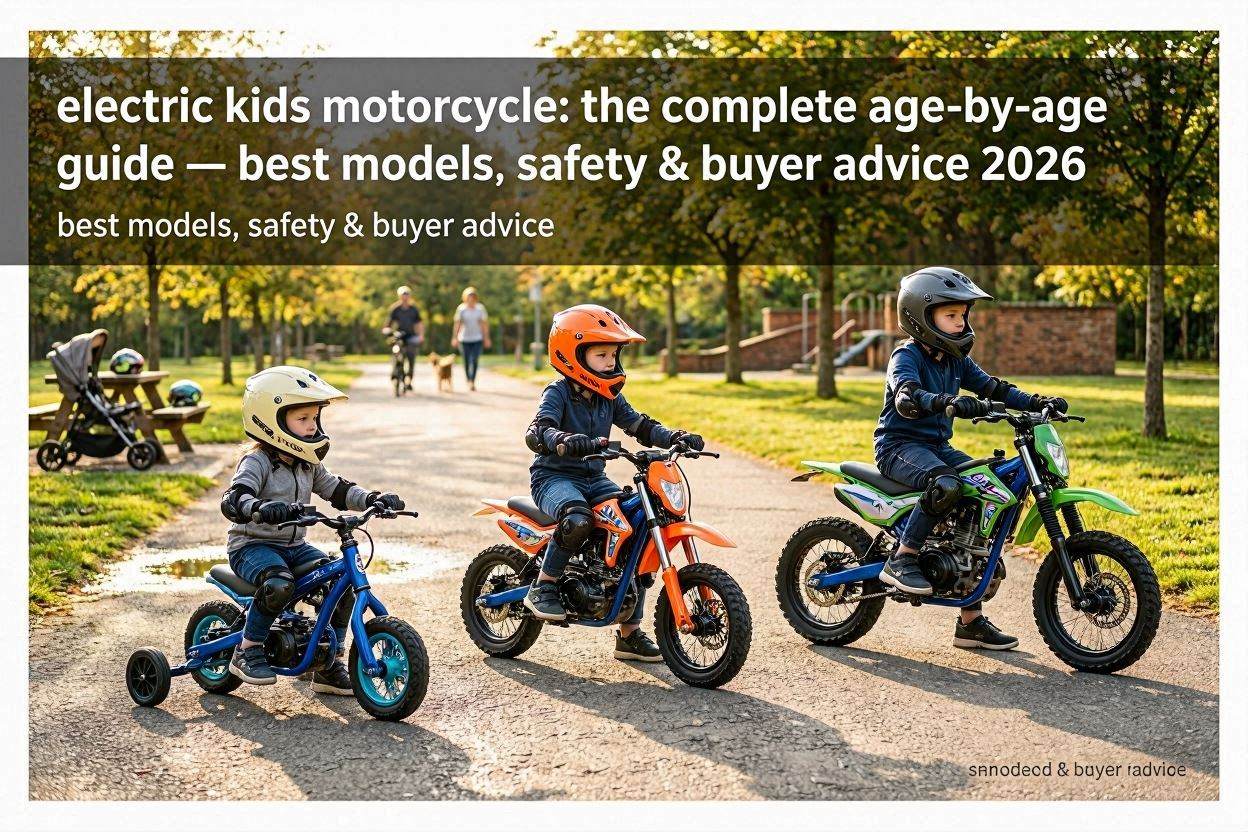
Choosing the right electric kids motorcycle starts with matching the machine to the child’s age, weight, and experience level. Here is the definitive age-by-age breakdown for 2026.
Electric Kids Motorcycle Ages 2–4: Ride-On Starters
At ages 2–4, the electric kids motorcycle is a ride-on toy — battery powered, low speed, stable, and designed to introduce the concept of throttle control and balance in a completely safe format. These machines typically run on 6V or 12V batteries, reach 2–5 mph maximum, and are designed to be ridden on flat surfaces like driveways, gardens, and indoor play areas.
The Power Wheels range — specifically the Power Wheels Motorcycle and Harley-Davidson variants — dominates this segment in the US. Built by Fisher-Price, these electric ride-on motorcycles are robust, widely available, and backed by solid brand support. The Peg Perego Ducati and similar licensed ride-ons offer similar capability with higher-end styling at a slightly higher price point. Budget: $80–$250.
Electric Kids Motorcycle Ages 4–6: First Real Bikes
Between ages 4 and 6, children develop the coordination and attention span to begin learning genuine motorcycle fundamentals on a proper electric kids motorcycle. Machines in this segment are larger than ride-ons, with real suspension (basic), proper throttle mechanisms, and speeds of 5–15 mph depending on model and speed setting.
The Razor Dirt Rocket MX350 is the most widely recommended entry at this age — proven, widely available at approximately $200–$280, and durable enough to survive the inevitable tumbles of early learning. The MX350’s 350W motor delivers enough performance to feel real without being intimidating, and the single-speed twist throttle is intuitive for young riders. For families wanting to step up, the Razor MX650 (~$350–$400) offers more power and larger wheels for older or more confident riders in this age bracket.
Electric Kids Motorcycle Ages 6–10: Proper Training Bikes
Ages 6–10 represent the critical window where riding skills develop most rapidly and the quality of the machine has the greatest impact on long-term rider development. Children at this age can handle genuine off-road riding on appropriate terrain, and the best electric kids motorcycles for this group are proper junior motorcycles — not toys — with real suspension travel, hydraulic or mechanical disc brakes, and power delivery calibrated for skill development.
The standout recommendation at this age is the KTM SX-E 3 — the junior electric motocross bike from KTM’s competition-proven SX-E range. Delivering 3 kW of power in a 35 kg package, the SX-E 3 is the machine serious junior riders use in sanctioned competition. For families whose priority is fun trail riding rather than competition, the MotoTec 36V (500W, ~20 mph, ~$350–$500) offers accessible performance at a fraction of the cost.
Electric Kids Motorcycle Ages 10–14: Junior Competition Machines
From age 10, the most committed young riders begin moving toward machines that are one step below adult performance — and the youth electric dirt bike segment at this level is genuinely impressive. The KTM SX-E 5 (5 kW, ~55 mph, ~$5,500) and the Gas Gas MC-E 5 (equivalent specification) are the benchmark machines, used in junior MX racing series across the US and Europe. The Sur-Ron Light Bee X (~$4,500) is a popular alternative for trail riding, offering lighter weight and lower seat height than the KTM, at the cost of some competition-specific capability.
| Age group | Recommended model | Motor / Voltage | Top speed | Price (approx.) | Best for |
|---|---|---|---|---|---|
| 2–4 years | Power Wheels Motorcycle / Peg Perego | 6V–12V | 2–5 mph | $80–$250 | Driveway / garden ride-on |
| 4–6 years | Razor MX350 / MX400 | 24V / 350W | ~14 mph | $200–$300 | Flat terrain, supervised learning |
| 5–8 years | MotoTec 36V 500W | 36V / 500W | ~20 mph | $350–$500 | Garden / private land |
| 6–10 years | KTM SX-E 3 | 3 kW | ~40 mph | ~$4,000 | Junior MX / trail |
| 6–12 years | Gas Gas MC-E 3 | 3 kW | ~40 mph | ~$4,000 | Junior MX / trail |
| 10–14 years | KTM SX-E 5 | 5 kW | ~55 mph | ~$5,500 | Junior competition MX |
| 10–14 years | Sur-Ron Light Bee X | 6 kW peak | ~45 mph | ~$4,500 | Trail / recreational |
| 12+ years (teen) | MotoTec 72V 3000W | 72V / 3,000W | ~50 mph | ~$1,000 | Budget trail / private land |
Best Electric Kids Motorcycle Models in 2026: Full Reviews
Razor MX350 Dirt Rocket — Best Entry-Level Electric Kids Motorcycle
The Razor MX350 Dirt Rocket is the most widely purchased electric kids motorcycle in the US — and with good reason. It has a proven, durable design that has been refined over multiple generations; a 350W chain-driven motor delivering ~14 mph maximum; a 24V sealed lead-acid battery with approximately 30 minutes of continuous riding; and a full motocross aesthetic that makes it visually exciting for young riders. It is not a serious off-road machine, but for flat garden and driveway riding with ages 7–12, it is the most reliable recommendation at its price point (~$200–$280). The Razor MX650 upgrades to a 650W motor, 17 mph top speed, and larger wheels — better suited to older or heavier children at approximately $350–$400.
KTM SX-E 3 / SX-E 5 — Best Competition Youth Electric Motorcycle
For families serious about junior motocross, the KTM SX-E 3 and KTM SX-E 5 are the benchmark electric kids motorcycles for competition. Built on KTM’s proven junior motocross platform, the SX-E series delivers factory-quality suspension (WP Xact), hydraulic disc brakes, and electric power calibrated for junior racing. The SX-E 3 (3 kW, for ages approximately 6–10) and SX-E 5 (5 kW, ages 10–14) are both used in AMA-sanctioned junior electric classes and FIM junior championships. They require a significant investment ($4,000–$5,500), but for a rider with genuine competitive ambition, no junior electric motorcycle for kids approaches their capability and build quality.
Gas Gas MC-E 3 / MC-E 5 — Best Alternative to KTM
The Gas Gas MC-E 3 and MC-E 5 share their core engineering with the KTM SX-E series (both are part of the KTM Group) but offer equivalent performance in Gas Gas’s distinctive red livery at a similar price point. For junior riders who prefer the Gas Gas brand identity — or whose local dealer network is stronger for Gas Gas than KTM — these are equally valid competition choices. Specification, performance, and ride quality are functionally equivalent to the KTM equivalents.
Sur-Ron Light Bee X — Best Electric Kids Motorcycle for Trail Riding
The Sur-Ron Light Bee X occupies a unique position as a youth electric motorcycle — it is technically an adult machine at its base specification, but its 50 kg weight, 760mm seat height, and adjustable power modes make it accessible for tall, confident riders from approximately age 12–13. For families whose priority is trail riding fun rather than competition, the Light Bee X’s combination of capable off-road performance, relatively affordable price (~$4,500), and rider-adjustable power make it an excellent option for the upper end of the youth rider age range transitioning toward adult machines.
MotoTec 36V / 72V — Best Budget Electric Kids Motorcycle
For families who want a real electric kids motorcycle — not a ride-on toy — without spending $4,000+, MotoTec offers the most credible budget options. The MotoTec 36V 500W (~$350–$500) is a proper junior dirt bike with adjustable speed, a chain-driven motor, and full motocross styling suitable for ages 7–12. The MotoTec 72V 3000W (~$800–$1,200) steps up significantly for older/heavier riders, delivering ~50 mph top speed and a 72V lithium battery system. Build quality is not at KTM or Razor levels, but MotoTec machines offer genuine performance per dollar and are widely available through Amazon and independent retailers.

Electric Kids Motorcycle for Toddlers: Ride-On and Power Wheels Guide
The youngest tier of the electric kids motorcycle market — ride-ons and Power Wheels for ages 2–5 — requires different evaluation criteria from performance machines. Safety, durability, ease of use for the parent, and the ability to survive the abuse a toddler inflicts on a toy are the primary considerations.
Best ride-on electric motorcycles for toddlers
- Power Wheels Harley-Davidson Motorcycle — the most iconic battery powered child’s motorcycle in the US market. 6V battery, two speeds (2.5 mph and 5 mph), parental speed lock, and Harley-Davidson styling. Recommended for ages 3–5. Available from Amazon, Walmart, and major toy retailers. Price: ~$80–$150.
- Peg Perego Ducati GP — 12V — one of the most visually realistic toddler electric motorcycle ride-ons available. 12V battery, rubber tyres, working headlight, and authentic Ducati GP styling. Recommended for ages 3–7. Price: ~$200–$300.
- 12V Ride-On Motorcycle (generic / Aosom / Costzon) — a wide range of 12V electric ride-on motorcycles is available from $80–$180 through Amazon and Walmart. Build quality varies; look for models with parental remote control, adjustable speed limiters, and MP3/USB inputs for music (popular with young riders). Recommended for ages 3–6.
- Police Power Wheels Motorcycle / themed ride-ons — licensed police, fire department, and racing team variants of the basic Power Wheels platform. Same 6V–12V specification, themed styling. Popular as birthday gifts for ages 3–6. Price: ~$100–$200.
Electric Kids Motorcycle Safety: Essential Gear and Parent Guidance
No guide to the electric kids motorcycle category is complete without a direct address of safety — both the protective equipment required and the supervision and riding environment standards that protect young riders. According to the National Highway Traffic Safety Administration (NHTSA), head injury is the leading cause of fatal motorcycle accidents across all age groups. For young riders on electric kids motorcycles, appropriate protective equipment is non-negotiable regardless of speed or terrain.
Essential protective gear for young electric motorcycle riders
- Helmet — a properly fitted, age-appropriate motorcycle helmet is the single most important piece of protective equipment. For off-road riding, use a full-face motocross helmet certified to DOT or ECE 22.06 standards. Never use a bicycle helmet on an electric kids motorcycle — they are not rated for motorcycle impact speeds. Brands including Fox Racing, Shoei, and Bell offer junior-specific motocross helmets from approximately $60–$200.
- Gloves — motocross gloves protect palms and knuckles in falls and improve grip in all conditions. Junior sizing is available from Fox, O’Neal, and Thor from approximately $15–$40.
- Boots — ankle and foot injury is common in motorcycle accidents for all ages. Motocross boots provide essential ankle protection and grip. Junior motocross boots are available from $50–$150.
- Body armour / chest protector — for riders progressing beyond basic ride-ons, a chest protector and elbow/knee pads are strongly recommended. Fox, Alpinestars, and Leatt offer junior-specific protective gear from $30–$120 per component.
- Goggles — for off-road riding on any terrain, goggles protect eyes from debris, dust, and mud. Match goggles to the helmet for best fit and coverage.
Supervision and riding environment guidelines
- Ages 2–6: always within arm’s reach of an adult. Ride-ons only. Flat, fenced areas. Remove obstacles. Supervise continuously.
- Ages 6–10: adult supervision at all times. Private land or dedicated off-road facilities only. No public roads under any circumstances. Confirm the riding area is clear of hazards before each session.
- Ages 10–14: adult present at all times. Dedicated off-road tracks or private land. Begin introducing formal instruction — local MX clubs and junior riding schools provide structured progression that significantly improves safety outcomes.
- All ages: always conduct a pre-ride check — battery charge level, brake function, tyre pressure, throttle return, and chain/belt tension (where applicable).
Electric Kids Motorcycle Buying Guide: What to Look for in 2026
With the electric kids motorcycle market now spanning $80 ride-ons to $5,500 competition machines, navigating the buying decision requires a clear framework. Here are the key factors that should drive your decision:
| Factor | What to assess | Why it matters |
|---|---|---|
| Age & weight rating | Check manufacturer min/max weight and age | Overweight riders damage motors and frames; underweight riders lose control |
| Speed limiter / riding modes | Adjustable top speed or multiple power modes | Allows the bike to grow with the rider over months/years |
| Battery type & charge time | Lithium-ion preferred over lead-acid | Lithium = lighter, faster charging, longer lifespan; lead-acid = heavy, slow |
| Brake type | Disc brakes preferred; drum acceptable for low speeds | Stopping power matters even at low speeds for young riders |
| Warranty & parts availability | Minimum 1-year warranty; check parts availability | Budget brands often have no replacement parts after 6–12 months |
| Spare battery availability | Can you buy a second battery? | Doubles riding time; essential for serious young riders |
| Brand dealer network | KTM, Gas Gas, Razor — established dealer support | Warranty claims and servicing are practical only with dealer access |
FAQ — Electric Kids Motorcycle
What is the best electric kids motorcycle for a 5-year-old?
The best electric kids motorcycle for a 5-year-old depends on prior riding experience. For a first bike with no riding experience, the Razor MX350 (~$200–$280) is the most widely recommended — proven, durable, appropriately powered, and affordable. For a child who has already ridden a ride-on or balance bike and shows strong coordination, the MotoTec 36V 500W (~$350–$500) offers a step up in realism and performance. Ensure proper safety gear (helmet, gloves, boots) before any first ride.
What is the best electric kids motorcycle for a 10-year-old?
For a 10-year-old with riding experience who wants to develop seriously, the KTM SX-E 5 (~$5,500) is the gold standard electric kids motorcycle for competition ambitions. For trail riding without competition focus, the Sur-Ron Light Bee X (~$4,500) is an excellent choice if the child meets the height requirement. For families with a tighter budget, the MotoTec 72V 3000W (~$1,000) offers significant performance at an accessible price for private land riding.
How long does an electric kids motorcycle battery last?
Battery life varies by model and riding intensity. Budget electric kids motorcycles with lead-acid batteries (Razor MX350, most ride-ons) deliver 30–45 minutes of continuous riding. Mid-range lithium models (MotoTec 36V) deliver 45–90 minutes. Competition machines (KTM SX-E 3/5) deliver approximately 1 hour of MX-pace riding or 1.5–2 hours of relaxed trail riding. Charge times range from 4–8 hours for lead-acid to 1.5–3 hours for lithium systems. Buying a spare battery — where available — is the most practical solution for riders who want extended sessions.
Are electric kids motorcycles safe?
Yes — when used with appropriate protective equipment, on suitable terrain, and under proper supervision for the child’s age. The electric kids motorcycle category has an excellent safety record relative to gas-powered youth bikes, primarily because: motors can be speed-limited, there is no stall or kickback risk, and the quieter operation keeps parents more spatially aware of their child. The most significant safety factor is helmet use — a properly fitted, motorcycle-specific helmet dramatically reduces the risk of serious head injury in falls at any speed.
Can my child ride an electric kids motorcycle on the road?
No — with very limited exceptions, electric kids motorcycles are not road-legal vehicles. Ride-ons (6V–12V) are toys and are not licensed for any road use. Mid-range electric dirt bikes for kids (MotoTec, Razor) are off-road and private land only. Even competition-grade junior machines (KTM SX-E 3/5) are certified for off-road use only. All electric kids motorcycle riding should take place on private land, dedicated off-road facilities, or AMA/FIM sanctioned events. Public road use is illegal and dangerous.
What age can a child start riding an electric motorcycle?
Children can begin on electric ride-on motorcycles from age 2 (6V ride-ons on flat surfaces with parental supervision). Proper electric kids motorcycles with throttle control start from age 4–5 (Razor MX350 at reduced speed settings). Serious off-road junior electric motorcycles (KTM SX-E 3) are rated from approximately age 6. There is no single universal answer — the correct starting point depends on the individual child’s physical development, coordination, and maturity, not purely on age.
Verdict: Choosing the Right Electric Kids Motorcycle in 2026
Luca, now eight, is riding a KTM SX-E 3 at his local junior MX club three times a week. His mother Jess reports that the progression from that first birthday electric kids motorcycle to junior competition has been the most consistent confidence-building activity in his life. “He’s learned that getting better at something takes time and practice. The electric bike was the thing that taught him that.” Luca’s response, when asked what he wants for his ninth birthday: “A bigger battery.”
The electric kids motorcycle category in 2026 offers a genuine, well-developed product for every young rider from toddler to serious junior competitor. The technology works, the safety record is good when used correctly, and the skill development pathway — from ride-on to Razor to KTM SX-E — is now fully established. Whatever the budget and whatever the age, there is a right electric kids motorcycle for your child. The guide above should help you find it.
Ready to buy? Our electric motorcycle shop directory lists authorised KTM, Gas Gas, Razor, and Sur-Ron dealers with verified current inventory across the US, UK, and EU. And for a full side-by-side comparison of every youth electric motorcycle in production, see our electric motorcycle comparison guide.
Leave a Reply