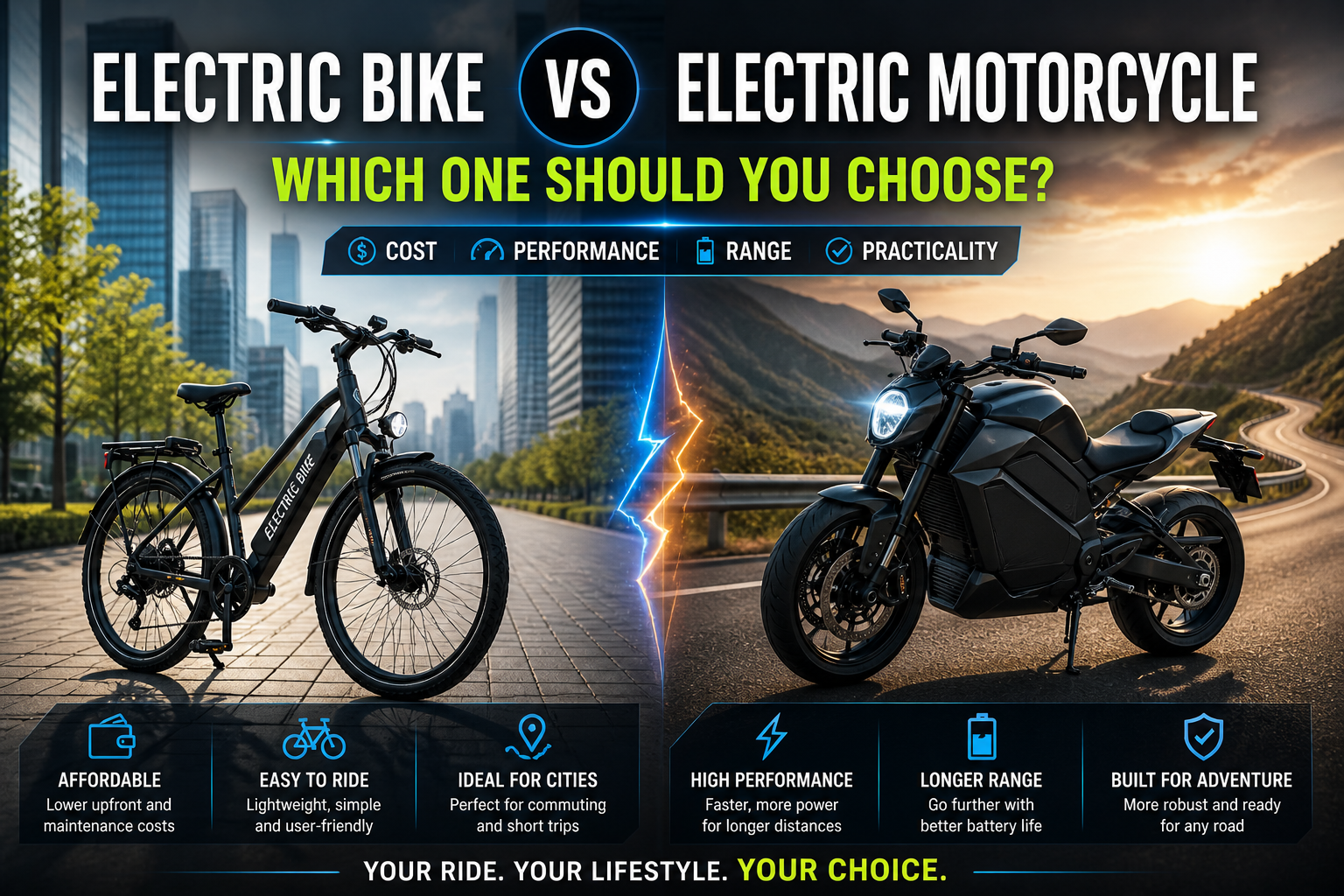
Okay, let’s settle this once and for all — because I get this question constantly. Someone sees a Sur-Ron blasting down a trail and a Rad Power bike cruising a bike lane and asks: “wait, aren’t those both just electric bikes?” No. They are very much not the same thing. And choosing the wrong category will either get you ticketed or leave you underwhelmed.
Here’s the breakdown you actually need — honest, practical, and without the usual manufacturer spin.
Key Differences at a Glance
| Feature | Electric Bike | Electric Motorcycle |
|---|---|---|
| Top Speed | 20–28 mph | 60–150+ mph |
| Motor Power | Up to 750W | 5,000W–100kW+ |
| License Required? | No (most US states) | Yes — M endorsement |
| Registration | Not required | Required |
| Insurance | Optional | Required by law |
| Price | $400–$15,000 | $3,000–$35,000+ |
| Exercise benefit | Yes | No |
| Bike paths OK? | Yes (Class 1 & 2) | No |
Speed: Not Even Close
A standard electric bike tops out at 20–28 mph depending on class. That’s genuinely useful for city commuting and recreational riding — you’ll be passing car traffic in bike lanes and arriving fresh.
An electric motorcycle? The Zero SR/F hits 124 mph. The Energica Ego+ reaches 150 mph. The Lightning LS-218 — brace yourself — tops 218 mph. If you need highway speeds, an e-bike will leave you frustrated. If you’re commuting in a city, a 28 mph e-bike is everything you need and then some.
Cost: The Real Math
Electric bike pricing: $400–$800 for budget, $1,000–$3,000 for quality mid-range, $3,000+ for premium. No additional ongoing costs beyond maintenance.
Electric motorcycle pricing: $3,000–$8,000 entry (small city e-motos), $8,000–$20,000 for Zero or Livewire, $20,000–$35,000+ for Energica or Lightning. Add mandatory insurance, registration, gear costs, and potentially financing. The gap widens fast.
License and Legal Requirements
This is where the decision gets practical for most people. A Class 1, 2, or 3 electric bike requires no license in most US states. You hop on and ride. Some states have age minimums (usually 16 for Class 3), but that’s it.
An electric motorcycle is treated exactly like a gas motorcycle: M endorsement on your driver’s license, vehicle registration, mandatory liability insurance. Per the DMV.org motorcycle law overview, requirements vary by state but registration and licensing are universal.
Range and Battery
Quality e-bikes deliver 20–80 real-world miles per charge. Charge time: 3–6 hours on a standard outlet. Electric motorcycles typically offer 80–200+ highway miles but require much longer charge times on standard outlets (8–12 hours) — though DC fast charging cuts this dramatically.
Who Should Choose What?
Choose an Electric Bike If You…
- Commute under 30 miles daily on city streets or bike paths
- Want the option to exercise while riding
- Don’t have (or don’t want to get) a motorcycle license
- Need easy urban parking and storage
- Are budget-conscious or want to test electric mobility first
Choose an Electric Motorcycle If You…
- Need highway-capable speeds (60+ mph)
- Already have a motorcycle license or are willing to get one
- Are replacing a gas motorcycle — not a bicycle
- Want long-distance capability without any pedaling
- Ride 50+ miles regularly on open roads
Safety: Different Risks, Same Rule
E-bikes crash at lower speeds with less severity. Electric motorcycles carry much higher injury risk at highway speeds. Both vehicle types, however, share the single most important rule: wear a helmet, every single ride. The NHTSA reports helmets reduce motorcycle fatality risk by 37% — similar data applies to e-bike accidents.
The Verdict
If you’re new to electric two-wheelers, start with an electric bike. Lower cost, no license hurdles, access to bike lanes, and the option to exercise. You can always upgrade later — and many enthusiasts end up owning both. Browse our top electric bike picks for 2026 →
Frequently Asked Questions
Are electric bikes more dangerous than motorcycles?
In general, no — lower speeds mean less severe crashes. But e-bike accidents are increasing with ridership. Gear up and ride smart regardless of which you choose.
Can you ride an electric motor bike without a license?
For standard electric bikes (Class 1–3), yes — no license required in most US states. For electric motorcycles, a motorcycle license (M endorsement) is required.
Do I need insurance for an electric bike?
Not legally required in most states. Recommended for expensive models. Electric motorcycles always require insurance by law.
Can an electric bike go as fast as a motorcycle?
Standard e-bikes max out at 28 mph. High-performance electric dirt bikes (Sur-Ron) hit ~47 mph. Electric motorcycles top 100+ mph. Very different speed profiles.