Elena had been commuting on a Kawasaki Z400 for three years. The bike was good — reliable, nimble, well-priced. But the toll lanes, the oil changes, the petrol stops on cold mornings, and the noise complaints from her building’s parking garage were starting to add up into a quiet irritation she couldn’t quite shake. She spent six weeks researching electric motorcycles before she bought a Zero SR/F. Eighteen months later, she describes the purchase as “the best decision I’ve made about a vehicle in my adult life.” Not because the technology dazzled her. Because it solved every single one of the problems the Z400 couldn’t.
The electric motorcycle is no longer a niche technology for early adopters and engineering enthusiasts. In 2026, it is a mature, commercially available, and rapidly diversifying product category that spans entry-level commuters under $3,000, high-performance sport bikes capable of 150+ mph, competition-grade off-road machines racing in FIM-sanctioned events, and custom-built one-offs that represent the leading edge of what motorcycle design can become. This guide covers everything — how electric motorcycles work, the best models in every segment, real-world range and charging, costs, legality, maintenance, and the honest comparison with gas bikes that every prospective buyer deserves.
Already know what you want? Jump straight to our full electric motorcycle comparison guide — every model ranked by performance, range, and real-world owner scores — or browse authorised dealers in our electric motorcycle shop directory.
What Is an Electric Motorcycle?
An electric motorcycle is a two-wheeled motor vehicle powered entirely by an electric motor drawing energy from an onboard rechargeable battery pack — with no internal combustion engine, no fuel tank, no exhaust system, and no gearbox. The powertrain consists of four core components: a battery (measured in kWh), an electric motor (measured in kW and Nm torque), a motor controller (which manages power delivery), and a Battery Management System or BMS (which protects and monitors the battery). That is the complete drivetrain. Everything else on the machine — frame, suspension, brakes, tyres, lights, instruments — is conventional motorcycle engineering.
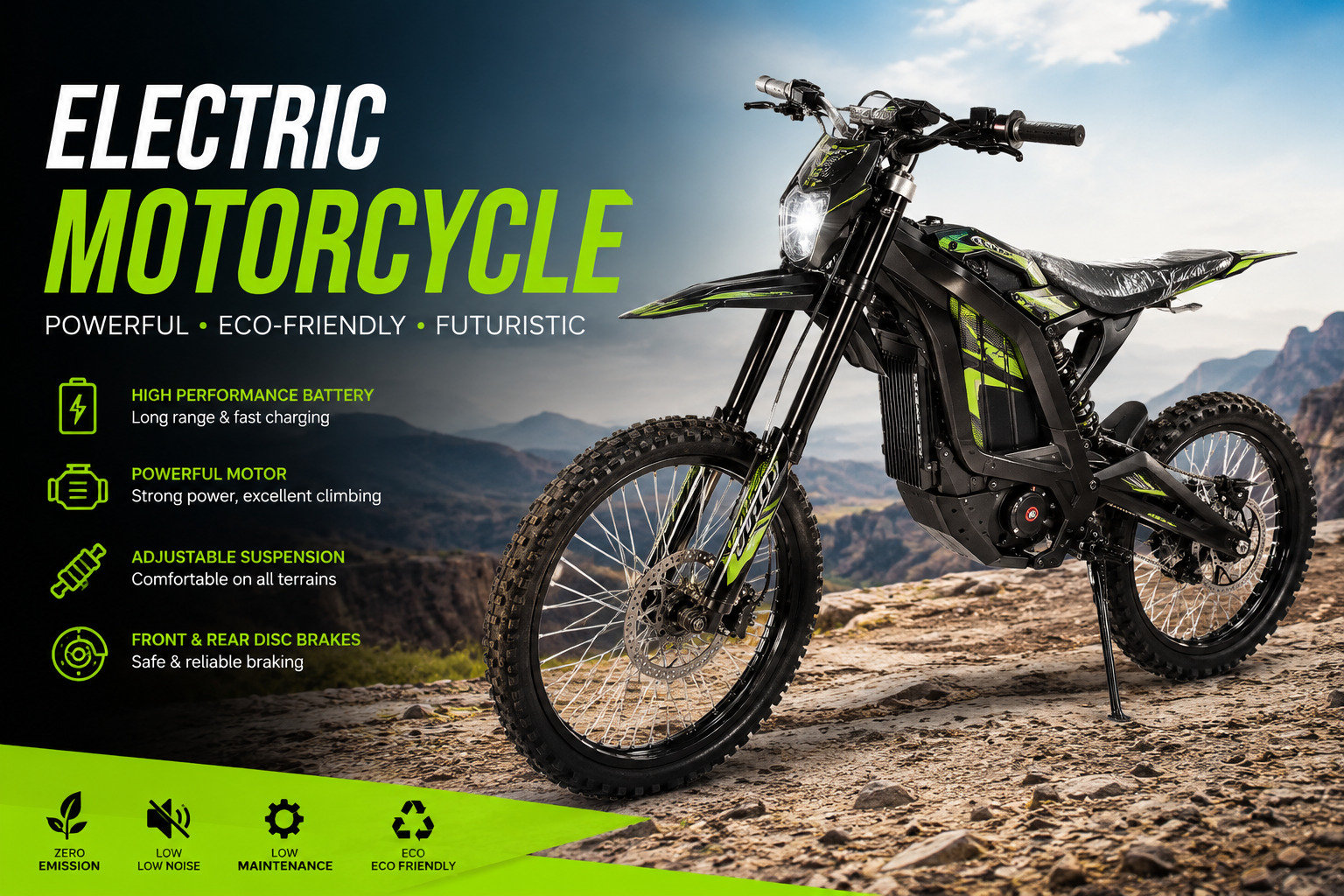
The category is broad. An electric motorcycle includes everything from a 6V toddler ride-on to a 150 kW superbike. The defining characteristic is the electric powertrain — and within that definition, the riding experience, performance envelope, price range, and practical use cases vary as widely as in the gas motorcycle world. Understanding which part of the electric motorcycle spectrum is relevant to a specific rider’s needs is the first step in making a good purchase decision.

How Do Electric Motorcycles Work?
Understanding how electric motorcycles work does not require an engineering background. The fundamental operation is simpler than a combustion motorcycle — fewer components, no fuel-air mixture, no ignition timing, no gearbox. Here is the complete picture:
The battery pack
The battery stores electrical energy in lithium-ion cells, measured in kilowatt-hours (kWh). A larger kWh figure means more stored energy and more range. Modern electric motorcycle batteries range from 2 kWh (entry-level and youth machines) to 21.5 kWh (Energica Ego+). Battery voltage varies from 48V in low-power machines to 400V in high-performance models — higher voltage allows faster charging and more efficient high-power delivery. The battery is the most expensive single component in an electric motorcycle, and its capacity is the primary determinant of range.
The electric motor
The motor converts stored electrical energy into mechanical rotation. Most electric motorcycles use either a BLDC (Brushless DC) or PMSM (Permanent Magnet Synchronous Motor) — both are highly efficient (85–95% energy conversion vs 20–35% for a combustion engine) and produce maximum torque at zero RPM. This is the physical fact that every new electric motorcycle rider notices first: the power is instantaneous, requiring no clutch, no rev, no gear selection. The Zero SR/F produces 190 Nm of torque from a standstill. A Ducati Panigale V4 produces its peak 124 Nm at 11,500 RPM.
The motor controller
The controller converts battery DC power into the form the motor requires, managing throttle response, riding modes, regenerative braking intensity, and protection functions. On modern electric motorcycles, the controller is programmable — either through manufacturer smartphone apps or proprietary software — allowing riders to set power curves, engine braking, and maximum output for different conditions. This programmability replaces the mechanical adjustability (jetting, sprocket ratios, camshaft profiles) of gas engines.
The Battery Management System (BMS)
The BMS monitors every cell in the battery thousands of times per second, preventing overcharge, over-discharge, thermal runaway, and cell imbalance. The BMS is why modern electric motorcycle batteries last for hundreds of charge cycles with minimal capacity loss — and why low-quality BMS implementations in budget machines degrade significantly faster.
Regenerative braking
When the rider lifts off the throttle or applies light braking, the motor reverses function — resisting wheel rotation to generate electricity that flows back into the battery. In urban stop-start riding, regenerative braking recovers 10–18% of the energy used in acceleration, which is why city range figures for electric motorcycles consistently exceed highway range figures. According to the U.S. Department of Energy, EV energy costs run 3–5× lower per mile than gasoline — regenerative braking is a significant contributor to this efficiency advantage.
Best Electric Motorcycles in 2026: By Category
The best electric motorcycle is not a single machine — it is the right machine for a specific rider, use case, and budget. Here is the definitive breakdown of the leading models by category in 2026.
Best electric motorcycle overall: Zero SR/F
The Zero SR/F remains the benchmark electric motorcycle for road riders who want the most complete package. Its 14.4 kWh battery delivers 179 miles of city range; 82 kW peak power gives 0–60 mph in approximately 3.5 seconds; the Z-Force PMSM motor is refined, durable, and thoroughly proven over multiple model years. The optional Charge Tank accessory enables DC fast charging (0–100% in ~1 hour). Zero’s US dealer network and 5-year battery warranty make it the most buyer-confident choice in the category. MSRP: approximately $18,995.
Best electric motorcycle for beginners: Kawasaki Ninja E-1
The Kawasaki Ninja E-1 is the most credible A1-licence and learner-legal electric motorcycle in production. Its full fairing, familiar Ninja ergonomics, dual removable battery packs (chargeable indoors without a dedicated charging point), and ~72 km city range make it ideal for urban commuters and new riders. The absence of a clutch and the instant, predictable torque delivery make it significantly more forgiving than an equivalent gas bike for less experienced riders. MSRP: approximately €8,500.
Best electric motorcycle for performance: LiveWire One
The LiveWire One is the most refined high-performance electric motorcycle from a mainstream brand. With 78 kW peak, 146 miles city range, DC fast charging (0–80% in ~60 minutes), and Harley-Davidson’s engineering heritage, it is the machine that most convincingly bridges the gap between electric technology and traditional premium motorcycle character. MSRP: approximately $22,799.
Best electric motorcycle for off-road: Stark Varg MX
The Stark Varg MX is the fastest, most capable electric motorcycle in the off-road segment — 80 kW, 110 kg, 200+ programmable settings via app, and lap times that challenge the fastest 450cc gas bikes in the same class. For riders whose electric motorcycle use is exclusively off-road, it is the unambiguous choice. MSRP: approximately $12,000.
Best electric motorcycle for the money: Sur-Ron Ultra Bee
The Sur-Ron Ultra Bee delivers genuine electric motorcycle performance at a price point ($8,500–$9,500) that undercuts every comparable machine. At 55 kg with 22.5 kW continuous power, it is capable of serious trail riding and recreational use without the competition-grade price of a Stark or KTM. Not road-legal as standard, but the performance-per-dollar ratio is unmatched in the category.
| Model | Power | City range | Top speed | Price (approx.) | Best for |
|---|---|---|---|---|---|
| Zero SR/F | 82 kW | 179 mi | 124 mph | ~$18,995 | Best overall |
| LiveWire One | 78 kW | 146 mi | 110 mph | ~$22,799 | Performance / premium |
| Energica Ego+ RS | 80 kW (peak 147 kW) | ~250 mi | 150 mph | ~$28,000 | Longest range |
| Kawasaki Ninja E-1 | 9 kW | 45 mi | 62 mph | ~€8,500 | Beginners / A1 |
| Stark Varg MX | 80 kW | N/A (off-road) | ~80 mph | ~$12,000 | Electric dirt motorcycle |
| Zero FX | 46 kW | ~95 mi | 85 mph | ~$12,195 | Dual sport |
| Sur-Ron Ultra Bee | 22.5 kW | ~60 mi | ~60 mph | ~$8,500 | Best value trail |
| Sondors Metacycle | ~8 kW | ~80 mi | ~80 mph | ~$6,500 | Budget commuter |
Electric Motorcycle Range: What You Can Realistically Expect
Range is the most frequently misunderstood aspect of the electric motorcycle — and the most important to evaluate honestly before purchase. Manufacturer figures are real, but they require context.
The fundamental truth: speed kills range. An electric motorcycle consuming 8 Wh/mile at 45 mph will consume 18–22 Wh/mile at 75 mph — a 125–175% increase in energy consumption for a 67% increase in speed. This is why city range figures consistently exceed highway range figures for every electric motorcycle on the market. Temperature matters too: lithium-ion batteries deliver approximately 75–85% of rated capacity at 0°C (32°F).
| Model | Battery | City range (official) | Highway range (est.) | Real-world urban range |
|---|---|---|---|---|
| Zero SR/F | 14.4 kWh | 179 miles | ~82 miles | 140–165 miles |
| LiveWire One | 15.5 kWh | 146 miles | ~70 miles | 120–140 miles |
| Energica Ego+ | 21.5 kWh | ~250 miles | ~130 miles | 200–230 miles |
| Kawasaki Ninja E-1 | 3.0 kWh | 45 miles | ~25 miles | 37–43 miles |
| Zero FX | 7.2 kWh | ~95 miles | ~55 miles | 75–90 miles |
| Sondors Metacycle | 4.0 kWh | ~80 miles | ~45 miles | 60–75 miles |
For most urban commuters covering under 40 miles daily, even the most affordable electric motorcycle provides ample range. For longer distances and multi-day touring, the Energica platform — with its DC fast charging capability — is the only production machine that makes longer journeys consistently practical. The longest range electric motorcycle in production is the Energica Ego+, with a city-cycle range exceeding 250 miles on a single charge.
Electric Motorcycle Charging: Everything You Need to Know
Charging an electric motorcycle is simpler than most riders expect — and significantly more convenient than a petrol stop for daily commuters who charge at home overnight.
The three charging levels
- Level 1 (120V AC / standard socket) — adds 5–8 miles of range per hour. Suitable for overnight charging for riders covering under 50 miles daily. Requires no special equipment — any standard domestic socket works. All electric motorcycles can charge at Level 1.
- Level 2 (240V AC / Type 2 or J1772) — adds 20–55 miles per hour depending on the bike’s onboard charger capacity (3.3–7.2 kW). The standard home charging setup for electric motorcycle owners. A wallbox charger installation costs approximately $300–$800. Most electric motorcycles can charge at Level 2.
- DC Fast Charging (CCS / CHAdeMO) — 25–50 kW charge rates. The LiveWire One and Energica models charge from 0–80% in approximately 40–60 minutes. Zero SR/F with Charge Tank accessory also supports DC fast charging. Currently available on a minority of electric motorcycle models but expanding rapidly as the category matures.
For daily commuters, the most practical approach is overnight Level 1 or Level 2 home charging — the electric motorcycle is always “full” in the morning, eliminating petrol station stops entirely. For riders without home charging access (apartment dwellers, urban parking without outlets), removable battery systems — like the Kawasaki Ninja E-1’s dual packs — offer an alternative by allowing packs to be carried indoors and charged from any domestic socket.
Electric Motorcycle Cost: Purchase Price, Running Costs and 5-Year Ownership
The electric motorcycle‘s higher purchase price relative to gas equivalents is the most common objection from prospective buyers — and the most commonly misunderstood aspect of the full cost picture.
Purchase price
The electric motorcycle price range in 2026 spans from approximately $200 (toddler ride-ons) to $28,000+ (Energica Ego+ RS). Road-legal adult electric motorcycles start at approximately $3,000–$4,000 for basic commuter/scooter models. Mid-range performance models (Zero S, Livewire Del Mar) cost $12,000–$16,000. Premium full-performance models (Zero SR/F, LiveWire One, Energica) cost $18,000–$28,000. At comparable performance levels, electric models carry a 20–40% purchase price premium over gas equivalents.
Running costs: where electric wins decisively
| Cost factor | Electric motorcycle (Zero SR/F) | Gas motorcycle (comparable performance) |
|---|---|---|
| Annual fuel/energy (8,000 miles) | ~$120–$180 | ~$800–$1,200 |
| Annual servicing | ~$150–$250 | ~$400–$800 |
| Oil changes | $0 (none required) | ~$80–$120/year |
| Tyres (same wear rate) | ~$200–$400/year | ~$200–$400/year |
| Brake pads (regen extends life) | ~$30–$80/year | ~$60–$150/year |
| Insurance | Similar to gas equivalent | Baseline |
| 5-year total running cost | ~$3,000–$5,000 | ~$8,000–$14,000 |
The 5-year total cost of ownership — purchase price plus running costs — typically favours electric motorcycles for riders covering 5,000+ miles annually, with the break-even point falling at 2–4 years depending on model, local electricity prices, and petrol costs. According to Consumer Reports, EV owners consistently report significantly lower lifetime fuel and maintenance costs than combustion vehicle owners.
Electric motorcycle tax credit and incentives
In the US, electric motorcycles may qualify for a federal tax credit of up to $1,500 under the Inflation Reduction Act (IRC Section 30D), subject to vehicle price and buyer income thresholds. Several states offer additional incentives including rebates, HOV lane access, and reduced registration fees. In the UK, the Plug-in Motorcycle Grant has been discontinued but zero-emission vehicles benefit from reduced road tax and exemption from most ULEZ and clean air zone charges. Check fueleconomy.gov for current US federal tax credit eligibility by model.
Electric Motorcycle vs Gas Motorcycle: The Honest Comparison
No pillar guide to the electric motorcycle is complete without an honest, point-by-point comparison with gas motorcycles — acknowledging both the genuine advantages and the real limitations that still exist in 2026.
| Factor | Electric motorcycle | Gas motorcycle | Winner |
|---|---|---|---|
| Powertrain efficiency | 85–95% | 20–35% | Electric |
| Torque delivery | Instant, from 0 RPM | RPM-dependent | Electric |
| Fuel/energy cost per 100 miles | $1.50–$2.50 | $6–$12 | Electric |
| Annual maintenance cost | $150–$300 | $400–$900 | Electric |
| Maximum highway range | 70–130 miles | 150–250 miles | Gas |
| Refuelling time | 40 min (DC fast) — 8+ hrs (L1) | 5 minutes | Gas |
| Noise | Near-silent | 85–110 dB | Depends on preference |
| Purchase price (equivalent performance) | 20–40% higher | Baseline | Gas (initial) |
| 5-year total cost of ownership | Lower for high-mileage riders | Higher running costs | Electric (TCO) |
| Gearbox required | No | Yes | Electric (simplicity) |
| Sound character | Electric whine / silence | Engine character / exhaust note | Subjective |
| Cold weather performance | ~15–25% range reduction | Minimal effect | Gas |
| Long-distance touring | Requires charging planning | Minimal planning | Gas |
| Environmental impact | Zero at point of use | CO₂, NOx, particulates | Electric |
Are Electric Motorcycles Street Legal?
Yes — road-legal electric motorcycles are regulated and registered as standard motorcycles in the US, UK, and EU. The key distinction is between road-legal production machines and off-road-only models.
Street legal electric motorcycles in the USA
In the United States, a street legal electric motorcycle must comply with Federal Motor Vehicle Safety Standards (FMVSS) applicable to motorcycles — specifically lighting (headlight, tail/brake light, indicators), mirrors, horn, and tyres rated for the vehicle’s top speed. Factory electric motorcycles like the Zero SR/F, LiveWire One, Energica, Zero FX, and Honda EM1 e: are pre-certified and fully road-legal in all 50 states. Licensing follows standard state motorcycle licence requirements — in most states, a motorcycle endorsement (M class) is required regardless of whether the machine is electric or gas-powered. Some states define low-speed electric motorcycles differently — check your state’s DMV for speed-based vehicle classifications.
Do you need a licence for an electric motorcycle?
Yes — in the US, UK, and EU, a road-legal electric motorcycle requires an appropriate motorcycle licence regardless of the powertrain. In the US, a standard M-class motorcycle endorsement is required. In the UK, A1 licence covers machines up to 11 kW (e.g. Kawasaki Ninja E-1); full A licence is required for higher-powered machines. In the EU, the same licence category structure applies: AM (moped), A1 (125cc equivalent), A2, or A (full). An electric motorcycle does not receive any licensing exemption simply for being electric in any major market.
Electric motorcycle titles and registration
Factory electric motorcycles come with a standard Manufacturer’s Certificate of Origin (MCO) and are titled and registered identically to gas motorcycles in all US states. A common search query — “why do electric motorcycles have no titles” — reflects confusion about lower-power models (under 49cc equivalent) which may be classified as mopeds or motorised bicycles and titled differently, or about imported Chinese machines that sometimes lack compliant documentation. Any factory production electric motorcycle from a recognised manufacturer (Zero, LiveWire, Energica, Kawasaki, etc.) has a standard title and is registered as a motorcycle.
Electric Motorcycle Maintenance: What You Actually Need to Do
The maintenance schedule of an electric motorcycle is one of the most genuinely compelling practical advantages of ownership — and one of the most misunderstood. Here is the complete, honest picture.
What you never need to do on an electric motorcycle
- Oil changes — there is no engine oil in an electric motorcycle.
- Air filter cleaning or replacement — there is no air intake system.
- Spark plug replacement — there are no spark plugs.
- Valve clearance checks — there are no valves.
- Coolant changes — most electric motorcycles are air or liquid cooled at the battery/motor, but there is no combustion cooling circuit.
- Carburettor or fuel injection servicing — there is no fuel system.
- Exhaust system maintenance — there is no exhaust.
- Clutch cable adjustment or replacement — there is no clutch.
- Fuel filter replacement — there is no fuel filter.
What you do need to maintain
- Tyres — same inspection and replacement intervals as any motorcycle. Check pressure before each ride; inspect for wear and damage.
- Brake fluid — annual inspection and replacement every 2 years as per standard motorcycle practice.
- Chain or belt — chain-driven electric motorcycles (Zero SR/F, Energica) require chain cleaning and lubrication every 300–500 miles, and replacement at approximately 10,000–15,000 miles. Belt-driven models (LiveWire) require periodic tension checks only.
- Fork seals and suspension — standard motorcycle service intervals, typically every 2–3 years depending on mileage.
- Battery — no active maintenance required. Best practice: avoid consistently charging to 100% for daily use (charge to 80% reduces cell stress); avoid deep discharge below 10%; store at 20–80% charge if not in regular use. The BMS handles all protection functions automatically.
- Software updates — most modern electric motorcycles receive over-the-air or dealer-applied software updates that improve performance, fix bugs, and occasionally add features. Zero and LiveWire both have established OTA update programmes.
Electric Motorcycle Brands: The Complete 2026 Landscape
The electric motorcycle brand landscape has expanded dramatically since 2020. Here is the current state of every significant manufacturer:
- Zero Motorcycles — California’s dedicated electric motorcycle manufacturer, founded 2006. The most established pure-EV brand, with the broadest road-legal lineup (S, SR, SR/F, SR/S, DSR, FX, FXE) and the strongest dealer network in North America. The benchmark for reliability and long-term ownership confidence.
- LiveWire — Harley-Davidson’s dedicated EV brand. The LiveWire One and Del Mar combine American motorcycle heritage with genuine electric performance and DC fast charging. Strong brand identity; growing dealer network.
- Energica — Italian premium performance electric motorcycle manufacturer. The Ego+ RS and Eva Ribelle RS offer the longest real-world range and the highest performance in the production EV motorcycle segment. Former MotoE supplier.
- Kawasaki — the Ninja E-1 and Ninja 7 HEV mark Kawasaki’s EV entry. The E-1 targets learner/urban riders; multiple further EV models confirmed before 2030.
- Yamaha — the E01 is in limited launch markets; Yamaha’s dominant position in the electric bike motor market (PW series) signals serious EV engineering capability.
- Honda — the EM1 e: is Honda’s first road-legal electric motorcycle for Western markets. Low power, removable battery, and Honda reliability credentials. Further models confirmed.
- BMW Motorrad — the CE 04 electric scooter and CE 02 electric moped are BMW’s current EV offering. Strong build quality and brand support; limited range and performance relative to price.
- Stark Future — Swedish startup producing the Varg MX, the benchmark electric motocross motorcycle for competition. 80 kW, 110 kg, racing-proven.
- Sur-Ron — Chinese manufacturer of the Light Bee X and Ultra Bee, the dominant force in mid-range trail and recreational electric motorcycles globally. Exceptional performance per dollar.
- Can-Am (BRP) — the Can-Am Origin and Pulse are BRP’s adventure and sport electric motorcycles, bringing snowmobile and ATV engineering expertise to the road EV space.
Electric Motorcycle Buying Guide: How to Choose the Right One
The correct electric motorcycle for any given rider is determined by five questions. Answer these honestly before evaluating any specific model.
- 1. What is your primary use case? Daily urban commuting, weekend sport riding, trail/off-road, touring, or a mix? Each use case prioritises different specifications — range, power, charging capability, road legality, and weight all matter differently for different riding patterns.
- 2. What is your realistic daily range requirement? If you cover 30 miles daily, even a $4,000 machine with 60-mile range is sufficient. If you regularly need 100+ miles, you need a 10+ kWh battery and DC charging capability.
- 3. Do you have access to home charging? Riders with a garage or driveway can charge overnight on Level 1 or Level 2 — the most convenient charging scenario. Apartment dwellers without dedicated charging need either a removable battery system (Kawasaki E-1, Honda EM1 e:) or reliable access to public charging infrastructure.
- 4. What is your budget — total cost of ownership, not just purchase price? An $18,000 Zero SR/F costs approximately the same to own over 5 years as a $10,000 gas equivalent when fuel and maintenance savings are factored in. Use TCO, not sticker price, as the primary financial metric.
- 5. What licence do you hold? A1-licence holders in Europe are restricted to machines up to 11 kW. Full-licence holders have the full range of electric motorcycle performance available. In the US, any M-class licence covers all power levels.

FAQ — Electric Motorcycle: Every Question Answered
Are electric motorcycles automatic?
Yes — virtually all production electric motorcycles are automatic. There is no clutch and no gearbox. The motor operates across its full RPM range on a single fixed-ratio drivetrain, and all power management is handled electronically by the controller. This makes electric motorcycles significantly more accessible for new riders and simpler to operate in stop-start urban traffic. Some specialist high-performance models use a two-speed transmission to extend highway RPM range, but these are rare exceptions.
Do electric motorcycles have gears?
No — standard production electric motorcycles do not have a gearbox or manual gears. Power delivery is managed electronically through the motor controller, which adjusts current flow (and therefore torque and speed) in response to throttle input. The riding experience is analogous to an automatic scooter in terms of throttle-only operation, but with dramatically more power and performance potential than any scooter.
How much is an electric motorcycle?
The price range for road-legal adult electric motorcycles in 2026 starts at approximately $3,000–$4,000 for basic commuter models and scooters, rises through $8,000–$15,000 for mid-range performance machines, and reaches $18,000–$28,000+ for premium full-performance models. The cheapest electric motorcycle viable for regular adult road use is approximately $3,500–$4,500 (entry scooter or Sondors Metacycle range). The best electric motorcycle for most adult road riders — balancing performance, range, reliability, and running costs — falls in the $12,000–$19,000 range.
Are electric motorcycles faster than gas?
In straight-line acceleration from a standstill, electric motorcycles are faster than gas equivalents at comparable power levels because of instant torque delivery from 0 RPM. The Zero SR/F reaches 60 mph in approximately 3.5 seconds — faster than many 600cc sport bikes. At sustained high speeds and in top-speed contests, the advantage narrows; the fastest electric motorcycle in production (Energica Ego+ RS, 150 mph) is comparable to a high-performance 1000cc superbike in absolute maximum speed. The Curtiss Zeus exceeds 170 mph in specialist builds.
Are electric motorcycles good for beginners?
Yes — electric motorcycles have several characteristics that make them well-suited to new riders: no clutch or gearbox eliminates one of the most common sources of beginner mistakes (stalling, missed gears, improper clutch control); power delivery is linear and predictable with no power band surprises; riding modes allow power to be restricted for learning; regenerative braking provides additional deceleration control. The main caution for beginners is that instant torque means sudden throttle inputs have immediate, powerful consequences — smooth throttle control is essential. Overall, most riding instructors who have evaluated both report electric motorcycles as easier to learn on than gas equivalents.
Are electric motorcycles worth it?
For urban commuters covering 20–60 miles daily with home charging access, an electric motorcycle is unambiguously worth it in 2026 — lower running costs, zero urban emissions, no gear changes in traffic, and minimal maintenance. For occasional weekend riders who cover 100+ miles per ride in areas without charging infrastructure, a gas motorcycle remains more practical. The answer depends entirely on use case — which is why the buying guide questions above are the correct starting point for every prospective buyer.
What is the best electric motorcycle for adults?
The best electric motorcycle for adults in general use is the Zero SR/F — its combination of 179-mile city range, 82 kW performance, optional DC fast charging, 5-year battery warranty, and Zero’s established dealer network makes it the most complete package for a road-riding adult in 2026. For adults primarily interested in trail/dual sport, the Zero FX. For adults on a tighter budget, the Sondors Metacycle or equivalent commuter machines. For adults wanting the brand experience of a major OEM, the LiveWire One.
Who makes electric motorcycles?
In 2026, the major electric motorcycle manufacturers include: Zero Motorcycles (US), LiveWire / Harley-Davidson (US), Energica (Italy), Kawasaki (Japan), Yamaha (Japan), Honda (Japan), BMW Motorrad (Germany), Stark Future (Sweden), Sur-Ron (China), Can-Am / BRP (Canada), KTM (Austria), Gas Gas (Spain/Austria), and a growing number of smaller specialist manufacturers including Curtiss Motorcycles, Ryvid, Cake, and others. The category is expanding rapidly — established OEMs are accelerating EV programmes, and new entrants continue to bring innovative designs to market.
The Future of Electric Motorcycles: What’s Coming Beyond 2026
The electric motorcycle industry in 2026 is evolving faster than any comparable vehicle segment. Several developments will define the next phase:
- Solid-state batteries — currently in development at Toyota, Samsung SDI, and specialist suppliers, solid-state cells promise 2× energy density, faster charging, and superior thermal stability compared to current lithium-ion. When available in motorcycle-scale formats (expected late 2020s), they will roughly double the range of any given battery pack size — transforming the long-distance touring case for electric motorcycles.
- Hydrogen fuel cell motorcycles — a consortium of Honda, Yamaha, Kawasaki, and Suzuki is developing hydrogen fuel cell motorcycle technology for applications where battery range is insufficient. Hydrogen offers refuelling times comparable to petrol and potentially greater range than battery-electric — targeting touring and long-distance use cases. Demonstrator vehicles are targeted for the late 2020s.
- Major OEM full EV lineups — Honda, Yamaha, Kawasaki, and Suzuki have all committed to multiple EV motorcycle models by 2030. The arrival of these brands’ full EV lineups — with their global dealer networks and established engineering credibility — will dramatically expand the accessible market for the electric motorcycle.
- Expanding charging infrastructure — the growth of CCS and CHAdeMO fast charging networks, combined with the increasing prevalence of destination charging at hotels, campsites, and parking facilities, is progressively extending the practical range of touring on an electric motorcycle.
- Price parity — analysts at BloombergNEF project purchase price parity between electric and combustion motorcycles in the commuter segment before 2030, as battery costs continue their long-run decline. When parity arrives, the running cost advantages of the electric motorcycle will make the total cost of ownership argument decisive.
Final Verdict: Is an Electric Motorcycle Right for You in 2026?
Elena covered 11,000 miles on her Zero SR/F in the first twelve months. Her total energy cost was £180. She has had one service — a brake fluid check and chain lubrication. The parking garage that previously objected to her gas bike has no objection to the Zero. She has converted two colleagues to electric motorcycling through the simple act of letting them ride it. “The technology argument is over,” she says. “Now it’s just a question of which one.”
The electric motorcycle in 2026 is not a compromise technology or a proof of concept. It is a mature, commercially available, continuously improving product category that outperforms gas motorcycles on the metrics that matter most to daily riders: running cost, maintenance burden, urban practicality, and instant torque delivery. Its limitations — range at sustained speeds, charging time relative to a petrol stop, and purchase price premium — are real but manageable for the majority of riders whose use case the technology suits.
If your daily riding is urban and regular, home charging is accessible, and you value simplicity and low running costs, an electric motorcycle is the superior choice in 2026. If you regularly tour 200+ miles in a single day through areas without charging infrastructure, a gas motorcycle remains more practical — for now. For everyone else, the question is not whether an electric motorcycle makes sense. It is which one.
Start your search with our full electric motorcycle comparison guide — every model in production, ranked by segment, with real-world range data, owner scores, and current pricing. When you’re ready to buy, our electric motorcycle dealer directory lists authorised dealers and verified retailers across the US, UK, and EU.